Pearson+ LogoPearson+ Logo
Ch. 15 - Gene Mutation, DNA Repair, and Transposition
Klug - Concepts of Genetics  12th Edition
Klug12th EditionConcepts of Genetics ISBN: 9780135564776Not the one you use?Change textbook
Chapter 15, Problem 7

Most mutations in a diploid organism are recessive. Why?

Verified step by step guidance
1
Understand the concept of diploidy: In diploid organisms, each gene exists in two copies (alleles), one inherited from each parent.
Recall that a recessive mutation typically results in a loss of function or reduced function of the gene product, which means the mutated allele does not produce a functional protein.
Recognize that if one allele is mutated (recessive) and the other allele is normal (wild-type), the normal allele often produces enough functional protein to mask the effect of the mutated allele.
This masking effect means the organism shows the normal phenotype despite carrying the mutation, so the mutation is recessive because its effect is hidden in the presence of a normal allele.
Conclude that most mutations are recessive because loss-of-function mutations usually do not affect the phenotype unless both alleles are mutated, which is less common.

Verified video answer for a similar problem:

This video solution was recommended by our tutors as helpful for the problem above.
Video duration:
28s
Was this helpful?

Key Concepts

Here are the essential concepts you must grasp in order to answer the question correctly.

Diploidy and Allelic Pairs

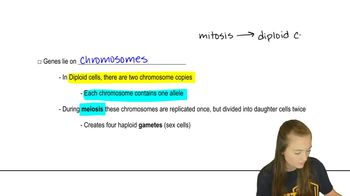
Diploid organisms have two copies of each gene, called alleles. This means that if one allele carries a mutation, the other normal allele can often compensate, masking the effect of the mutation in the organism's phenotype.
Recommended video:
Guided course
27:36
Diploid Genetics

Recessive vs. Dominant Mutations

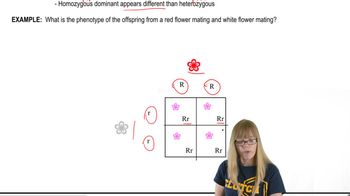
A recessive mutation only affects the phenotype when both alleles are mutated, while a dominant mutation shows its effect even if only one allele is mutated. Most mutations are recessive because the normal allele usually produces enough functional protein to maintain normal function.
Recommended video:
Guided course
04:37
Variations on Dominance

Gene Function and Protein Production

Many mutations reduce or eliminate the function of a gene product, but as long as one allele produces sufficient functional protein, the organism remains unaffected. This functional redundancy explains why most mutations are recessive in diploid organisms.
Recommended video: