Pearson+ LogoPearson+ Logo
Ch. 15 - Gene Mutation, DNA Repair, and Transposition
Klug - Concepts of Genetics  12th Edition
Klug12th EditionConcepts of Genetics ISBN: 9780135564776Not the one you use?Change textbook
Chapter 15, Problem 4

Why would a mutation in a somatic cell of a multicellular organism not necessarily result in a detectable phenotype?

Verified step by step guidance
1
Understand the difference between somatic cells and germ cells: Somatic cells make up the body tissues and organs, while germ cells are involved in reproduction and give rise to gametes.
Recognize that mutations in somatic cells affect only the individual cell and its descendants, not the entire organism or its offspring.
Consider that many somatic cells are part of large tissues where a mutation in a single cell may be diluted or masked by the normal function of surrounding cells.
Acknowledge that some mutations may not affect gene function significantly or may occur in non-coding regions, resulting in no visible change in phenotype.
Realize that the organism's overall phenotype depends on the collective function of many cells, so a mutation in one somatic cell often does not produce a detectable change.

Verified video answer for a similar problem:

This video solution was recommended by our tutors as helpful for the problem above.
Video duration:
30s
Was this helpful?

Key Concepts

Here are the essential concepts you must grasp in order to answer the question correctly.

Somatic vs. Germline Cells

Somatic cells make up the body tissues and organs, while germline cells give rise to gametes. Mutations in somatic cells affect only the individual cell lineage and are not inherited by offspring, limiting their impact to the organism itself.
Recommended video:
Guided course
03:52
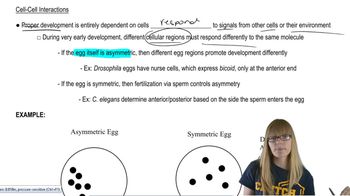
Cell-cell interactions

Phenotypic Expression and Cell Lineage

A mutation in a single somatic cell may not produce a visible phenotype if the mutated cell represents a small portion of the tissue or if the mutation does not affect critical genes. Phenotypic changes often require widespread or functionally significant mutations.
Recommended video:
Guided course
02:09
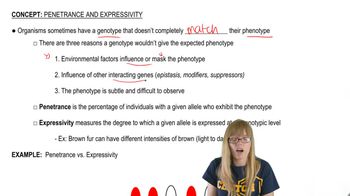
Penetrance and Expressivity

Genetic Redundancy and Cellular Compensation

Organisms often have redundant genes or pathways that can compensate for the effects of a mutation. Additionally, neighboring cells can mitigate the impact of a mutated cell, preventing the mutation from manifesting as a detectable phenotype.
Recommended video:
Guided course
08:30
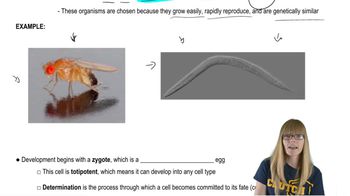
Genetics of Development