Pearson+ LogoPearson+ Logo
Ch. 15 - Gene Mutation, DNA Repair, and Transposition
Klug - Concepts of Genetics  12th Edition
Klug12th EditionConcepts of Genetics ISBN: 9780135564776Not the one you use?Change textbook
Chapter 15, Problem 31f

Mutations in the IL2RG gene cause approximately 30 percent of severe combined immunodeficiency disorder (SCID) cases in humans. These mutations result in alterations to a protein component of cytokine receptors that are essential for proper development of the immune system. The IL2RG gene is composed of eight exons and contains upstream and downstream sequences that are necessary for proper transcription and translation. Below are some of the mutations observed. For each, explain its likely influence on the IL2RG gene product (assume its length to be 375 amino acids).
Deletion in Exon 2, in frame

Verified step by step guidance
1
Understand that the IL2RG gene codes for a protein of 375 amino acids, and the gene contains eight exons. Each exon contributes a specific portion of the amino acid sequence in the final protein.
Recognize that an "in-frame deletion" means nucleotides are deleted in multiples of three, so the reading frame downstream of the deletion remains unchanged. This results in the loss of one or more amino acids but does not cause a frameshift.
Since the deletion is in Exon 2, identify that the missing amino acids will be located early in the protein sequence, potentially affecting the protein's structure or function depending on the importance of that region.
Consider that the rest of the protein sequence after the deletion will be translated normally because the reading frame is preserved, so the protein will be shorter but not completely disrupted by a frameshift.
Evaluate the likely impact on protein function: the deletion may remove critical amino acids necessary for cytokine receptor activity, possibly reducing or abolishing function, but it will not cause a truncated protein due to premature stop codons caused by frameshifts.

Verified video answer for a similar problem:

This video solution was recommended by our tutors as helpful for the problem above.
Video duration:
2m
Was this helpful?

Key Concepts

Here are the essential concepts you must grasp in order to answer the question correctly.

Gene Structure and Exons

Genes are composed of exons and introns; exons contain the coding sequences that are spliced together to form mRNA. Each exon contributes specific amino acid sequences to the final protein. Understanding which exon is affected by a mutation helps predict how the protein’s structure and function might change.
Recommended video:
Guided course
03:49
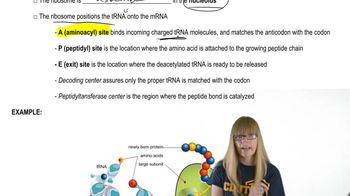
Ribosome Structure

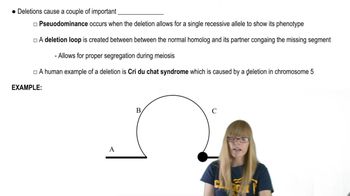
In-Frame Deletions

An in-frame deletion removes nucleotides in multiples of three, preserving the reading frame of the gene. This results in a protein missing certain amino acids but otherwise intact, potentially altering protein function depending on the deleted region’s importance.
Recommended video:

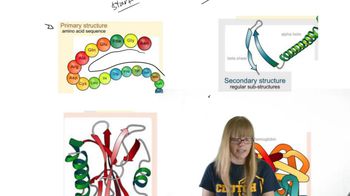
Protein Function and Cytokine Receptors

The IL2RG gene encodes a protein critical for cytokine receptor complexes involved in immune cell development. Mutations affecting this protein can disrupt receptor assembly or signaling, leading to immune deficiencies like SCID by impairing immune system maturation.
Recommended video:
Related Practice
Textbook Question

Mutations in the IL2RG gene cause approximately 30 percent of severe combined immunodeficiency disorder (SCID) cases in humans. These mutations result in alterations to a protein component of cytokine receptors that are essential for proper development of the immune system. The IL2RG gene is composed of eight exons and contains upstream and downstream sequences that are necessary for proper transcription and translation. Below are some of the mutations observed. For each, explain its likely influence on the IL2RG gene product (assume its length to be 375 amino acids).

Insertion in Exon 7, causing frameshift

466
views
Textbook Question

Mutations in the IL2RG gene cause approximately 30 percent of severe combined immunodeficiency disorder (SCID) cases in humans. These mutations result in alterations to a protein component of cytokine receptors that are essential for proper development of the immune system. The IL2RG gene is composed of eight exons and contains upstream and downstream sequences that are necessary for proper transcription and translation. Below are some of the mutations observed. For each, explain its likely influence on the IL2RG gene product (assume its length to be 375 amino acids).

Missense mutation

526
views
Textbook Question

Mutations in the IL2RG gene cause approximately 30 percent of severe combined immunodeficiency disorder (SCID) cases in humans. These mutations result in alterations to a protein component of cytokine receptors that are essential for proper development of the immune system. The IL2RG gene is composed of eight exons and contains upstream and downstream sequences that are necessary for proper transcription and translation. Below are some of the mutations observed. For each, explain its likely influence on the IL2RG gene product (assume its length to be 375 amino acids).

Deletion in Exon 2, causing frameshift

547
views
Textbook Question

Mutations in the IL2RG gene cause approximately 30 percent of severe combined immunodeficiency disorder (SCID) cases in humans. These mutations result in alterations to a protein component of cytokine receptors that are essential for proper development of the immune system. The IL2RG gene is composed of eight exons and contains upstream and downstream sequences that are necessary for proper transcription and translation. Below are some of the mutations observed. For each, explain its likely influence on the IL2RG gene product (assume its length to be 375 amino acids).

Large deletion covering Exons 2 and 3

592
views
Textbook Question
When a double-strand DNA break occurs in a eukaryotic cell, it may be repaired by either nonhomologous end joining or homologous recombination. How do these different repair mechanisms lead to potentially different outcomes?
943
views