
Pearson+ LogoPearson+ Logo
Ch. 15 - Gene Mutation, DNA Repair, and Transposition
Klug - Concepts of Genetics  12th Edition
Klug12th EditionConcepts of Genetics ISBN: 9780135564776Not the one you use?Change textbook
Chapter 15, Problem 29a

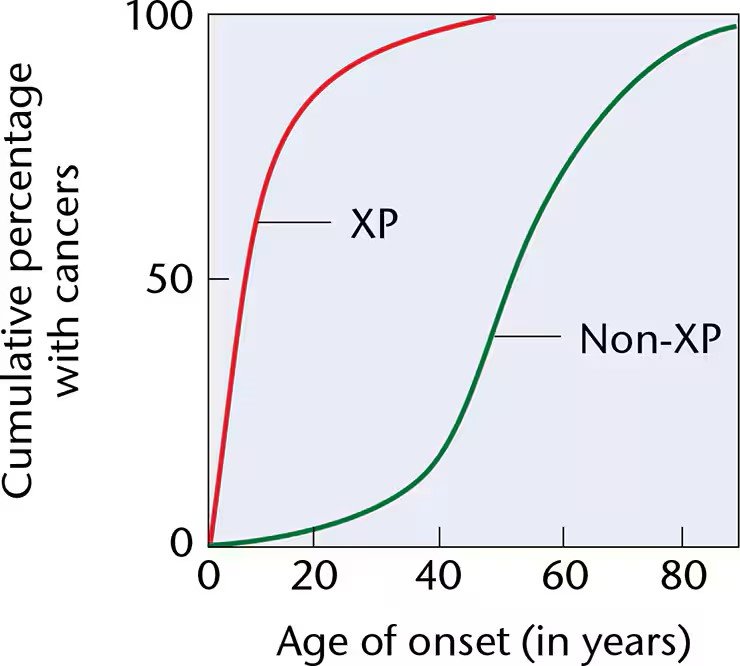
Skin cancer carries a lifetime risk nearly equal to that of all other cancers combined. Following is a graph [modified from K. H. Kraemer (1997). Proc. Natl. Acad. Sci. (USA) 94:11 14] depicting the age of onset of skin cancers in patients with or without XP, where the cumulative percentage of skin cancer is plotted against age. The non-XP curve is based on 29,757 cancers surveyed by the National Cancer Institute, and the curve representing those with XP is based on 63 skin cancers from the Xeroderma Pigmentosum Registry.
Provide an overview of the information contained in the graph. 
Graph showing earlier and higher cumulative skin cancer onset in XP patients versus later onset in non-XP individuals.

Verified step by step guidance
1
Step 1: Identify the two groups being compared in the graph: patients with Xeroderma Pigmentosum (XP) and patients without XP (the general population).
Step 2: Understand that the graph plots the cumulative percentage of skin cancer cases against age, showing how the risk accumulates over a lifetime for each group.
Step 3: Note the sample sizes for each group: 63 skin cancers from the XP registry and 29,757 cancers from the National Cancer Institute for the non-XP group, which affects the reliability and scale of the data.
Step 4: Observe the shape and position of the curves to compare the age of onset and rate of increase in skin cancer cases between the two groups, focusing on how early and how rapidly skin cancer develops in XP patients compared to non-XP individuals.
Step 5: Summarize that the graph illustrates a much earlier onset and higher cumulative risk of skin cancer in XP patients, highlighting the genetic susceptibility and the importance of DNA repair mechanisms in preventing skin cancer.

Verified video answer for a similar problem:

This video solution was recommended by our tutors as helpful for the problem above.
Video duration:
1m
Was this helpful?

Key Concepts

Here are the essential concepts you must grasp in order to answer the question correctly.

Xeroderma Pigmentosum (XP)

Xeroderma Pigmentosum is a rare genetic disorder characterized by a defect in nucleotide excision repair, leading to extreme sensitivity to ultraviolet (UV) light. Individuals with XP have a much higher risk of developing skin cancers at an early age due to their inability to repair UV-induced DNA damage effectively.

Cumulative Incidence and Age of Onset

Cumulative incidence represents the proportion of individuals who develop a condition over time. In the context of the graph, it shows the percentage of patients developing skin cancer by a certain age, allowing comparison of the timing and frequency of cancer onset between XP and non-XP populations.
Recommended video:

DNA Repair Mechanisms and Cancer Risk

DNA repair mechanisms, such as nucleotide excision repair, correct damage caused by environmental factors like UV radiation. Defects in these pathways, as seen in XP patients, lead to accumulation of mutations, increasing the risk and accelerating the onset of skin cancers compared to individuals with normal repair capacity.
Recommended video:
Guided course
05:44
Repair Pathways
Related Practice
Textbook Question
With the knowledge that radiation causes mutations, many assume that human-made forms of radiation are the major contributors to the mutational load in humans. What evidence suggests otherwise?
620
views
Textbook Question

What evidence indicates that mutations in human DNA mismatch repair genes are related to certain forms of cancer?

493
views
Textbook Question

Among Betazoids in the world of Star Trek®, the ability to read minds is under the control of a gene called mindreader (abbreviated mr). Most Betazoids can read minds, but rare recessive mutations in the mr gene result in two alternative phenotypes: delayed-receivers and insensitives. Delayed-receivers have some mind-reading ability but perform the task much more slowly than normal Betazoids. Insensitives cannot read minds at all. Betazoid genes do not have introns, so the gene only contains coding DNA. It is 3332 nucleotides in length, and Betazoids use a four-letter genetic code.

The following table shows some data from five unrelated mr mutations.

For each mutation, provide a plausible explanation for why it gives rise to its associated phenotype and not to the other phenotype. For example, hypothesize why the mr-1 nonsense mutation in codon 829 gives rise to the milder delayed-receiver phenotype rather than the more severe insensitive phenotype. Then repeat this type of analysis for the other mutations. (More than one explanation is possible, so be creative within plausible bounds!)

531
views
Textbook Question

Skin cancer carries a lifetime risk nearly equal to that of all other cancers combined. Following is a graph [modified from K. H. Kraemer (1997). Proc. Natl. Acad. Sci. (USA) 94:11 14] depicting the age of onset of skin cancers in patients with or without XP, where the cumulative percentage of skin cancer is plotted against age. The non-XP curve is based on 29,757 cancers surveyed by the National Cancer Institute, and the curve representing those with XP is based on 63 skin cancers from the Xeroderma Pigmentosum Registry.

Explain why individuals with XP show such an early age of onset.

491
views
Textbook Question

It has been noted that most transposons in humans and other organisms are located in noncoding regions of the genome—regions such as introns, pseudogenes, and stretches of particular types of repetitive DNA. There are several ways to interpret this observation. Describe two possible interpretations. Which interpretation do you favor? Why?

663
views
Textbook Question

Mutations in the IL2RG gene cause approximately 30 percent of severe combined immunodeficiency disorder (SCID) cases in humans. These mutations result in alterations to a protein component of cytokine receptors that are essential for proper development of the immune system. The IL2RG gene is composed of eight exons and contains upstream and downstream sequences that are necessary for proper transcription and translation. Below are some of the mutations observed. For each, explain its likely influence on the IL2RG gene product (assume its length to be 375 amino acids).

Nonsense mutation in a coding region

641
views