Pearson+ LogoPearson+ Logo
Ch. 18 - Post-transcriptional Regulation in Eukaryotes
Klug - Concepts of Genetics  12th Edition
Klug12th EditionConcepts of Genetics ISBN: 9780135564776Not the one you use?Change textbook
Chapter 18, Problem 8

Nonsense-mediated decay is an mRNA surveillance pathway that eliminates mRNAs with premature stop codons. How does the cell distinguish between normal mRNAs and those with a premature stop?

Verified step by step guidance
1
Understand that nonsense-mediated decay (NMD) is a quality control mechanism that targets mRNAs containing premature stop codons (also called nonsense codons) to prevent the production of truncated, potentially harmful proteins.
Recognize that during normal mRNA processing, exon junction complexes (EJCs) are deposited upstream of exon-exon junctions after splicing; these EJCs serve as markers for the cell to monitor mRNA integrity.
Learn that during the first round of translation, the ribosome removes EJCs as it moves along the mRNA; if the ribosome encounters a stop codon before the last EJC is removed, this indicates a premature stop codon.
Understand that the presence of an EJC downstream of a stop codon signals to the NMD machinery that the stop codon is premature, triggering the degradation of that mRNA.
Summarize that the cell distinguishes normal mRNAs from those with premature stops by checking whether translation terminates upstream of EJCs, using the position of stop codons relative to EJCs as a key indicator.

Verified video answer for a similar problem:

This video solution was recommended by our tutors as helpful for the problem above.
Video duration:
4m
Was this helpful?

Key Concepts

Here are the essential concepts you must grasp in order to answer the question correctly.

Nonsense-Mediated Decay (NMD) Pathway

NMD is a cellular quality control mechanism that detects and degrades mRNAs containing premature stop codons to prevent the production of truncated, potentially harmful proteins. It ensures only properly processed mRNAs are translated, maintaining protein integrity.
Recommended video:
Guided course
09:49
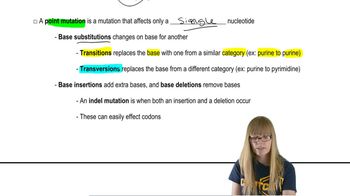
Point Mutations

Premature Stop Codons and Translation Termination

Premature stop codons are nonsense mutations that cause early termination of translation. The cell distinguishes these from normal stop codons by their position relative to downstream exon-exon junctions, which affects the recruitment of NMD factors.
Recommended video:
Guided course
01:55
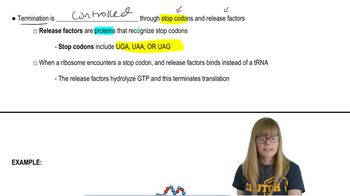
Translation Termination

Exon Junction Complex (EJC) and mRNA Surveillance

The EJC is a protein complex deposited near exon-exon junctions after splicing. During translation, if a stop codon is detected upstream of an EJC, it signals that the stop is premature, triggering NMD to degrade the faulty mRNA.
Recommended video:
Guided course
08:26
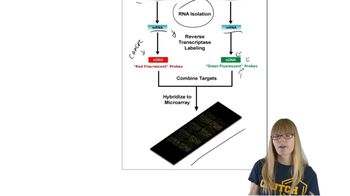
Functional Genomics