Pearson+ LogoPearson+ Logo
Ch. 2 - Mitosis and Meiosis
Klug - Concepts of Genetics  12th Edition
Klug12th EditionConcepts of Genetics ISBN: 9780135564776Not the one you use?Change textbook
Chapter 2, Problem 33

Assume that you were examining a first polar body and noted that it had one copy (dyad) of each chromosome except chromosome 21. Chromosome 21 was completely absent. What would you expect to be the chromosome 21 complement (only with respect to chromosome 21) in the secondary oocyte? What consequences are likely in the resulting zygote if the secondary oocyte was fertilized?

Verified step by step guidance
1
Understand the context: The first polar body is a byproduct of meiosis I in oogenesis. It typically contains one copy (dyad) of each chromosome that was segregated during meiosis I. If chromosome 21 is absent in the first polar body, it means that chromosome 21 did not segregate properly during meiosis I.
Determine the chromosome 21 complement in the secondary oocyte: Since the first polar body lacks chromosome 21, the secondary oocyte must have retained both copies of chromosome 21 (a condition known as nondisjunction). This means the secondary oocyte will have two copies of chromosome 21 instead of the normal one copy.
Predict the outcome of fertilization: During fertilization, the sperm will contribute one copy of chromosome 21. If the secondary oocyte already has two copies of chromosome 21, the resulting zygote will have three copies of chromosome 21 (trisomy 21).
Explain the consequences of trisomy 21: Trisomy 21 is the genetic basis for Down syndrome, a condition characterized by developmental delays, intellectual disabilities, and specific physical traits. The presence of an extra chromosome disrupts normal gene dosage and development.
Summarize the key points: The absence of chromosome 21 in the first polar body indicates nondisjunction during meiosis I. This results in the secondary oocyte having two copies of chromosome 21. If fertilized, the zygote will have trisomy 21, leading to Down syndrome.

Verified video answer for a similar problem:

This video solution was recommended by our tutors as helpful for the problem above.
Video duration:
1m
Was this helpful?

Key Concepts

Here are the essential concepts you must grasp in order to answer the question correctly.

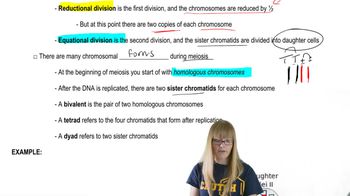
Meiosis and Polar Bodies

Meiosis is a specialized type of cell division that reduces the chromosome number by half, producing gametes. In females, this process results in the formation of one functional ovum and polar bodies, which are typically non-functional. The first polar body is a byproduct of meiosis I and may contain an unequal distribution of chromosomes, which can lead to abnormalities in the gametes.
Recommended video:
Guided course
05:30
Meiosis Overview

Chromosome Complement

The chromosome complement refers to the complete set of chromosomes present in a cell. In the context of the secondary oocyte, if chromosome 21 is absent in the first polar body, the secondary oocyte would typically have one copy of chromosome 21. This is crucial for understanding the genetic makeup of the resulting zygote after fertilization.
Recommended video:
Guided course
05:05
Complementation

Consequences of Chromosomal Abnormalities

When a gamete with an abnormal chromosome number, such as the absence of chromosome 21, is fertilized, it can lead to significant developmental issues in the resulting zygote. In this case, the zygote would be missing chromosome 21, which could result in conditions like Down syndrome or other genetic disorders, depending on the specific chromosomes involved and their roles in development.
Recommended video:
Guided course
07:10
Chromosome Structure
Related Practice
Textbook Question

A species of cereal rye (Secale cereale) has a chromosome number of 14, while a species of Canadian wild rye (Elymus canadensis) has a chromosome number of 28. Sterile hybrids can be produced by crossing Secale with Elymus.

What would be the expected chromosome number in the somatic cells of the hybrids?

525
views
Textbook Question

A species of cereal rye (Secale cereale) has a chromosome number of 14, while a species of Canadian wild rye (Elymus canadensis) has a chromosome number of 28. Sterile hybrids can be produced by crossing Secale with Elymus.

Given that none of the chromosomes pair at meiosis I in the sterile hybrid (Hang and Franckowlak, 1984), speculate on the anaphase I separation patterns of these chromosomes.

1169
views
Textbook Question

An interesting procedure has been applied for assessing the chromosomal balance of potential secondary oocytes for use in human in vitro fertilization. Using fluorescence in situ hybridization (FISH), Kuliev and Verlinsky (2004) were able to identify individual chromosomes in first polar bodies and thereby infer the chromosomal makeup of 'sister' oocytes. Assume that when examining a first polar body you saw that it had one copy (dyad) of each chromosome but two dyads of chromosome 21. What would you expect to be the chromosomal 21 complement in the secondary oocyte? What consequences are likely in the resulting zygote, if the secondary oocyte was fertilized?

386
views
Textbook Question

Kuliev and Verlinsky (2004) state that there was a relatively high number of separation errors at meiosis I. In these cases the centromere underwent a premature division, occurring at meiosis I rather than meiosis II. Regarding chromosome 21, what would you expect to be the chromosome 21 complement in the secondary oocyte in which you saw a single chromatid (monad) for chromosome 21 in the first polar body? If this secondary oocyte was involved in fertilization, what would be the expected consequences?

546
views