Pearson+ LogoPearson+ Logo
Ch. 2 - Mitosis and Meiosis
Klug - Concepts of Genetics  12th Edition
Klug12th EditionConcepts of Genetics ISBN: 9780135564776Not the one you use?Change textbook
Chapter 2, Problem 22

Describe the 'folded-fiber' model of the mitotic chromosome.

Verified step by step guidance
1
Begin by explaining that the 'folded-fiber' model describes how chromatin fibers are compacted during mitosis to form highly condensed mitotic chromosomes.
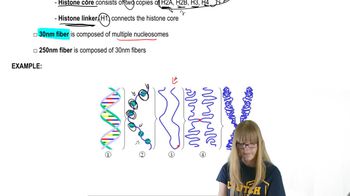
Describe that in this model, the 30 nm chromatin fiber undergoes successive folding and looping, creating higher-order structures that progressively compact the DNA.
Explain that these folds and loops are organized in a hierarchical manner, where smaller loops fold into larger loops, contributing to the overall chromosome architecture.
Mention that this folding allows the chromosome to be densely packed while still maintaining accessibility for essential processes like segregation during mitosis.
Conclude by noting that the folded-fiber model contrasts with simpler linear or solenoid models by emphasizing dynamic folding and looping as key to chromosome condensation.

Verified video answer for a similar problem:

This video solution was recommended by our tutors as helpful for the problem above.
Video duration:
1m
Was this helpful?

Key Concepts

Here are the essential concepts you must grasp in order to answer the question correctly.

Chromosome Structure

Chromosomes are highly organized structures of DNA and proteins that ensure accurate DNA packaging and segregation during cell division. Understanding their hierarchical organization, from DNA double helix to chromatin fibers and higher-order folding, is essential to grasp models of chromosome architecture.
Recommended video:
Guided course
07:10
Chromosome Structure

Folded-Fiber Model

The folded-fiber model proposes that mitotic chromosomes are formed by folding and looping of chromatin fibers into compact structures. This model emphasizes hierarchical folding of 30 nm chromatin fibers into larger loops and coils, explaining the dense packing observed in mitotic chromosomes.
Recommended video:
Guided course
07:10
Chromosome Structure

Mitotic Chromosome Condensation

During mitosis, chromosomes undergo condensation to become visible and manageable for segregation. This process involves protein complexes like condensins that facilitate chromatin folding and stabilization, which is a key aspect underlying the folded-fiber model's explanation of chromosome compaction.
Recommended video:
Guided course
07:10
Chromosome Structure
Related Practice
Textbook Question

What is the probability that, in an organism with a haploid number of 10, a sperm will be formed that contains all 10 chromosomes whose centromeres were derived from maternal homologs?

553
views
1
comments
Textbook Question

The nuclear DNA content of a single sperm cell in Drosophila melanogaster is approximately 0.18 picogram. What would be the expected nuclear DNA content of a primary spermatocyte in Drosophila? What would be the expected nuclear DNA content of a somatic cell (non-sex cell) in the G1 phase? What would be the expected nuclear DNA content of a somatic cell at metaphase?

731
views
Textbook Question

Contrast the chromatin fiber with the mitotic chromosome. How are the two structures related?

666
views
Textbook Question

You are given a metaphase chromosome preparation (a slide) from an unknown organism that contains 12 chromosomes. Two that are clearly smaller than the rest appear identical in length and centromere placement. Describe all that you can about these chromosomes.

818
views
Textbook Question

If one follows 50 primary oocytes in an animal through their various stages of oogenesis, how many secondary oocytes would be formed? How many first polar bodies would be formed? How many ootids would be formed? If one follows 50 primary spermatocytes in an animal through their various stages of spermatogenesis, how many secondary spermatocytes would be formed? How many spermatids would be formed?

721
views
Textbook Question

Consider a diploid cell that contains three pairs of chromosomes designated AA, BB, and CC. Each pair contains a maternal and a paternal member (e.g., Am and Ap). Using these designations, demonstrate your understanding of mitosis and meiosis by drawing chromatid combinations as requested. Be sure to indicate when chromatids are paired as a result of replication and/or synapsis.

In mitosis, what chromatid combination(s) will be present during metaphase? What combination(s) will be present at each pole at the completion of anaphase?

552
views