Pearson+ LogoPearson+ Logo
Ch. 2 - Mitosis and Meiosis
Klug - Concepts of Genetics  12th Edition
Klug12th EditionConcepts of Genetics ISBN: 9780135564776Not the one you use?Change textbook
Chapter 2, Problem 25

Consider a diploid cell that contains three pairs of chromosomes designated AA, BB, and CC. Each pair contains a maternal and a paternal member (e.g., Am and Ap). Using these designations, demonstrate your understanding of mitosis and meiosis by drawing chromatid combinations as requested. Be sure to indicate when chromatids are paired as a result of replication and/or synapsis.
In mitosis, what chromatid combination(s) will be present during metaphase? What combination(s) will be present at each pole at the completion of anaphase?

Verified step by step guidance
1
Step 1: Understand the chromosome composition before replication. The diploid cell has three pairs of chromosomes: AA, BB, and CC. Each pair consists of one maternal (e.g., A^{m}) and one paternal (e.g., A^{p}) chromosome, so initially, there are 6 individual chromosomes (A^{m}, A^{p}, B^{m}, B^{p}, C^{m}, C^{p}).
Step 2: During the S phase before mitosis, each chromosome replicates to form two sister chromatids. For example, A^{m} replicates to form two identical sister chromatids, which remain joined at the centromere. This applies to all chromosomes, so each pair now consists of four chromatids (two sister chromatids per chromosome).
Step 3: At metaphase of mitosis, chromosomes align at the metaphase plate as sister chromatid pairs. Each chromosome is composed of two sister chromatids joined at the centromere. Therefore, the chromatid combinations present are pairs of sister chromatids for each chromosome: (A^{m} chromatids), (A^{p} chromatids), (B^{m} chromatids), (B^{p} chromatids), (C^{m} chromatids), and (C^{p} chromatids). There is no synapsis between homologous chromosomes in mitosis.
Step 4: During anaphase of mitosis, the sister chromatids separate and move to opposite poles. Each chromatid is now considered an individual chromosome. At the completion of anaphase, each pole will have one copy of each chromosome (one chromatid from each original pair), so each pole contains one set of chromosomes: A^{m}, A^{p}, B^{m}, B^{p}, C^{m}, and C^{p}, but as single chromatids, not pairs.
Step 5: Summarize the chromatid combinations: at metaphase, chromosomes are paired as sister chromatids (replicated chromosomes), and at the end of anaphase, chromatids have separated so each pole has one complete set of unreplicated chromosomes. There is no synapsis (pairing of homologous chromosomes) in mitosis.

Verified video answer for a similar problem:

This video solution was recommended by our tutors as helpful for the problem above.
Video duration:
1m
Was this helpful?

Key Concepts

Here are the essential concepts you must grasp in order to answer the question correctly.

Chromosome Structure and Replication

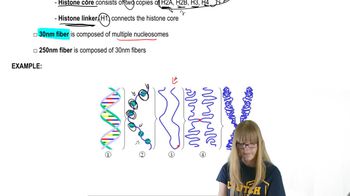
Chromosomes consist of two sister chromatids joined at a centromere after DNA replication. Each chromatid is an identical copy of the original DNA molecule. Understanding when chromatids are replicated (S phase) and how they remain paired until separation is essential for analyzing chromatid combinations during cell division.
Recommended video:
Guided course
07:10
Chromosome Structure

Mitosis Phases and Chromatid Behavior

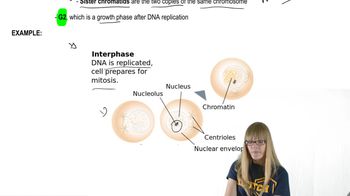
Mitosis is a process of nuclear division resulting in two identical daughter cells. During metaphase, replicated chromosomes align at the metaphase plate as paired sister chromatids. At anaphase, sister chromatids separate and move to opposite poles, ensuring each daughter cell receives one copy of each chromosome.
Recommended video:
Guided course
09:46
Mitosis Steps

Diploid Chromosome Pairing and Notation

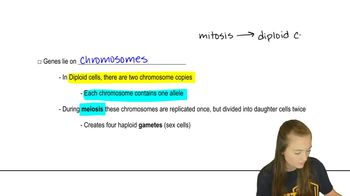
Diploid cells have pairs of homologous chromosomes, one maternal (e.g., A^m) and one paternal (e.g., A^p). Recognizing these pairs and their chromatids helps track inheritance and chromatid combinations during mitosis. This notation clarifies which chromatids are identical sisters and which are homologs.
Recommended video:
Guided course
27:36
Diploid Genetics
Related Practice
Textbook Question

Describe the 'folded-fiber' model of the mitotic chromosome.

994
views
Textbook Question

You are given a metaphase chromosome preparation (a slide) from an unknown organism that contains 12 chromosomes. Two that are clearly smaller than the rest appear identical in length and centromere placement. Describe all that you can about these chromosomes.

818
views
Textbook Question

If one follows 50 primary oocytes in an animal through their various stages of oogenesis, how many secondary oocytes would be formed? How many first polar bodies would be formed? How many ootids would be formed? If one follows 50 primary spermatocytes in an animal through their various stages of spermatogenesis, how many secondary spermatocytes would be formed? How many spermatids would be formed?

721
views
Textbook Question

Consider a diploid cell that contains three pairs of chromosomes designated AA, BB, and CC. Each pair contains a maternal and a paternal member (e.g., Am and Ap). Using these designations, demonstrate your understanding of mitosis and meiosis by drawing chromatid combinations as requested. Be sure to indicate when chromatids are paired as a result of replication and/or synapsis.

During meiosis I, assuming no crossing over, what chromatid combination(s) will be present at the completion of prophase I? Draw all possible alignments of chromatids as migration begins during early anaphase.

588
views
Textbook Question

Consider a diploid cell that contains three pairs of chromosomes designated AA, BB, and CC. Each pair contains a maternal and a paternal member (e.g., Am and Ap). Using these designations, demonstrate your understanding of mitosis and meiosis by drawing chromatid combinations as requested. Be sure to indicate when chromatids are paired as a result of replication and/or synapsis.

Are there any possible combinations present during prophase of meiosis II other than those that you drew in Problem 26? If so, draw them.

583
views
Textbook Question

Consider a diploid cell that contains three pairs of chromosomes designated AA, BB, and CC. Each pair contains a maternal and a paternal member (e.g., Am and Ap). Using these designations, demonstrate your understanding of mitosis and meiosis by drawing chromatid combinations as requested. Be sure to indicate when chromatids are paired as a result of replication and/or synapsis.

Draw all possible combinations of chromatids during the early phases of anaphase in meiosis II.

506
views