Pearson+ LogoPearson+ Logo
Ch. 2 - Mitosis and Meiosis
Klug - Concepts of Genetics  12th Edition
Klug12th EditionConcepts of Genetics ISBN: 9780135564776Not the one you use?Change textbook
Chapter 2, Problem 18

What is the probability that, in an organism with a haploid number of 10, a sperm will be formed that contains all 10 chromosomes whose centromeres were derived from maternal homologs?

Verified step by step guidance
1
Understand that the organism has a haploid number of 10, meaning each gamete (sperm) will contain 10 chromosomes, one from each homologous pair.
Recognize that for each homologous chromosome pair, there are two possible centromere origins: maternal or paternal.
Since the question asks for the probability that all 10 chromosomes in the sperm have centromeres derived from the maternal homologs, consider that each chromosome pair independently contributes either the maternal or paternal centromere with equal probability (assuming no bias).
Calculate the probability for one chromosome to have the maternal centromere, which is \(\frac{1}{2}\), and then raise this probability to the power of 10 (the number of chromosome pairs) to find the combined probability for all chromosomes.
Express the final probability as \(\left(\frac{1}{2}\right)^{10}\), representing the chance that all 10 chromosomes in the sperm carry maternal centromeres.

Key Concepts

Here are the essential concepts you must grasp in order to answer the question correctly.

Haploid Number and Chromosome Composition

The haploid number represents the number of chromosomes in a gamete, which is half the diploid number. In this case, the organism has 10 chromosomes in its haploid set, meaning each sperm normally contains one chromosome from each homologous pair, either maternal or paternal.
Recommended video:
Guided course
02:45
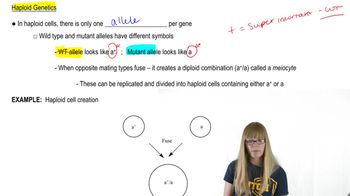
Haploid Genetics

Independent Assortment of Chromosomes

During meiosis, homologous chromosomes segregate independently, so each chromosome in a gamete has a 50% chance of being maternal or paternal in origin. This random assortment leads to genetic variation in gametes.
Recommended video:
Guided course
04:58
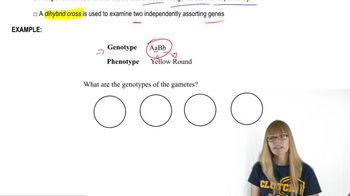
Gamete Genetics and Independent Assortment

Probability of Inheriting All Maternal Homologs

Since each chromosome has a 1/2 chance of being maternal, the probability that all 10 chromosomes in a sperm are maternal is (1/2)^10. This reflects the combined independent probabilities of inheriting each maternal chromosome.
Recommended video:
Guided course
00:36
Types of Maternal Inheritance
Related Practice
Textbook Question

A diploid cell contains three pairs of homologous chromosomes designated C1 and C2, M1 and M2, and S1 and S2. No crossing over occurs. What combinations of chromosomes are possible in?

(a) daughter cells following mitosis

(b) cells undergoing the first meiotic metaphase

(c) haploid cells following both divisions of meiosis

1972
views
Textbook Question

Considering Problem 15, predict the number of different haploid cells that could be produced by meiosis if a fourth chromosome pair (W1 and W2) were added.

606
views
Textbook Question

During oogenesis in an animal species with a haploid number of 6, one dyad undergoes nondisjunction during meiosis II. Following the second meiotic division, this dyad ends up intact in the ovum. How many chromosomes are present in

(a) the mature ovum and

(b) the second polar body?

(c) Following fertilization by a normal sperm, what chromosome condition is created?

739
views
Textbook Question

The nuclear DNA content of a single sperm cell in Drosophila melanogaster is approximately 0.18 picogram. What would be the expected nuclear DNA content of a primary spermatocyte in Drosophila? What would be the expected nuclear DNA content of a somatic cell (non-sex cell) in the G1 phase? What would be the expected nuclear DNA content of a somatic cell at metaphase?

731
views
Textbook Question

Contrast the chromatin fiber with the mitotic chromosome. How are the two structures related?

666
views
Textbook Question

Describe the 'folded-fiber' model of the mitotic chromosome.

994
views