Pearson+ LogoPearson+ Logo
Ch. 20 - Recombinant DNA Technology
Klug - Concepts of Genetics  12th Edition
Klug12th EditionConcepts of Genetics ISBN: 9780135564776Not the one you use?Change textbook
Chapter 20, Problem 17

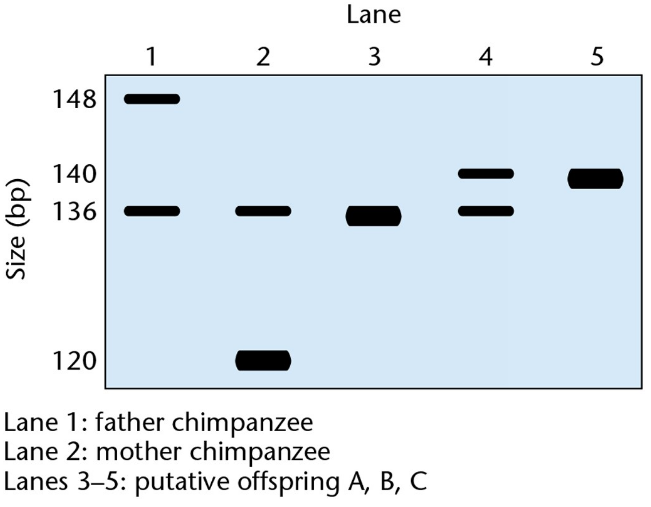
Although the capture and trading of great apes has been banned in 112 countries since 1973, it is estimated that about 1000 chimpanzees are removed annually from Africa and smuggled into Europe, the United States, and Japan. This illegal trade is often disguised by simulating births in captivity. Until recently, genetic identity tests to uncover these illegal activities were not used because of the lack of highly polymorphic markers (markers that vary from one individual to the next) and the difficulties of obtaining chimpanzee blood samples. A study was reported in which DNA samples were extracted from freshly plucked chimpanzee hair roots and used as templates for PCR. The primers used in these studies flank highly polymorphic sites in human DNA that result from variable numbers of tandem nucleotide repeats. Several offspring and their putative parents were tested to determine whether the offspring were 'legitimate' or the product of illegal trading. The data are shown in the following Southern blot.
Southern blot showing DNA band patterns of chimpanzee parents and three offspring for genetic identity testing.
Examine the data carefully and choose the best conclusion.
a. None of the offspring is legitimate.
b. Offspring B and C are not the products of these parents and were probably purchased on the illegal market. The data are consistent with offspring A being legitimate.
c. Offspring A and B are products of the parents shown, but C is not and was therefore probably purchased on the illegal market.
d. There are not enough data to draw any conclusions. Additional polymorphic sites should be examined.
e. No conclusion can be drawn because 'human' primers were used.

Verified step by step guidance
1
Understand the context: The problem involves using DNA polymorphic markers (variable number tandem repeats, VNTRs) amplified by PCR to verify parentage of chimpanzee offspring, similar to human forensic or paternity testing.
Recall the principle of inheritance for VNTR markers: Each offspring inherits one allele from each parent at a given locus, so the offspring's band pattern should be a combination of bands present in the mother and father.
Analyze the Southern blot data by comparing the band patterns of each offspring with those of the putative parents. For each offspring, check if every band can be accounted for by at least one parent’s band.
Determine legitimacy: If an offspring has bands not present in either parent, it suggests that the offspring is not genetically related to those parents and may have been illegally traded or purchased.
Evaluate the options based on your analysis of the band patterns and inheritance rules, considering whether the data are sufficient or if additional markers are needed to confirm parentage conclusively.

Verified video answer for a similar problem:

This video solution was recommended by our tutors as helpful for the problem above.
Video duration:
1m
Was this helpful?

Key Concepts

Here are the essential concepts you must grasp in order to answer the question correctly.

Variable Number Tandem Repeats (VNTRs)

VNTRs are DNA regions where a short nucleotide sequence is repeated a variable number of times among individuals. These highly polymorphic markers are useful for genetic fingerprinting because the number of repeats differs between individuals, allowing for identification and parentage testing.
Recommended video:

Polymerase Chain Reaction (PCR) and Primer Specificity

PCR is a technique used to amplify specific DNA sequences using primers that flank the target region. Using primers designed for human VNTRs can still amplify similar regions in closely related species like chimpanzees due to genetic similarity, enabling analysis despite cross-species primer use.
Recommended video:
Guided course
07:39
Genetic Cloning

Parentage Testing Using Genetic Markers

Parentage testing compares genetic markers between offspring and putative parents to verify biological relationships. Offspring inherit one allele from each parent at polymorphic loci, so mismatches at these loci can indicate non-parentage or illegal trade in animals.
Recommended video:
Guided course
07:11
Mapping with Markers
Related Practice
Textbook Question

What advantages do cDNA libraries provide over genomic DNA libraries? Describe cloning applications where the use of a genomic library is necessary to provide information that a cDNA library cannot.

1242
views
Textbook Question

You have recovered a cloned DNA segment from a vector and determine that the insert is 1300 bp in length. To characterize this cloned segment, you isolate the insert and decide to construct a restriction map. Using enzyme I and enzyme II, followed by gel electrophoresis, you determine the number and size of the fragments produced by enzymes I and II alone and in combination, as recorded in the following table. Construct a restriction map from these data, showing the positions of the restriction-enzyme cutting sites relative to one another and the distance between them in units of base pairs.

735
views
Textbook Question

To create a cDNA library, cDNA can be inserted into vectors and cloned. In the analysis of cDNA clones, it is often difficult to find clones that are full length—that is, many clones are shorter than the mature mRNA molecules from which they are derived. Why is this so?

647
views
Textbook Question

To estimate the number of cleavage sites in a particular piece of DNA with a known size, you can apply the formula N/4ⁿ where N is the number of base pairs in the target DNA and n is the number of bases in the recognition sequence of the restriction enzyme. If the recognition sequence for BamHI is GGATCC and the λ\lambda phage DNA contains approximately 48,500 bp, how many cleavage sites would you expect?

1172
views
Textbook Question

In a typical PCR reaction, describe what is happening in stages occurring at temperature ranges

(a) 92-26 °C

(b) 45-65 °C and

(c) 65-75 °C

667
views
Textbook Question

We usually think of enzymes as being most active at around 37°C, yet in PCR the DNA polymerase is subjected to multiple exposures of relatively high temperatures and seems to function appropriately at 65–75°C. What is special about the DNA polymerase typically used in PCR?

520
views