Pearson+ LogoPearson+ Logo
Ch. 20 - Recombinant DNA Technology
Klug - Concepts of Genetics  12th Edition
Klug12th EditionConcepts of Genetics ISBN: 9780135564776Not the one you use?Change textbook
Chapter 20, Problem 15

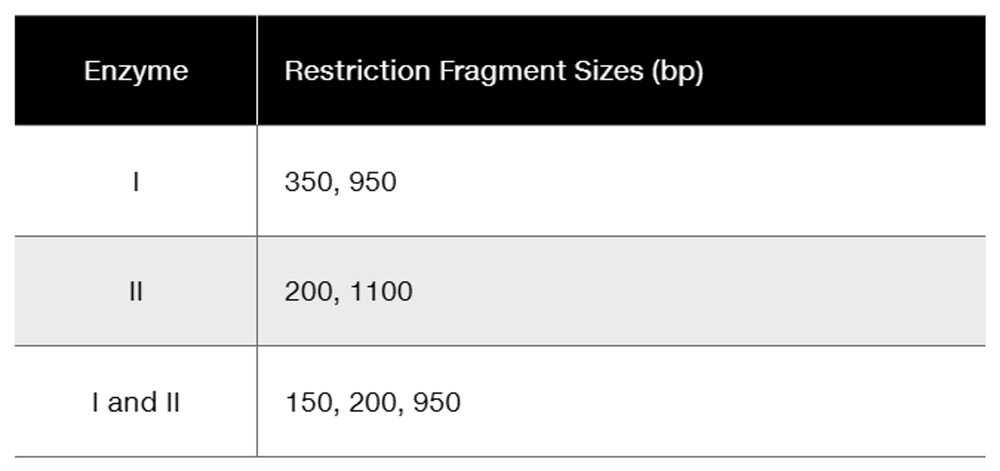
You have recovered a cloned DNA segment from a vector and determine that the insert is 1300 bp in length. To characterize this cloned segment, you isolate the insert and decide to construct a restriction map. Using enzyme I and enzyme II, followed by gel electrophoresis, you determine the number and size of the fragments produced by enzymes I and II alone and in combination, as recorded in the following table. Construct a restriction map from these data, showing the positions of the restriction-enzyme cutting sites relative to one another and the distance between them in units of base pairs.
Table showing restriction fragment sizes in base pairs for enzyme I: 350 and 950; enzyme II: 200 and 1100; both enzymes: 150, 200, and 950.

Verified step by step guidance
1
Step 1: Understand the problem. You are tasked with constructing a restriction map for a 1300 bp DNA segment based on the fragment sizes produced by two restriction enzymes (I and II) alone and in combination. A restriction map shows the positions of the cutting sites of the enzymes and the distances between them in base pairs.
Step 2: Analyze the data for enzyme I. When enzyme I is used alone, it produces two fragments of 350 bp and 950 bp. This indicates that enzyme I cuts the DNA at one site, dividing the DNA into two fragments whose sizes add up to the total length of 1300 bp.
Step 3: Analyze the data for enzyme II. When enzyme II is used alone, it produces two fragments of 200 bp and 1100 bp. This indicates that enzyme II cuts the DNA at one site, dividing the DNA into two fragments whose sizes also add up to 1300 bp.
Step 4: Analyze the data for the combination of enzymes I and II. When both enzymes are used together, three fragments are produced: 150 bp, 200 bp, and 950 bp. This suggests that the cutting sites of enzyme I and enzyme II are located at different positions on the DNA, and their combined action creates additional fragments.
Step 5: Construct the restriction map. To do this, determine the relative positions of the cutting sites for enzyme I and enzyme II based on the fragment sizes. Use the data from the combination of enzymes to deduce the distances between the cutting sites. For example, the 150 bp fragment likely represents the distance between the cutting sites of enzyme I and enzyme II, while the 200 bp and 950 bp fragments represent the remaining portions of the DNA after both enzymes have cut.

Verified video answer for a similar problem:

This video solution was recommended by our tutors as helpful for the problem above.
Video duration:
3m
Was this helpful?

Key Concepts

Here are the essential concepts you must grasp in order to answer the question correctly.

Restriction Enzymes

Restriction enzymes, or restriction endonucleases, are proteins that cut DNA at specific sequences, known as recognition sites. Each enzyme recognizes a unique sequence of nucleotides, allowing for precise cutting of DNA. This property is essential for cloning and DNA manipulation, as it enables researchers to isolate specific DNA fragments for further study or use in genetic engineering.
Recommended video:
Guided course
07:11
Mapping with Markers

Gel Electrophoresis

Gel electrophoresis is a laboratory technique used to separate DNA fragments based on their size. When an electric current is applied to a gel matrix, smaller fragments move faster and travel further than larger ones. This method allows researchers to visualize the sizes of DNA fragments produced by restriction enzyme digestion, facilitating the construction of a restriction map.
Recommended video:

Restriction Map

A restriction map is a diagram that shows the locations of restriction enzyme cut sites within a DNA segment. It is constructed by analyzing the sizes of DNA fragments generated by different enzymes and their combinations. By comparing the fragment sizes, researchers can infer the relative positions of the cut sites, which is crucial for understanding the structure of the cloned DNA and for planning further experiments.
Recommended video:
Guided course
07:11
Mapping with Markers
Related Practice
Textbook Question

If you performed a PCR experiment starting with only one copy of double-stranded DNA, approximately how many DNA molecules would be present in the reaction tube after 15 cycles of amplification?

741
views
Textbook Question

In a control experiment, a plasmid containing a HindIII recognition sequence within a kanamycin resistance gene is cut with HindIII, re-ligated, and used to transform E. coli K12 cells. Kanamycin-resistant colonies are selected, and plasmid DNA from these colonies is subjected to electrophoresis. Most of the colonies contain plasmids that produce single bands that migrate at the same rate as the original intact plasmid. A few colonies, however, produce two bands, one of original size and one that migrates much less far down the gel. Diagram the origin of this slow band as a product of ligation.

613
views
Textbook Question

What advantages do cDNA libraries provide over genomic DNA libraries? Describe cloning applications where the use of a genomic library is necessary to provide information that a cDNA library cannot.

1242
views
Textbook Question

To create a cDNA library, cDNA can be inserted into vectors and cloned. In the analysis of cDNA clones, it is often difficult to find clones that are full length—that is, many clones are shorter than the mature mRNA molecules from which they are derived. Why is this so?

647
views
Textbook Question

Although the capture and trading of great apes has been banned in 112 countries since 1973, it is estimated that about 1000 chimpanzees are removed annually from Africa and smuggled into Europe, the United States, and Japan. This illegal trade is often disguised by simulating births in captivity. Until recently, genetic identity tests to uncover these illegal activities were not used because of the lack of highly polymorphic markers (markers that vary from one individual to the next) and the difficulties of obtaining chimpanzee blood samples. A study was reported in which DNA samples were extracted from freshly plucked chimpanzee hair roots and used as templates for PCR. The primers used in these studies flank highly polymorphic sites in human DNA that result from variable numbers of tandem nucleotide repeats. Several offspring and their putative parents were tested to determine whether the offspring were 'legitimate' or the product of illegal trading. The data are shown in the following Southern blot.

Examine the data carefully and choose the best conclusion.

a. None of the offspring is legitimate.

b. Offspring B and C are not the products of these parents and were probably purchased on the illegal market. The data are consistent with offspring A being legitimate.

c. Offspring A and B are products of the parents shown, but C is not and was therefore probably purchased on the illegal market.

d. There are not enough data to draw any conclusions. Additional polymorphic sites should be examined.

e. No conclusion can be drawn because 'human' primers were used.

565
views
Textbook Question

To estimate the number of cleavage sites in a particular piece of DNA with a known size, you can apply the formula N/4ⁿ where N is the number of base pairs in the target DNA and n is the number of bases in the recognition sequence of the restriction enzyme. If the recognition sequence for BamHI is GGATCC and the λ\lambda phage DNA contains approximately 48,500 bp, how many cleavage sites would you expect?

1172
views