Pearson+ LogoPearson+ Logo
Ch. 24 - Cancer Genetics
Klug - Concepts of Genetics  12th Edition
Klug12th EditionConcepts of Genetics ISBN: 9780135564776Not the one you use?Change textbook
Chapter 24, Problem 1a

How do we know that malignant tumors arise from a single cell that contains mutations?

Verified step by step guidance
1
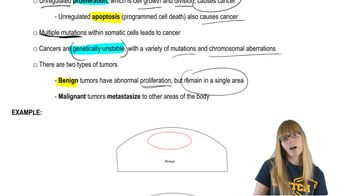
Understand the concept of clonal origin: Malignant tumors are believed to arise from a single cell because all the tumor cells share the same genetic mutations, indicating they originated from one mutated progenitor cell.
Examine genetic markers: Scientists analyze specific genetic mutations or chromosomal abnormalities present in tumor cells. If all tumor cells have identical mutations, it suggests a common ancestor cell.
Use techniques like X-chromosome inactivation analysis: In females, one X chromosome is randomly inactivated in each cell. If a tumor is monoclonal, all tumor cells will inactivate the same X chromosome, supporting the single-cell origin hypothesis.
Consider mutation accumulation: The single progenitor cell accumulates mutations that confer growth advantages, leading to clonal expansion and tumor formation.
Review experimental evidence: Studies involving lineage tracing and molecular profiling confirm that malignant tumors typically arise from a single mutated cell that proliferates uncontrollably.

Verified video answer for a similar problem:

This video solution was recommended by our tutors as helpful for the problem above.
Video duration:
1m
Was this helpful?

Key Concepts

Here are the essential concepts you must grasp in order to answer the question correctly.

Clonal Origin of Tumors

Malignant tumors originate from a single progenitor cell that acquires mutations, leading to uncontrolled growth. Evidence for this clonal origin includes uniform genetic markers or mutations found throughout the tumor, indicating all cancer cells descend from one mutated ancestor.
Recommended video:
Guided course
09:46
Cancer Characteristics

Somatic Mutations in Cancer

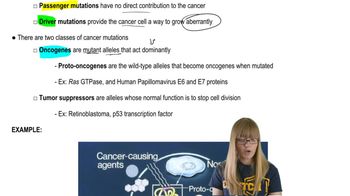
Somatic mutations are genetic alterations acquired by a cell during an individual's lifetime, not inherited from parents. These mutations can disrupt normal cell regulation, causing a single cell to proliferate abnormally and form a tumor, demonstrating how mutations drive cancer development.
Recommended video:
Guided course
04:46
Cancer Mutations

Molecular and Genetic Analysis Techniques

Techniques like DNA sequencing, X-chromosome inactivation patterns, and analysis of specific genetic markers help identify the clonal nature of tumors. These methods reveal that tumor cells share identical mutations, confirming their origin from a single mutated cell.
Recommended video:
Guided course
02:48
Chi Square Analysis