Pearson+ LogoPearson+ Logo
Ch. 24 - Cancer Genetics
Klug - Concepts of Genetics  12th Edition
Klug12th EditionConcepts of Genetics ISBN: 9780135564776Not the one you use?Change textbook
Chapter 24, Problem 30

Although cancer is not a contagious disease in humans or other vertebrates, there have been rare cases in which cancers have spread from one organism to another. Describe three cases of these contagious cancers and what conditions might have led to their appearance.

Verified step by step guidance
1
Understand the concept of contagious cancers: While cancer is generally not contagious, there are rare cases where cancer cells can spread between individuals under specific conditions. These cases are typically observed in certain animal species and involve direct transmission of cancer cells.
Case 1: Tasmanian Devil Facial Tumor Disease (DFTD): This is a transmissible cancer affecting Tasmanian devils. It spreads through biting during social interactions, where cancer cells are physically transferred from one individual to another. The lack of genetic diversity in Tasmanian devils may contribute to the immune system's inability to recognize and reject the foreign cancer cells.
Case 2: Canine Transmissible Venereal Tumor (CTVT): This cancer is spread among dogs during mating or close physical contact. The cancer cells themselves are transmitted as living cells, and the immune system of the recipient dog does not always recognize them as foreign due to genetic compatibility or immune suppression.
Case 3: Contagious cancer in clams and other shellfish: Certain species of clams and mussels have been found to develop transmissible cancers that spread through water. These cancers are thought to be transmitted by cancer cells released into the environment, which are then taken up by other individuals. Environmental factors, such as pollution or stress, may play a role in the emergence of these cancers.
Summarize the conditions leading to contagious cancers: Factors such as close physical contact, genetic similarity between individuals, immune system suppression, and environmental stressors can contribute to the appearance and spread of contagious cancers. These cases are rare and typically limited to specific species under unique circumstances.

Verified video answer for a similar problem:

This video solution was recommended by our tutors as helpful for the problem above.
Video duration:
2m
Was this helpful?

Key Concepts

Here are the essential concepts you must grasp in order to answer the question correctly.

Contagious Cancers

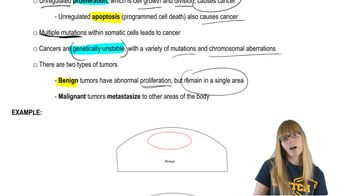
Contagious cancers are rare instances where cancer cells can be transmitted from one individual to another, leading to the development of tumors in the recipient. This phenomenon has been documented in certain species, such as Tasmanian devils and dogs, where cancer cells can spread through direct contact or environmental exposure. Understanding these cases helps illustrate the unique mechanisms of cancer biology and the role of the immune system in recognizing foreign cells.
Recommended video:
Guided course
09:46
Cancer Characteristics

Environmental Factors

Environmental factors play a crucial role in the emergence of contagious cancers. For instance, factors such as habitat destruction, population density, and social behavior can influence the transmission of cancer cells among individuals. In species like the Tasmanian devil, close social interactions and a declining population have facilitated the spread of facial tumor disease, highlighting how ecological conditions can impact disease dynamics.
Recommended video:
Guided course
08:52
F Factor and Hfr

Immune System Evasion

The ability of cancer cells to evade the immune system is a key factor in the development of contagious cancers. Normally, the immune system identifies and destroys foreign cells, but certain cancer cells have developed mechanisms to avoid detection. This evasion allows them to survive and proliferate in a new host, as seen in the transmissible venereal tumor in dogs, where tumor cells can thrive despite the host's immune response.
Recommended video:
Guided course
07:55
Non-Random Mating
Related Practice