Pearson+ LogoPearson+ Logo
Ch. 25 - Quantitative Genetics and Multifactorial Traits
Klug - Concepts of Genetics  12th Edition
Klug12th EditionConcepts of Genetics ISBN: 9780135564776Not the one you use?Change textbook
Chapter 25, Problem 6d

An inbred strain of plants has a mean height of 24 cm. A second strain of the same species from a different geographic region also has a mean height of 24 cm. When plants from the two strains are crossed together, the F₁ plants are the same height as the parent plants. However, the F₂ generation shows a wide range of heights; the majority are like the P₁ and F₁ plants, but approximately 4 of 1000 are only 12 cm high and about 4 of 1000 are 36 cm high.
Indicate one possible set of genotypes for the original P₁ parents and the F₁ plants that could account for these results.

Verified step by step guidance
1
Step 1: Understand the problem context. We have two inbred parent strains (P₁) with the same mean height (24 cm), and their F₁ offspring also have the same height. The F₂ generation shows a wide range of heights, with most plants at 24 cm but some at 12 cm and 36 cm, which suggests segregation of alleles affecting height.
Step 2: Consider the inheritance pattern. Since the F₁ plants have the same height as the parents, this suggests that the alleles from each parent are codominant or show incomplete dominance, resulting in an intermediate phenotype in the heterozygous F₁.
Step 3: Assign genotypes to the P₁ parents. Because the parents are inbred and have the same phenotype (24 cm), but the F₂ shows extremes (12 cm and 36 cm), each parent is likely homozygous for different alleles that affect height additively. For example, one parent could be homozygous for allele A (AA) and the other homozygous for allele a (aa), where A and a contribute different amounts to height.
Step 4: Determine the F₁ genotype. Crossing AA (tall allele) with aa (short allele) results in all heterozygous Aa plants in the F₁, which have the intermediate height (24 cm), matching the parents' phenotype.
Step 5: Explain the F₂ phenotypic ratios. When F₁ plants (Aa) are self-crossed, the F₂ genotypes segregate as AA, Aa, and aa in a 1:2:1 ratio. The AA plants would be tallest (36 cm), the aa plants shortest (12 cm), and the Aa plants intermediate (24 cm), explaining the observed distribution of heights.

Verified video answer for a similar problem:

This video solution was recommended by our tutors as helpful for the problem above.
Video duration:
1m
Was this helpful?

Key Concepts

Here are the essential concepts you must grasp in order to answer the question correctly.

Quantitative Trait Inheritance

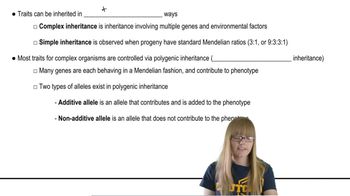
Quantitative traits, like plant height, are controlled by multiple genes (polygenes) and show continuous variation. The distribution of phenotypes in offspring often follows a normal curve, with most individuals near the mean and fewer at extremes, reflecting the combined effect of several alleles.
Recommended video:
Guided course
13:40
Traits and Variance

Genotype-Phenotype Relationship in Polygenic Traits

In polygenic inheritance, different combinations of alleles at multiple loci produce a range of phenotypes. Homozygous genotypes at these loci can lead to extreme phenotypes (e.g., very short or very tall plants), while heterozygous or intermediate genotypes result in average phenotypes, explaining the variation seen in F₂.
Recommended video:
Guided course
13:40
Traits and Variance

Segregation and Recombination in F₂ Generation

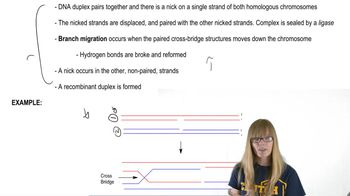
When F₁ hybrids self-pollinate, alleles segregate and recombine, producing diverse genotypes in the F₂. This genetic reshuffling can reveal recessive or additive effects, causing some offspring to exhibit extreme phenotypes not seen in the parents or F₁, consistent with the observed rare short and tall plants.
Recommended video:
Guided course
03:51
Recombination after Single Strand Breaks
Related Practice
Textbook Question

An inbred strain of plants has a mean height of 24 cm. A second strain of the same species from a different geographic region also has a mean height of 24 cm. When plants from the two strains are crossed together, the F₁ plants are the same height as the parent plants. However, the F₂ generation shows a wide range of heights; the majority are like the P₁ and F₁ plants, but approximately 4 of 1000 are only 12 cm high and about 4 of 1000 are 36 cm high.

What mode of inheritance is occurring here?

592
views
Textbook Question

An inbred strain of plants has a mean height of 24 cm. A second strain of the same species from a different geographic region also has a mean height of 24 cm. When plants from the two strains are crossed together, the F₁ plants are the same height as the parent plants. However, the F₂ generation shows a wide range of heights; the majority are like the P₁ and F₁ plants, but approximately 4 of 1000 are only 12 cm high and about 4 of 1000 are 36 cm high.

How many gene pairs are involved?

709
views
Textbook Question

An inbred strain of plants has a mean height of 24 cm. A second strain of the same species from a different geographic region also has a mean height of 24 cm. When plants from the two strains are crossed together, the F₁ plants are the same height as the parent plants. However, the F₂ generation shows a wide range of heights; the majority are like the P₁ and F₁ plants, but approximately 4 of 1000 are only 12 cm high and about 4 of 1000 are 36 cm high.

How much does each gene contribute to plant height?

618
views
Textbook Question

An inbred strain of plants has a mean height of 24 cm. A second strain of the same species from a different geographic region also has a mean height of 24 cm. When plants from the two strains are crossed together, the F₁ plants are the same height as the parent plants. However, the F₂ generation shows a wide range of heights; the majority are like the P₁ and F₁ plants, but approximately 4 of 1000 are only 12 cm high and about 4 of 1000 are 36 cm high.

Indicate three possible genotypes that could account for F₂ plants that are 18 cm high and three that account for F₂ plants that are 33 cm high.

462
views
Textbook Question

Erma and Harvey were a compatible barnyard pair, but a curious sight. Harvey's tail was only 6 cm long, while Erma's was 30 cm. Their F₁ piglet offspring all grew tails that were 18 cm. When inbred, an F₂ generation resulted in many piglets (Erma and Harvey's grandpigs), whose tails ranged in 4-cm intervals from 6 to 30 cm (6, 10, 14, 18, 22, 26, and 30). Most had 18-cm tails, while 1/64 had 6-cm tails and 1/64 had 30-cm tails.

Explain how these tail lengths were inherited by describing the mode of inheritance, indicating how many gene pairs were at work, and designating the genotypes of Harvey, Erma, and their 18-cm-tail offspring.

562
views
Textbook Question

Erma and Harvey were a compatible barnyard pair, but a curious sight. Harvey's tail was only 6 cm long, while Erma's was 30 cm. Their F₁ piglet offspring all grew tails that were 18 cm. When inbred, an F₂ generation resulted in many piglets (Erma and Harvey's grandpigs), whose tails ranged in 4-cm intervals from 6 to 30 cm (6, 10, 14, 18, 22, 26, and 30). Most had 18-cm tails, while 1/64 had 6-cm tails and 1/64 had 30-cm tails.

If one of the 18-cm-tail F₁ pigs is mated with one of the 6-cm-tail F₂ pigs, what phenotypic ratio will be predicted if many offspring resulted? Diagram the cross.

480
views