Pearson+ LogoPearson+ Logo
Ch. 25 - Quantitative Genetics and Multifactorial Traits
Klug - Concepts of Genetics  12th Edition
Klug12th EditionConcepts of Genetics ISBN: 9780135564776Not the one you use?Change textbook
Chapter 25, Problem 6b

An inbred strain of plants has a mean height of 24 cm. A second strain of the same species from a different geographic region also has a mean height of 24 cm. When plants from the two strains are crossed together, the F₁ plants are the same height as the parent plants. However, the F₂ generation shows a wide range of heights; the majority are like the P₁ and F₁ plants, but approximately 4 of 1000 are only 12 cm high and about 4 of 1000 are 36 cm high.
How many gene pairs are involved?

Verified step by step guidance
1
Step 1: Understand the problem context. We have two inbred strains with the same mean height (24 cm), and their F₁ offspring also have the same height. The F₂ generation shows variation, with most plants at 24 cm, but some at 12 cm and 36 cm, which are extreme phenotypes.
Step 2: Recognize that the F₁ uniformity and F₂ variation suggest that the trait is controlled by multiple gene pairs showing additive effects, where each gene pair contributes to the height.
Step 3: Note the extreme phenotypes in the F₂ generation occur at a frequency of about 4 in 1000 (0.004) for both the low (12 cm) and high (36 cm) heights. These extremes correspond to homozygous genotypes at all gene pairs for either the recessive or dominant alleles.
Step 4: Use the fact that for each gene pair, the probability of a homozygous genotype (either dominant or recessive) in the F₂ is 1/4. For n independent gene pairs, the probability of being homozygous at all loci is \( (\frac{1}{4})^n \). Set this equal to the observed frequency of the extreme phenotypes:
\[ (\frac{1}{4})^n = 0.004 \]
Step 5: Solve for n by taking the logarithm of both sides:
\[ n = \frac{\log(0.004)}{\log(\frac{1}{4})} \]
This will give the number of gene pairs involved in controlling the height.

Verified video answer for a similar problem:

This video solution was recommended by our tutors as helpful for the problem above.
Video duration:
42s
Was this helpful?

Key Concepts

Here are the essential concepts you must grasp in order to answer the question correctly.

Polygenic Inheritance

Polygenic inheritance involves multiple gene pairs contributing additively to a single trait, such as height. This results in continuous variation and a range of phenotypes rather than discrete categories. The presence of extreme phenotypes in the F2 generation suggests several genes influence the trait.
Recommended video:
Guided course
05:13
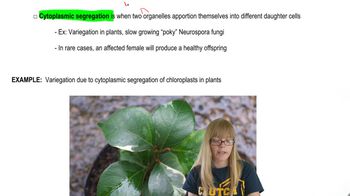
Organelle Inheritance

F1 and F2 Generations in Genetic Crosses

The F1 generation is the first filial generation from crossing two parent strains, often showing uniform traits due to heterozygosity. The F2 generation results from selfing or intercrossing F1 individuals, revealing genetic segregation and recombination, which can produce a wider range of phenotypes.
Recommended video:
Guided course
26:08
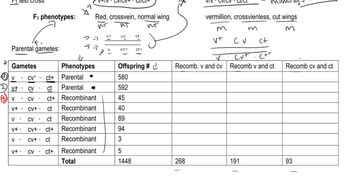
Trihybrid Cross

Segregation and Recombination of Alleles

During gamete formation, alleles segregate independently, and recombination can create new allele combinations. In polygenic traits, this leads to a distribution of phenotypes in the F2, including rare extreme types, which helps estimate the number of gene pairs involved based on observed ratios.
Recommended video:
Guided course
03:37
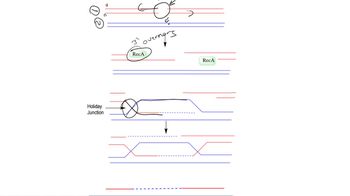
Recombination after Double Strand Breaks
Related Practice
Textbook Question

Height in humans depends on the additive action of genes. Assume that this trait is controlled by the four loci R, S, T, and U and that environmental effects are negligible. Instead of additive versus nonadditive alleles, assume that additive and partially additive alleles exist. Additive alleles contribute two units, and partially additive alleles contribute one unit to height.

Can two individuals of moderate height produce offspring that are much taller or shorter than either parent? If so, how?

914
views
Textbook Question

Height in humans depends on the additive action of genes. Assume that this trait is controlled by the four loci R, S, T, and U and that environmental effects are negligible. Instead of additive versus nonadditive alleles, assume that additive and partially additive alleles exist. Additive alleles contribute two units, and partially additive alleles contribute one unit to height.

If an individual with the minimum height specified by these genes marries an individual of intermediate or moderate height, will any of their children be taller than the tall parent? Why or why not?

698
views
Textbook Question

An inbred strain of plants has a mean height of 24 cm. A second strain of the same species from a different geographic region also has a mean height of 24 cm. When plants from the two strains are crossed together, the F₁ plants are the same height as the parent plants. However, the F₂ generation shows a wide range of heights; the majority are like the P₁ and F₁ plants, but approximately 4 of 1000 are only 12 cm high and about 4 of 1000 are 36 cm high.

What mode of inheritance is occurring here?

592
views
Textbook Question

An inbred strain of plants has a mean height of 24 cm. A second strain of the same species from a different geographic region also has a mean height of 24 cm. When plants from the two strains are crossed together, the F₁ plants are the same height as the parent plants. However, the F₂ generation shows a wide range of heights; the majority are like the P₁ and F₁ plants, but approximately 4 of 1000 are only 12 cm high and about 4 of 1000 are 36 cm high.

How much does each gene contribute to plant height?

618
views
Textbook Question

An inbred strain of plants has a mean height of 24 cm. A second strain of the same species from a different geographic region also has a mean height of 24 cm. When plants from the two strains are crossed together, the F₁ plants are the same height as the parent plants. However, the F₂ generation shows a wide range of heights; the majority are like the P₁ and F₁ plants, but approximately 4 of 1000 are only 12 cm high and about 4 of 1000 are 36 cm high.

Indicate one possible set of genotypes for the original P₁ parents and the F₁ plants that could account for these results.

621
views
Textbook Question

An inbred strain of plants has a mean height of 24 cm. A second strain of the same species from a different geographic region also has a mean height of 24 cm. When plants from the two strains are crossed together, the F₁ plants are the same height as the parent plants. However, the F₂ generation shows a wide range of heights; the majority are like the P₁ and F₁ plants, but approximately 4 of 1000 are only 12 cm high and about 4 of 1000 are 36 cm high.

Indicate three possible genotypes that could account for F₂ plants that are 18 cm high and three that account for F₂ plants that are 33 cm high.

462
views