Pearson+ LogoPearson+ Logo
Ch. 25 - Quantitative Genetics and Multifactorial Traits
Klug - Concepts of Genetics  12th Edition
Klug12th EditionConcepts of Genetics ISBN: 9780135564776Not the one you use?Change textbook
Chapter 25, Problem 9

What kind of heritability estimates (broad sense or narrow sense) are obtained from human twin studies?

Verified step by step guidance
1
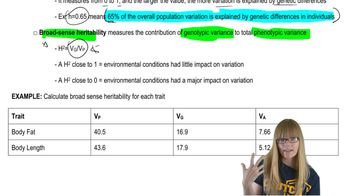
Understand the difference between broad-sense heritability (H\^2) and narrow-sense heritability (h\^2). Broad-sense heritability includes all genetic variance (additive, dominance, and epistatic), while narrow-sense heritability includes only additive genetic variance.
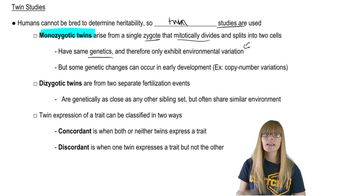
Recognize that human twin studies typically compare trait similarities between monozygotic (identical) twins and dizygotic (fraternal) twins to estimate genetic influence on traits.
Note that because twin studies capture the total genetic contribution to trait variance (including additive and non-additive effects), the heritability estimates from these studies reflect broad-sense heritability rather than just narrow-sense heritability.
Recall that narrow-sense heritability is more specifically estimated using methods that focus on additive genetic variance, such as parent-offspring regression or SNP-based methods, which are not the primary focus of classic twin studies.
Conclude that heritability estimates from human twin studies are generally considered broad-sense heritability because they encompass all genetic variance components influencing the trait.

Verified video answer for a similar problem:

This video solution was recommended by our tutors as helpful for the problem above.
Video duration:
1m
Was this helpful?

Key Concepts

Here are the essential concepts you must grasp in order to answer the question correctly.

Broad Sense Heritability (H²)

Broad sense heritability measures the proportion of total phenotypic variance in a population that is due to all genetic factors, including additive, dominance, and epistatic interactions. It reflects the overall genetic contribution to trait variation but does not distinguish between different genetic effects.
Recommended video:
Guided course
07:04
Calculating Heritability

Narrow Sense Heritability (h²)

Narrow sense heritability estimates the proportion of phenotypic variance attributable specifically to additive genetic variance. This measure is important for predicting the response to selection because additive effects are transmitted from parents to offspring.
Recommended video:
Guided course
07:04
Calculating Heritability

Human Twin Studies and Heritability Estimation

Human twin studies compare trait similarities between monozygotic and dizygotic twins to estimate genetic influence. These studies typically provide estimates closer to broad sense heritability because they capture all genetic effects shared by twins, not just additive genetic variance.
Recommended video:
Related Practice
Textbook Question

Erma and Harvey were a compatible barnyard pair, but a curious sight. Harvey's tail was only 6 cm long, while Erma's was 30 cm. Their F₁ piglet offspring all grew tails that were 18 cm. When inbred, an F₂ generation resulted in many piglets (Erma and Harvey's grandpigs), whose tails ranged in 4-cm intervals from 6 to 30 cm (6, 10, 14, 18, 22, 26, and 30). Most had 18-cm tails, while 1/64 had 6-cm tails and 1/64 had 30-cm tails.

Explain how these tail lengths were inherited by describing the mode of inheritance, indicating how many gene pairs were at work, and designating the genotypes of Harvey, Erma, and their 18-cm-tail offspring.

562
views
Textbook Question

Erma and Harvey were a compatible barnyard pair, but a curious sight. Harvey's tail was only 6 cm long, while Erma's was 30 cm. Their F₁ piglet offspring all grew tails that were 18 cm. When inbred, an F₂ generation resulted in many piglets (Erma and Harvey's grandpigs), whose tails ranged in 4-cm intervals from 6 to 30 cm (6, 10, 14, 18, 22, 26, and 30). Most had 18-cm tails, while 1/64 had 6-cm tails and 1/64 had 30-cm tails.

If one of the 18-cm-tail F₁ pigs is mated with one of the 6-cm-tail F₂ pigs, what phenotypic ratio will be predicted if many offspring resulted? Diagram the cross.

480
views
Textbook Question

In the following table, average differences of height, weight, and fingerprint ridge count between monozygotic twins (reared together and apart), dizygotic twins, and nontwin siblings are compared: 

Based on the data in this table, which of these quantitative traits has the highest heritability values?

688
views
Textbook Question

List as many human traits as you can that are likely to be under the control of a polygenic mode of inheritance.

461
views
Textbook Question

Corn plants from a test plot are measured, and the distribution of heights at 10-cm intervals is recorded in the following table: 

 Height (cm)   Plants (no.)    

100          20    

110          60    

120          90    

130         130    

140         180   

 150         120    

160          70    

170         50    

180         40 

Calculate 

(a) the mean height, 

(b) the variance, 

(c) the standard deviation, and 

(d) the standard error of the mean. 

Plot a rough graph of plant height against frequency. Do the values represent a normal distribution? Based on your calculations, how would you assess the variation within this population?

940
views
Textbook Question

The following variances were calculated for two traits in a herd of hogs.

Calculate broad-sense () and narrow-sense () heritabilities for each trait in this herd.

520
views