Pearson+ LogoPearson+ Logo
Ch. 26 - Population and Evolutionary Genetics
Klug - Concepts of Genetics  12th Edition
Klug12th EditionConcepts of Genetics ISBN: 9780135564776Not the one you use?Change textbook
Chapter 26, Problem 13

Assume that a recessive autosomal disorder occurs in 1 of 10,000 individuals (0.0001) in the general population and that in this population about 2 percent (0.02) of the individuals are carriers for the disorder. Estimate the probability of this disorder occurring in the offspring of a marriage between first cousins. Compare this probability to the population at large.

Verified step by step guidance
1
Identify the key parameters given: the frequency of affected individuals (q^2) is 0.0001, and the carrier frequency (2pq) is 0.02 in the general population. Here, q is the frequency of the recessive allele, and p is the frequency of the normal allele.
Calculate the allele frequencies p and q using the Hardy-Weinberg equilibrium equations: \(q^2 = 0.0001\) and \$2pq = 0.02\(. From \)q^2\(, find \)q = \sqrt{0.0001}\(, then use \)2pq = 0.02\( to solve for \)p$.
Determine the probability that first cousins both carry the recessive allele inherited from a common ancestor. Since first cousins share about 1/8 of their genes identical by descent, calculate the increased probability that both are carriers due to consanguinity.
Calculate the probability that two first cousins, both carriers, will have an affected child. For autosomal recessive inheritance, this is \(\frac{1}{4}\) if both parents are carriers.
Compare the probability of affected offspring from first cousin marriage to the baseline population risk (0.0001) by multiplying the increased carrier probability by \(\frac{1}{4}\) and then comparing this value to the population frequency.

Verified video answer for a similar problem:

This video solution was recommended by our tutors as helpful for the problem above.
Video duration:
5m
Was this helpful?

Key Concepts

Here are the essential concepts you must grasp in order to answer the question correctly.

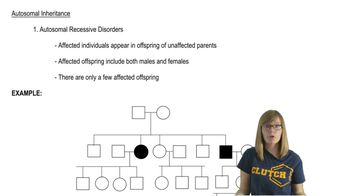
Autosomal Recessive Inheritance

Autosomal recessive disorders require two copies of a mutant allele for the disease to manifest. Carriers have one normal and one mutant allele but are typically unaffected. When both parents are carriers, there is a 25% chance their child will inherit the disorder. Understanding this inheritance pattern is essential for calculating disease risk in offspring.
Recommended video:
Guided course
09:08
Autosomal Pedigrees

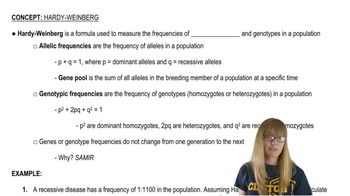
Hardy-Weinberg Equilibrium

The Hardy-Weinberg principle relates allele frequencies to genotype frequencies in a population at equilibrium. It allows estimation of carrier frequency (2pq) and affected frequency (q²) from disease prevalence. This concept helps interpret the given population data and estimate probabilities of genotypes in the general population.
Recommended video:
Guided course
13:04
Hardy Weinberg

Consanguinity and Increased Genetic Risk

Consanguineous marriages, such as between first cousins, increase the probability that both parents share alleles inherited from a common ancestor. This raises the chance of offspring inheriting two copies of a recessive allele, increasing disease risk compared to unrelated parents. Calculating this increased risk requires understanding pedigree relationships and inbreeding coefficients.
Recommended video:
Guided course
03:45
Descriptive Genetics
Related Practice
Textbook Question

Consider a population in which the frequency of allele A is p = 0.7 and the frequency of allele a is q = 0.3 and where the alleles are codominant. What will be the allele frequencies after one generation if the following occurs?

wAA = 0.8, wAa = 1, waa = 0.8

674
views
Textbook Question

If the initial allele frequencies are p = 0.5 and q = 0.5 and allele a is a lethal recessive, what will be the frequencies after 1, 5, 10, 25, 100, and 1000 generations?

982
views
Textbook Question

Under what circumstances might a lethal dominant allele persist in a population?

518
views
Textbook Question

One of the first Mendelian traits identified in humans was a dominant condition known as brachydactyly. This gene causes an abnormal shortening of the fingers or toes (or both). At the time, some researchers thought that the dominant trait would spread until 75 percent of the population would be affected (because the phenotypic ratio of dominant to recessive is 3 : 1). Show that the reasoning was incorrect.

588
views
Textbook Question

Describe how populations with substantial genetic differences can form. What is the role of natural selection?

823
views
Textbook Question

Achondroplasia is a dominant trait that causes a characteristic form of dwarfism. In a survey of 50,000 births, five infants with achondroplasia were identified. Three of the affected infants had affected parents, while two had normal parents. Calculate the mutation rate for achondroplasia and express the rate as the number of mutant genes per given number of gametes.

828
views