Pearson+ LogoPearson+ Logo
Ch. 26 - Population and Evolutionary Genetics
Klug - Concepts of Genetics  12th Edition
Klug12th EditionConcepts of Genetics ISBN: 9780135564776Not the one you use?Change textbook
Chapter 26, Problem 1d

How do we know when populations have diverged to the point that they form two different species?

Verified step by step guidance
1
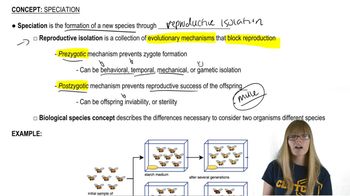
Understand the Biological Species Concept, which defines species as groups of interbreeding natural populations that are reproductively isolated from other such groups.
Examine reproductive isolation mechanisms, which can be prezygotic (before fertilization) or postzygotic (after fertilization), to determine if two populations can no longer produce viable, fertile offspring together.
Analyze genetic divergence by comparing DNA sequences or allele frequencies between populations; significant genetic differences can indicate speciation.
Consider ecological and behavioral differences that reduce gene flow, such as different mating calls, breeding seasons, or habitat preferences.
Integrate evidence from reproductive isolation, genetic data, and ecological factors to conclude whether the populations have diverged enough to be considered separate species.

Verified video answer for a similar problem:

This video solution was recommended by our tutors as helpful for the problem above.
Video duration:
1m
Was this helpful?

Key Concepts

Here are the essential concepts you must grasp in order to answer the question correctly.

Biological Species Concept

This concept defines species as groups of interbreeding natural populations that are reproductively isolated from other such groups. When populations can no longer produce fertile offspring together, they are considered separate species. It emphasizes reproductive barriers as the key factor in species divergence.
Recommended video:

Reproductive Isolation Mechanisms

These are barriers that prevent gene flow between populations, including prezygotic (e.g., behavioral, temporal isolation) and postzygotic (e.g., hybrid inviability) mechanisms. The presence of these barriers indicates that populations have diverged enough to be considered distinct species.
Recommended video:

Genetic Divergence and Speciation

Genetic divergence occurs when populations accumulate different mutations over time, leading to distinct genetic identities. This divergence can be measured using molecular markers, and significant genetic differences often correlate with speciation events, reflecting evolutionary separation.
Recommended video: