Pearson+ LogoPearson+ Logo
Ch. 26 - Population and Evolutionary Genetics
Klug - Concepts of Genetics  12th Edition
Klug12th EditionConcepts of Genetics ISBN: 9780135564776Not the one you use?Change textbook
Chapter 26, Problem 1a

How do we know how much genetic variation is in a population?

Verified step by step guidance
1
Understand that genetic variation in a population refers to the diversity of alleles and genotypes present among individuals.
Identify the key measures used to quantify genetic variation, such as allele frequency, genotype frequency, heterozygosity, and polymorphism rate.
Calculate allele frequencies by counting the number of copies of each allele and dividing by the total number of alleles in the population, using the formula: \(\text{Allele frequency} = \frac{\text{Number of copies of the allele}}{\text{Total number of alleles in the population}}\).
Determine genotype frequencies by counting the number of individuals with each genotype and dividing by the total number of individuals, using the formula: \(\text{Genotype frequency} = \frac{\text{Number of individuals with a genotype}}{\text{Total number of individuals}}\).
Use measures like expected heterozygosity (gene diversity), calculated as \(H_e = 1 - \sum p_i^2\), where \(p_i\) is the frequency of the \(i^{th}\) allele, to estimate the overall genetic variation within the population.

Verified video answer for a similar problem:

This video solution was recommended by our tutors as helpful for the problem above.
Video duration:
1m
Was this helpful?

Key Concepts

Here are the essential concepts you must grasp in order to answer the question correctly.

Genetic Variation

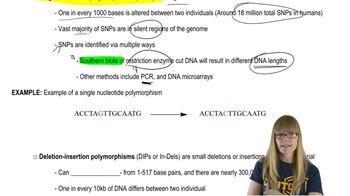
Genetic variation refers to the differences in DNA sequences among individuals within a population. It is the basis for diversity in traits and is essential for evolution and adaptation. Measuring this variation helps understand population health and potential for survival.
Recommended video:
Guided course
09:28
Genomic Variation

Allele Frequency

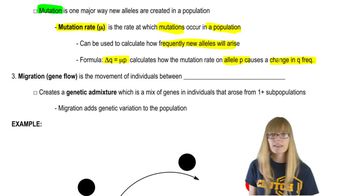
Allele frequency is the proportion of a specific allele among all alleles for a gene in a population. Tracking allele frequencies allows scientists to quantify genetic variation and observe changes over time due to factors like selection, mutation, or genetic drift.
Recommended video:
Guided course
03:03
New Alleles and Migration

Molecular Markers and Genotyping

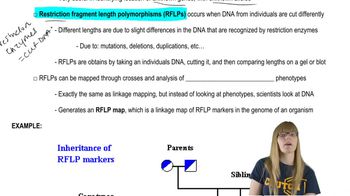
Molecular markers such as microsatellites, SNPs, or DNA sequencing are tools used to detect genetic differences at the molecular level. Genotyping individuals for these markers provides data to estimate genetic variation accurately within populations.
Recommended video:
Guided course
07:11
Mapping with Markers