Pearson+ LogoPearson+ Logo
Ch. 26 - Population and Evolutionary Genetics
Klug - Concepts of Genetics  12th Edition
Klug12th EditionConcepts of Genetics ISBN: 9780135564776Not the one you use?Change textbook
Chapter 26, Problem 2

Write a short essay describing the roles of mutation, migration, and selection in bringing about speciation.

Verified step by step guidance
1
Begin by defining speciation as the evolutionary process by which populations evolve to become distinct species, emphasizing the importance of genetic differences accumulating over time.
Explain the role of mutation as the original source of genetic variation, introducing new alleles into a population's gene pool, which can lead to differences between populations if mutations are unique or beneficial.
Describe migration (gene flow) as the movement of individuals and their genes between populations, which can either introduce new genetic material or homogenize populations, affecting the divergence necessary for speciation.
Discuss natural selection as the process by which certain alleles increase in frequency because they confer a reproductive or survival advantage, driving populations to adapt to different environments and potentially leading to reproductive isolation.
Conclude by integrating these concepts, showing how mutation provides variation, migration influences gene flow, and selection acts on variation, together facilitating the genetic divergence that underlies speciation.

Verified video answer for a similar problem:

This video solution was recommended by our tutors as helpful for the problem above.
Video duration:
4m
Was this helpful?

Key Concepts

Here are the essential concepts you must grasp in order to answer the question correctly.

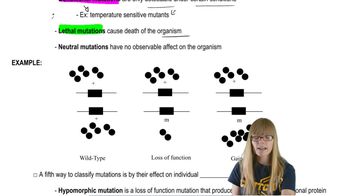
Mutation

Mutation refers to changes in the DNA sequence that introduce new genetic variations within a population. These random alterations can create novel traits that may affect an organism’s fitness, providing raw material for evolution and potentially leading to speciation over time.
Recommended video:
Guided course
10:48
Mutations and Phenotypes

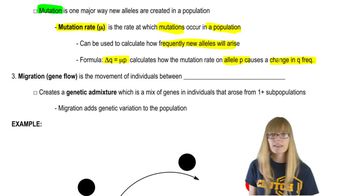
Migration (Gene Flow)

Migration, or gene flow, is the movement of individuals and their genes between populations. It can introduce new alleles to a population or homogenize genetic differences, influencing genetic diversity and either promoting or hindering speciation depending on the level of gene exchange.
Recommended video:
Guided course
03:03
New Alleles and Migration

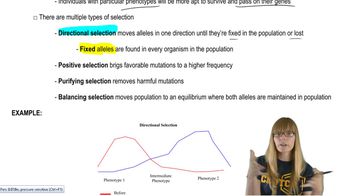
Natural Selection

Natural selection is the process where individuals with advantageous traits have higher survival and reproduction rates. This differential success shapes allele frequencies in populations, driving adaptation to environments and potentially leading to reproductive isolation and speciation.
Recommended video:
Guided course
05:54
Natural Selection
Related Practice
Textbook Question

How do we know whether the genetic structure of a population is static or dynamic?

555
views
Textbook Question

How do we know when populations have diverged to the point that they form two different species?

595
views
Textbook Question

How do we know the age of the last common ancestor shared by two species?

431
views
Textbook Question

Price et al. [(1999). J. Bacteriol. 181:2358–2362] conducted a genetic study of the toxin transport protein (PA) of Bacillus anthracis, the bacterium that causes anthrax in humans. Within the 2294-nucleotide gene in 26 strains they identified five point mutations—two missense and three synonyms—among different isolates. Necropsy samples from an anthrax outbreak in 1979 revealed a novel missense mutation and five unique nucleotide changes among ten victims. The authors concluded that these data indicate little or no horizontal transfer between different B. anthracis strains.

Which types of nucleotide changes (missense or synonyms) cause amino acid changes?

487
views
Textbook Question

Price et al. [(1999). J. Bacteriol. 181:2358–2362] conducted a genetic study of the toxin transport protein (PA) of Bacillus anthracis, the bacterium that causes anthrax in humans. Within the 2294-nucleotide gene in 26 strains they identified five point mutations—two missense and three synonyms—among different isolates. Necropsy samples from an anthrax outbreak in 1979 revealed a novel missense mutation and five unique nucleotide changes among ten victims. The authors concluded that these data indicate little or no horizontal transfer between different B. anthracis strains.

What is meant by 'horizontal transfer'?

451
views
Textbook Question

Price et al. [(1999). J. Bacteriol. 181:2358–2362] conducted a genetic study of the toxin transport protein (PA) of Bacillus anthracis, the bacterium that causes anthrax in humans. Within the 2294-nucleotide gene in 26 strains they identified five point mutations—two missense and three synonyms—among different isolates. Necropsy samples from an anthrax outbreak in 1979 revealed a novel missense mutation and five unique nucleotide changes among ten victims. The authors concluded that these data indicate little or no horizontal transfer between different B. anthracis strains.

On what basis did the authors conclude that evidence of horizontal transfer is absent from their data?

465
views