How do we know the age of the last common ancestor shared by two species?

Price et al. [(1999). J. Bacteriol. 181:2358–2362] conducted a genetic study of the toxin transport protein (PA) of Bacillus anthracis, the bacterium that causes anthrax in humans. Within the 2294-nucleotide gene in 26 strains they identified five point mutations—two missense and three synonyms—among different isolates. Necropsy samples from an anthrax outbreak in 1979 revealed a novel missense mutation and five unique nucleotide changes among ten victims. The authors concluded that these data indicate little or no horizontal transfer between different B. anthracis strains.
What is meant by 'horizontal transfer'?
Verified step by step guidance
Verified video answer for a similar problem:
Key Concepts
Horizontal Gene Transfer
Point Mutations (Missense and Synonymous)
Genetic Variation and Strain Differentiation
Write a short essay describing the roles of mutation, migration, and selection in bringing about speciation.
Price et al. [(1999). J. Bacteriol. 181:2358–2362] conducted a genetic study of the toxin transport protein (PA) of Bacillus anthracis, the bacterium that causes anthrax in humans. Within the 2294-nucleotide gene in 26 strains they identified five point mutations—two missense and three synonyms—among different isolates. Necropsy samples from an anthrax outbreak in 1979 revealed a novel missense mutation and five unique nucleotide changes among ten victims. The authors concluded that these data indicate little or no horizontal transfer between different B. anthracis strains.
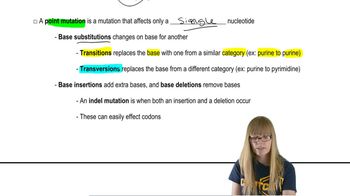
Which types of nucleotide changes (missense or synonyms) cause amino acid changes?
Price et al. [(1999). J. Bacteriol. 181:2358–2362] conducted a genetic study of the toxin transport protein (PA) of Bacillus anthracis, the bacterium that causes anthrax in humans. Within the 2294-nucleotide gene in 26 strains they identified five point mutations—two missense and three synonyms—among different isolates. Necropsy samples from an anthrax outbreak in 1979 revealed a novel missense mutation and five unique nucleotide changes among ten victims. The authors concluded that these data indicate little or no horizontal transfer between different B. anthracis strains.
On what basis did the authors conclude that evidence of horizontal transfer is absent from their data?
The genetic difference between two Drosophila species, D. heteroneura and D. silvestris, as measured by nucleotide diversity, is about 1.8 percent. The difference between chimpanzees (Pan troglodytes) and humans (H. sapiens) is about the same, yet the latter species is classified in a different genera. In your opinion, is this valid? Explain why.
The use of nucleotide sequence data to measure genetic variability is complicated by the fact that the genes of many eukaryotes are complex in organization and contain 5' and 3' flanking regions as well as introns. Researchers have compared the nucleotide sequence of two cloned alleles of the γ-globin gene from a single individual and found a variation of 1 percent. Those differences include 13 substitutions of one nucleotide for another and three short DNA segments that have been inserted in one allele or deleted in the other. None of the changes takes place in the gene's exons (coding regions). Why do you think this is so, and should it change our concept of genetic variation?
