Pearson+ LogoPearson+ Logo
Ch. 26 - Population and Evolutionary Genetics
Klug - Concepts of Genetics  12th Edition
Klug12th EditionConcepts of Genetics ISBN: 9780135564776Not the one you use?Change textbook
Chapter 26, Problem 31

Recent reconstructions of evolutionary history are often dependent on assigning divergence in terms of changes in amino acid or nucleotide sequences. For example, a comparison of cytochrome c shows 10 amino acid differences between humans and dogs, 24 differences between humans and moths, and 38 differences between humans and yeast. Such data provide no information as to the absolute times of divergence for humans, dogs, moths, and yeast. How might one calibrate the molecular clock to an absolute time clock? What problems might one encounter in such a calibration?

Verified step by step guidance
1
Understand that the molecular clock hypothesis assumes a roughly constant rate of molecular change over time, allowing us to estimate divergence times based on the number of sequence differences.
To calibrate the molecular clock to an absolute time scale, identify at least one pair of species for which the divergence time is known from independent sources, such as fossil records or geological events.
Use the known divergence time and the observed number of molecular differences between that species pair to calculate the rate of molecular change per unit time. This can be expressed as: \[\text{Rate} = \frac{\text{Number of molecular differences}}{\text{Divergence time}}\]
Apply this calculated rate to other species pairs by dividing their observed molecular differences by the rate to estimate their absolute divergence times: \[\text{Divergence time} = \frac{\text{Number of molecular differences}}{\text{Rate}}\]
Be aware of potential problems in calibration, such as variation in mutation rates among lineages, incomplete or inaccurate fossil records, horizontal gene transfer, and the assumption that molecular changes accumulate at a constant rate, which may not hold true for all genes or organisms.

Verified video answer for a similar problem:

This video solution was recommended by our tutors as helpful for the problem above.
Video duration:
1m
Was this helpful?

Key Concepts

Here are the essential concepts you must grasp in order to answer the question correctly.

Molecular Clock Hypothesis

The molecular clock hypothesis proposes that genetic mutations accumulate at a relatively constant rate over time, allowing estimation of divergence times between species by comparing molecular differences. This concept is fundamental for using sequence data to infer evolutionary timelines, assuming mutation rates are steady and comparable across lineages.
Recommended video:
Guided course
03:13
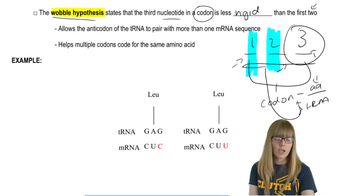
Translation:Wobble Hypothesis

Calibration of Molecular Clocks

Calibration involves linking molecular differences to absolute time by using independent data, such as fossil records or known geological events, to assign dates to specific divergence points. This step is essential to convert relative genetic distances into actual time estimates, enabling the molecular clock to reflect real evolutionary timelines.
Recommended video:
Guided course
07:11
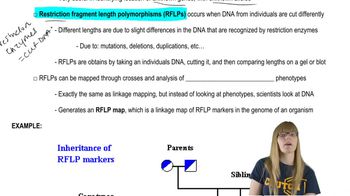
Mapping with Markers

Challenges in Molecular Clock Calibration

Calibrating molecular clocks faces challenges like variable mutation rates among lineages, incomplete or ambiguous fossil records, and assumptions about constant rates that may not hold true. These issues can lead to inaccurate time estimates and complicate the interpretation of evolutionary history.
Recommended video:
Guided course
07:11
Mapping with Markers
Related Practice
Textbook Question

The original source of new alleles, upon which selection operates, is mutation, a random event that occurs without regard to selectional value in the organism. Although many model organisms have been used to study mutational events in populations, some investigators have developed abiotic molecular models. Soll et al. (2006. Genetics 175: 267-275) examined one such model to study the relationship between both deleterious and advantageous mutations and population size in a ligase molecule composed of RNA (a ribozyme). Soll found that the smaller the population of molecules, the more likely it was that not only deleterious mutations but also advantageous mutations would disappear. Why would population size influence the survival of both types of mutations (deleterious and advantageous) in populations?

544
views
Textbook Question

A number of comparisons of nucleotide sequences among hominids and rodents indicate that inbreeding may have occurred more often in hominid than in rodent ancestry. Bakewell et al. (2007. Proc. Nat. Acad. Sci. [USA] 104: 7489-7494) suggest that an ancient population bottleneck that left approximately 10,000 humans might have caused early humans to have a greater chance of genetic disease. Why would a population bottleneck influence the frequency of genetic disease?

413
views
Textbook Question

Shown below are two homologous lengths of the alpha and beta chains of human hemoglobin. Consult a genetic code dictionary, and determine how many amino acid substitutions may have occurred as a result of a single nucleotide substitution. For any that cannot occur as a result of a single change, determine the minimal mutational distance.

Alpha: ala val ala his val asp asp met pro

Beta: gly leu ala his leu asp asn leu lys

536
views