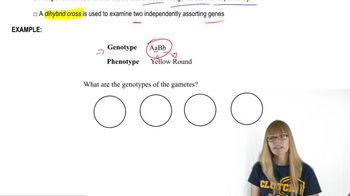
How many different types of gametes can be formed by individuals of the following genotypes:
(a) AaBb
(b) AaBB
(c) AaBbCc
(d) AaBBcc
(e) AaBbcc
(f) AaBbCcDdEe
What are the gametes in each case?

Verified step by step guidance
How many different types of gametes can be formed by individuals of the following genotypes:
(a) AaBb
(b) AaBB
(c) AaBbCc
(d) AaBBcc
(e) AaBbcc
(f) AaBbCcDdEe
What are the gametes in each case?
Mendel crossed peas having green seeds with peas having yellow seeds. The F₁ generation produced only yellow seeds. In the F₂, the progeny consisted of 6022 plants with yellow seeds and 2001 plants with green seeds. Of the F₂ yellow-seeded plants, 519 were self-fertilized with the following results: 166 bred true for yellow and 353 produced an F₃ ratio of 3/4 yellow: 1/4 green. Explain these results by diagramming the crosses.
In a study of black guinea pigs and white guinea pigs, 100 black animals were crossed with 100 white animals, and each cross was carried to an F₂ generation. In 94 of the crosses, all the F₁ offspring were black and an F₂ ratio of 3 black:1 white was obtained. In the other 6 cases, half of the F₁ animals were black and the other half were white. Why? Predict the results of crossing the black and white F₁ guinea pigs from the 6 exceptional cases.
Thalassemia is an inherited anemic disorder in humans. Affected individuals exhibit either a minor anemia or a major anemia. Assuming that only a single gene pair and two alleles are involved in the inheritance of these conditions, is thalassemia a dominant or recessive disorder?
The following are F₂ results of two of Mendel's monohybrid crosses.
For each cross, state a null hypothesis to be tested using x² analysis. Calculate the x² value and determine the p value for both. Interpret the p-values. Can the deviation in each case be attributed to chance or not? Which of the two crosses shows a greater amount of deviation?
In assessing data that fell into two phenotypic classes, a geneticist observed values of 250:150. She decided to perform a ² analysis by using the following two different null hypotheses:
(a) the data fit a 3:1 ratio, and
(b) the data fit a 1:1 ratio.
Calculate the ² values for each hypothesis. What can be concluded about each hypothesis?