Pearson+ LogoPearson+ Logo
Ch. 3 - Mendelian Genetics
Klug - Concepts of Genetics  12th Edition
Klug12th EditionConcepts of Genetics ISBN: 9780135564776Not the one you use?Change textbook
Chapter 3, Problem 15

In a study of black guinea pigs and white guinea pigs, 100 black animals were crossed with 100 white animals, and each cross was carried to an F₂ generation. In 94 of the crosses, all the F₁ offspring were black and an F₂ ratio of 3 black:1 white was obtained. In the other 6 cases, half of the F₁ animals were black and the other half were white. Why? Predict the results of crossing the black and white F₁ guinea pigs from the 6 exceptional cases.

Verified step by step guidance
1
Step 1: Understand the genetic basis of coat color in guinea pigs. Typically, black and white coat colors can be determined by alleles at a single gene locus, where black (B) is dominant over white (b). This means that black guinea pigs can be either homozygous dominant (BB) or heterozygous (Bb), while white guinea pigs are homozygous recessive (bb).
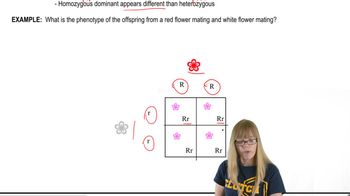
Step 2: Analyze the first group of crosses (94 cases) where all F₁ offspring were black and the F₂ generation showed a 3 black : 1 white ratio. This suggests that the black parents were homozygous dominant (BB) crossed with homozygous recessive (bb), producing all heterozygous black F₁ offspring (Bb). When these F₁ individuals are crossed (Bb × Bb), the F₂ generation exhibits the classic Mendelian 3:1 phenotypic ratio.
Step 3: Examine the exceptional 6 cases where the F₁ generation had a 1:1 ratio of black to white offspring. This indicates that the black parent in these crosses was heterozygous (Bb) rather than homozygous (BB). Crossing a heterozygous black (Bb) with a white (bb) results in F₁ offspring that are half black (Bb) and half white (bb).
Step 4: Predict the results of crossing the black and white F₁ guinea pigs from the exceptional cases. Since the black F₁ guinea pigs are heterozygous (Bb) and the white F₁ guinea pigs are homozygous recessive (bb), crossing Bb × bb will produce offspring with a 1:1 ratio of black (Bb) to white (bb) guinea pigs.
Step 5: Summarize the genetic explanation: The difference in F₁ ratios between the two groups is due to the genotype of the black parent in the original cross—homozygous dominant (BB) in the majority of cases and heterozygous (Bb) in the exceptional cases—leading to different F₁ and F₂ phenotypic ratios.

Verified video answer for a similar problem:

This video solution was recommended by our tutors as helpful for the problem above.
Video duration:
4m
Was this helpful?

Key Concepts

Here are the essential concepts you must grasp in order to answer the question correctly.

Mendelian Inheritance and Dominance

Mendelian inheritance explains how traits are passed from parents to offspring through dominant and recessive alleles. A dominant allele masks the expression of a recessive allele in heterozygotes, resulting in a 3:1 phenotypic ratio in the F₂ generation when two heterozygotes are crossed.
Recommended video:
Guided course
04:37
Variations on Dominance

Genotype and Phenotype Ratios in F₁ and F₂ Generations

The F₁ generation results from crossing two pure-breeding parents, typically showing uniform phenotype if one allele is dominant. The F₂ generation, from crossing F₁ individuals, reveals genotype and phenotype ratios (e.g., 3:1) that help identify dominant and recessive traits and heterozygosity.
Recommended video:
Guided course
08:52
F Factor and Hfr

Genetic Explanation for Deviations in Expected Ratios

When F₁ offspring show a 1:1 black to white ratio instead of all black, it suggests one parent was heterozygous or the trait is controlled by multiple alleles or loci. Predicting crosses in these cases involves understanding heterozygous crosses and possible genotypes to determine expected offspring ratios.
Recommended video:
Guided course
08:30
Genetics of Development
Related Practice
Textbook Question

In Drosophila, gray body color is dominant to ebony body color, while long wings are dominant to vestigial wings. Assuming that the P₁ individuals are homozygous, work the following crosses through the F₂ generation, and determine the genotypic and phenotypic ratios for each generation.

gray, long x gray, vestigial.

458
views
Textbook Question

How many different types of gametes can be formed by individuals of the following genotypes:

(a) AaBb

(b) AaBB

(c) AaBbCc

(d) AaBBcc

(e) AaBbcc

(f) AaBbCcDdEe

What are the gametes in each case?

3566
views
1
rank
Textbook Question

Mendel crossed peas having green seeds with peas having yellow seeds. The F₁ generation produced only yellow seeds. In the F₂, the progeny consisted of 6022 plants with yellow seeds and 2001 plants with green seeds. Of the F₂ yellow-seeded plants, 519 were self-fertilized with the following results: 166 bred true for yellow and 353 produced an F₃ ratio of 3/4 yellow: 1/4 green. Explain these results by diagramming the crosses.

551
views
Textbook Question

Mendel crossed peas having round green seeds with peas having wrinkled yellow seeds. All F₁ plants had seeds that were round and yellow. Predict the results of testcrossing these F₁ plants.

693
views
Textbook Question

Thalassemia is an inherited anemic disorder in humans. Affected individuals exhibit either a minor anemia or a major anemia. Assuming that only a single gene pair and two alleles are involved in the inheritance of these conditions, is thalassemia a dominant or recessive disorder?

1064
views
Textbook Question

The following are F₂ results of two of Mendel's monohybrid crosses.

For each cross, state a null hypothesis to be tested using x² analysis. Calculate the x² value and determine the p value for both. Interpret the p-values. Can the deviation in each case be attributed to chance or not? Which of the two crosses shows a greater amount of deviation?

649
views