
Pearson+ LogoPearson+ Logo
Ch. 4 - Extensions of Mendelian Genetics
Klug - Concepts of Genetics  12th Edition
Klug12th EditionConcepts of Genetics ISBN: 9780135564776Not the one you use?Change textbook
Chapter 4, Problem 43

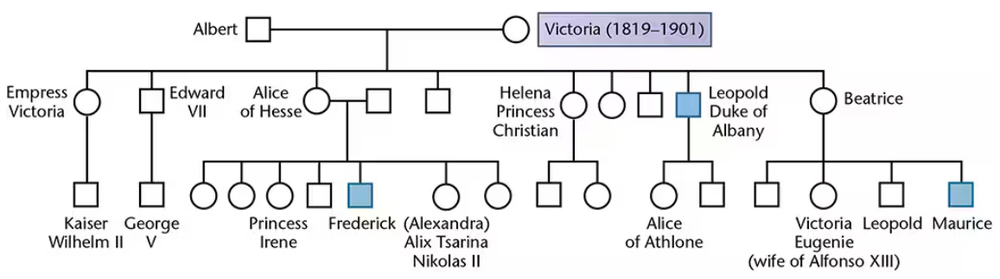
Below is a partial pedigree of hemophilia in the British Royal Family descended from Queen Victoria, who is believed to be the original 'carrier' in this pedigree.
Pedigree chart of hemophilia in the British Royal Family showing carriers and affected males descended from Queen Victoria.
Analyze the pedigree and indicate which females are also certain to be carriers. What is the probability that Princess Irene is a carrier?

Verified step by step guidance
1
Step 1: Understand the inheritance pattern of hemophilia. Hemophilia is an X-linked recessive disorder, meaning the gene causing hemophilia is located on the X chromosome. Males (XY) who inherit the affected X chromosome will express the disease, while females (XX) must inherit two affected X chromosomes to express the disease. Females with one affected X chromosome are carriers but typically do not show symptoms.
Step 2: Identify the original carrier. Queen Victoria is believed to be the original carrier, so she has one affected X chromosome (X^H) and one normal X chromosome (X). This means she can pass the affected X chromosome to her children.
Step 3: Determine which males are affected. In the pedigree, affected males are shown as filled squares. Since males inherit their X chromosome from their mother, any son of a carrier mother has a 50% chance of being affected. The presence of affected males in the descendants confirms that their mothers must be carriers.
Step 4: Identify females who are certain carriers. Any female who has an affected son must be a carrier because she must have passed the affected X chromosome to her son. Also, daughters of a carrier female have a 50% chance of being carriers. Use this logic to mark females who are certain carriers based on their affected sons or affected brothers.
Step 5: Calculate the probability that Princess Irene is a carrier. Since Princess Irene's mother is Alice of Hesse, who is a daughter of Queen Victoria, and considering whether Alice is a carrier or not, calculate the probability that Princess Irene inherited the affected X chromosome. This involves understanding the transmission probabilities from Queen Victoria to Alice, and then from Alice to Princess Irene.

Verified video answer for a similar problem:

This video solution was recommended by our tutors as helpful for the problem above.
Video duration:
5m
Was this helpful?

Key Concepts

Here are the essential concepts you must grasp in order to answer the question correctly.

X-linked Recessive Inheritance

Hemophilia is an X-linked recessive disorder, meaning the gene causing the disease is located on the X chromosome. Males (XY) with the affected X chromosome express the disease, while females (XX) are typically carriers if they have one affected X and one normal X. Understanding this pattern helps identify carriers and affected individuals in a pedigree.
Recommended video:
Guided course
09:30
X-Inactivation

Carrier Females in X-linked Disorders

Carrier females have one normal and one mutated allele on their X chromosomes and usually do not show symptoms. They can pass the affected X chromosome to their offspring, with sons having a 50% chance of being affected and daughters a 50% chance of being carriers. Identifying carriers involves tracing inheritance through affected males and their mothers.
Recommended video:
Guided course
09:30
X-Inactivation

Pedigree Analysis and Probability Calculation

Pedigree charts visually represent family relationships and inheritance patterns. By analyzing affected males and their maternal lineage, one can deduce which females must be carriers. Probability calculations for uncertain carriers, like Princess Irene, use known carrier statuses of relatives and Mendelian inheritance ratios to estimate the likelihood of carrier status.
Recommended video:
Related Practice
Textbook Question

Students taking a genetics exam were expected to answer the following question by converting data to a 'meaningful ratio' and then solving the problem. The instructor assumed that the final ratio would reflect two gene pairs, and most correct answers did. Here is the exam question: 'Flowers may be white, orange, or brown. When plants with white flowers are crossed with plants with brown flowers, all the F₁ flowers are white. For F₂ flowers, the following data were obtained:

48 white

12 orange

4 brown

Convert the F₂ data to a meaningful ratio that allows you to explain the inheritance of color. Determine the number of genes involved and the genotypes that yield each phenotype.'

A number of students failed to reduce the ratio for two gene pairs as described above and solved the problem using three gene pairs. When examined carefully, their solution was deemed a valid response by the instructor. Solve the problem using three gene pairs

953
views
Textbook Question

Students taking a genetics exam were expected to answer the following question by converting data to a 'meaningful ratio' and then solving the problem. The instructor assumed that the final ratio would reflect two gene pairs, and most correct answers did. Here is the exam question: 'Flowers may be white, orange, or brown. When plants with white flowers are crossed with plants with brown flowers, all the F₁ flowers are white. For F₂ flowers, the following data were obtained:

48 white

12 orange

4 brown

Convert the F₂ data to a meaningful ratio that allows you to explain the inheritance of color. Determine the number of genes involved and the genotypes that yield each phenotype.'

We now have a dilemma. The data are consistent with two alternative mechanisms of inheritance. Propose an experiment that executes crosses involving the original parents that would distinguish between the two solutions proposed by the students. Explain how this experiment would resolve the dilemma.

478
views
Textbook Question

In four o'clock plants, many flower colors are observed. In a cross involving two true-breeding strains, one crimson and the other white, all of the F₁ generation were rose color. In the F₂, four new phenotypes appeared along with the P₁ and F₁ parental colors. The following ratio was obtained:

1/16 crimson

4/16 rose

2/16 orange

2/16 pale yellow

1/16 yellow

4/16 white

2/16 magenta

Propose an explanation for the inheritance of these flower colors.

1336
views