Pearson+ LogoPearson+ Logo
Ch. 4 - Extensions of Mendelian Genetics
Klug - Concepts of Genetics  12th Edition
Klug12th EditionConcepts of Genetics ISBN: 9780135564776Not the one you use?Change textbook
Chapter 4, Problem 30b

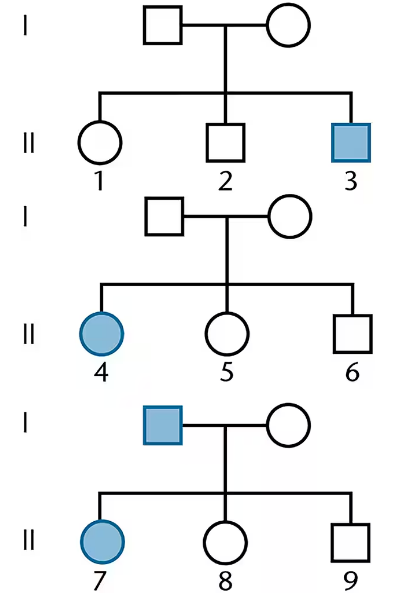
Consider the three pedigrees below, all involving a single human trait.

For each combination that you excluded, indicate the single individual in generation II (e.g., II-1, II-2) that was most instrumental in your decision to exclude it. If none were excluded, answer 'none apply.'

Verified step by step guidance
1
Step 1: Identify the trait pattern in each pedigree by noting which individuals are affected (shaded) and which are unaffected (unshaded). This helps determine if the trait is dominant or recessive.
Step 2: For each pedigree, analyze the inheritance pattern by considering the genotypes of the parents (generation I) and their offspring (generation II). Use the rules of Mendelian inheritance to predict possible genotypes.
Step 3: Check for inconsistencies in each pedigree. For example, if the trait is dominant, an affected individual must have at least one affected parent. If this is not the case, exclude that inheritance pattern and identify the individual in generation II who contradicts it.
Step 4: For recessive traits, ensure that affected individuals have parents who are either carriers or affected. If an affected individual has two unaffected parents who cannot be carriers, exclude that pattern and identify the key individual in generation II.
Step 5: Summarize your exclusions by listing the specific individual in generation II from each pedigree that led to the exclusion of a particular inheritance pattern. If no contradictions are found, state 'none apply.'

Verified video answer for a similar problem:

This video solution was recommended by our tutors as helpful for the problem above.
Video duration:
4m
Was this helpful?

Key Concepts

Here are the essential concepts you must grasp in order to answer the question correctly.

Pedigree Analysis

Pedigree analysis is a tool used to study the inheritance patterns of traits through generations in a family. It uses standardized symbols to represent individuals and their traits, helping to determine whether a trait is dominant, recessive, autosomal, or sex-linked. Understanding how to interpret these symbols and relationships is essential for analyzing genetic inheritance.
Recommended video:
Guided course
01:59
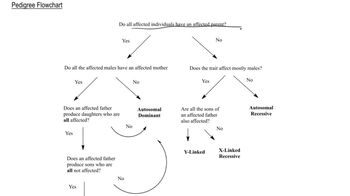
Pedigree Flowchart

Modes of Inheritance

Modes of inheritance describe how traits are passed from parents to offspring, including autosomal dominant, autosomal recessive, X-linked dominant, and X-linked recessive patterns. Each mode has distinct characteristics, such as affected individuals appearing in every generation for dominant traits or skipping generations for recessive traits, which are critical for excluding or confirming possible inheritance patterns in pedigrees.
Recommended video:
Guided course
05:13
Organelle Inheritance

Genotype-Phenotype Correlation in Pedigrees

Genotype-phenotype correlation involves linking the observed traits (phenotypes) in a pedigree to the underlying genetic makeup (genotypes). Identifying which individuals must carry or lack certain alleles based on their phenotype helps exclude incompatible inheritance patterns. This concept is key to pinpointing individuals in generation II who are instrumental in ruling out specific genetic models.
Recommended video:
Guided course
09:08
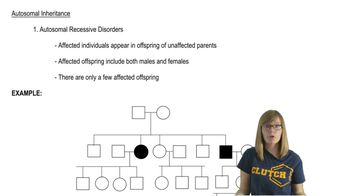
Autosomal Pedigrees
Related Practice
Textbook Question

In a cross in Drosophila involving the X-linked recessive eye mutation white and the autosomally linked recessive eye mutation sepia (resulting in a dark eye), predict the F₁ and F₂ results of crossing true-breeding parents of the following phenotypes: Note that white is epistatic to the expression of sepia.

white females x sepia males

1659
views
Textbook Question

In a cross in Drosophila involving the X-linked recessive eye mutation white and the autosomally linked recessive eye mutation sepia (resulting in a dark eye), predict the F₁ and F₂ results of crossing true-breeding parents of the following phenotypes: Note that white is epistatic to the expression of sepia.

sepia females x white males

855
views
Textbook Question

Consider the three pedigrees below, all involving a single human trait.

Which combination of conditions, if any, can be excluded? dominant and X-linked dominant and autosomal recessive and X-linked recessive and autosomal

623
views
Textbook Question

Consider the three pedigrees below, all involving a single human trait.

Given your conclusions in part (a), indicate the genotype of the following individuals: II-1, II-6, II-9 If more than one possibility applies, list all possibilities. Use the symbols A and a for the genotypes.

1023
views
Textbook Question

In goats, the development of the beard is due to a recessive gene. The following cross involving true-breeding goats was made and carried to the F₂ generation:

Offer an explanation for the inheritance and expression of this trait, diagramming the cross. Propose one or more crosses to test your hypothesis.

738
views
Textbook Question

Predict the F₁ and F₂ results of crossing a male fowl that is cock-feathered with a true-breeding hen-feathered female fowl. Recall that these traits are sex limited.

474
views