Pearson+ LogoPearson+ Logo
Ch. 4 - Extensions of Mendelian Genetics
Klug - Concepts of Genetics  12th Edition
Klug12th EditionConcepts of Genetics ISBN: 9780135564776Not the one you use?Change textbook
Chapter 4, Problem 31

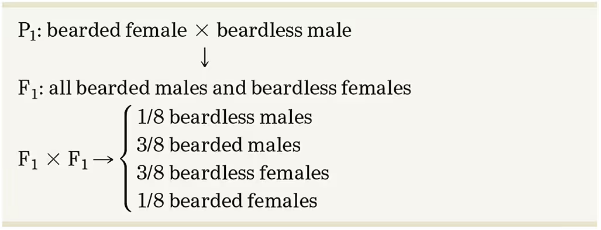
In goats, the development of the beard is due to a recessive gene. The following cross involving true-breeding goats was made and carried to the F₂ generation:
Diagram showing inheritance of beard trait in goats: P1 bearded female × beardless male, F1 all bearded males and beardless females, F2 with varied beard presence ratios.
Offer an explanation for the inheritance and expression of this trait, diagramming the cross. Propose one or more crosses to test your hypothesis.

Verified step by step guidance
1
Step 1: Define the alleles and their inheritance pattern. Since the beard trait is recessive, let 'b' represent the recessive allele for beard and 'B' the dominant allele for no beard. The bearded phenotype corresponds to the homozygous recessive genotype 'bb', and the beardless phenotype corresponds to either 'BB' or 'Bb'.
Step 2: Analyze the P₁ cross. The P₁ cross is between a bearded female (bb) and a beardless male. Since all F₁ males are bearded and all F₁ females are beardless, this suggests a sex-linked pattern of inheritance, likely X-linked, where the beard gene is on the X chromosome. Assign 'X^b' for the X chromosome carrying the beard allele and 'X^B' for the beardless allele. The male is XY, so the male parent is 'X^B Y' (beardless), and the female parent is 'X^b X^b' (bearded).
Step 3: Diagram the F₁ generation. Crossing 'X^b X^b' female with 'X^B Y' male produces F₁ females 'X^b X^B' (heterozygous, beardless) and F₁ males 'X^b Y' (hemizygous recessive, bearded). This matches the observation that all F₁ males are bearded and all F₁ females are beardless.
Step 4: Analyze the F₁ × F₁ cross. Crossing F₁ females 'X^b X^B' with F₁ males 'X^b Y' will produce the F₂ generation with the following genotypes and phenotypes: males 'X^b Y' (bearded) and 'X^B Y' (beardless), females 'X^b X^b' (bearded) and 'X^b X^B' (beardless). Calculate the expected ratios based on this cross.
Step 5: Propose test crosses to confirm the hypothesis. For example, cross a bearded male (X^b Y) with a beardless female (X^B X^B) and observe the offspring phenotypes. Alternatively, cross a beardless female heterozygote (X^b X^B) with a bearded male (X^b Y) and analyze the progeny ratios to confirm X-linked recessive inheritance.

Verified video answer for a similar problem:

This video solution was recommended by our tutors as helpful for the problem above.
Video duration:
1m
Was this helpful?

Key Concepts

Here are the essential concepts you must grasp in order to answer the question correctly.

Sex-Linked Inheritance

Sex-linked inheritance refers to genes located on sex chromosomes, typically the X chromosome, which results in different inheritance patterns between males and females. In this case, the beard trait shows different expression in males and females, suggesting it is linked to the sex chromosomes, with males and females inheriting and expressing the trait differently.
Recommended video:
Guided course
07:56
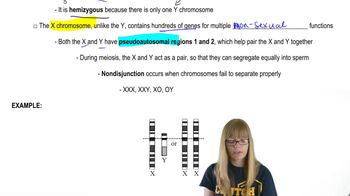
Sex-Linked Genes

Recessive Alleles and Phenotypic Expression

A recessive allele requires two copies (homozygous recessive) to express the trait in females, but in males, who have only one X chromosome, a single recessive allele can cause expression. This explains why all F1 males are bearded (hemizygous recessive) while females are beardless, indicating the beard gene is recessive and sex-linked.
Recommended video:
Guided course
02:09
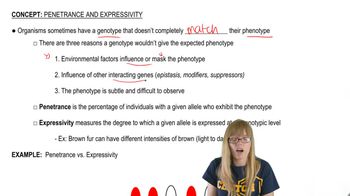
Penetrance and Expressivity

Test Cross and Genetic Cross Diagramming

A test cross involves breeding an individual with a known genotype to a homozygous recessive to determine unknown genotypes. Diagramming the cross using Punnett squares helps visualize allele segregation and predict offspring ratios, which is essential to confirm hypotheses about inheritance patterns, such as the sex-linked recessive nature of the beard trait.
Recommended video:
Guided course
26:08
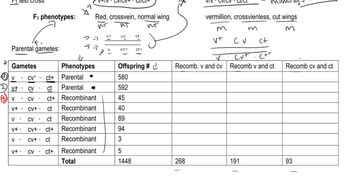
Trihybrid Cross
Related Practice
Textbook Question

Consider the three pedigrees below, all involving a single human trait.

Which combination of conditions, if any, can be excluded? dominant and X-linked dominant and autosomal recessive and X-linked recessive and autosomal

623
views
Textbook Question

Consider the three pedigrees below, all involving a single human trait.

For each combination that you excluded, indicate the single individual in generation II (e.g., II-1, II-2) that was most instrumental in your decision to exclude it. If none were excluded, answer 'none apply.'

572
views
Textbook Question

Consider the three pedigrees below, all involving a single human trait.

Given your conclusions in part (a), indicate the genotype of the following individuals: II-1, II-6, II-9 If more than one possibility applies, list all possibilities. Use the symbols A and a for the genotypes.

1023
views
Textbook Question

Predict the F₁ and F₂ results of crossing a male fowl that is cock-feathered with a true-breeding hen-feathered female fowl. Recall that these traits are sex limited.

474
views
Textbook Question

Two mothers give birth to sons at the same time at a busy urban hospital. The son of mother 1 is afflicted with hemophilia, a disease caused by an X-linked recessive allele. Neither parent has the disease. Mother 2 has a normal son, despite the fact that the father has hemophilia. Several years later, couple 1 sues the hospital, claiming that these two newborns were swapped in the nursery following their birth. As a genetic counselor, you are called to testify. What information can you provide the jury concerning the allegation?

544
views
Textbook Question

Discuss the topic of phenotypic expression and the many factors that impinge on it.

502
views