Pearson+ LogoPearson+ Logo
Ch. 4 - Extensions of Mendelian Genetics
Klug - Concepts of Genetics  12th Edition
Klug12th EditionConcepts of Genetics ISBN: 9780135564776Not the one you use?Change textbook
Chapter 4, Problem 40

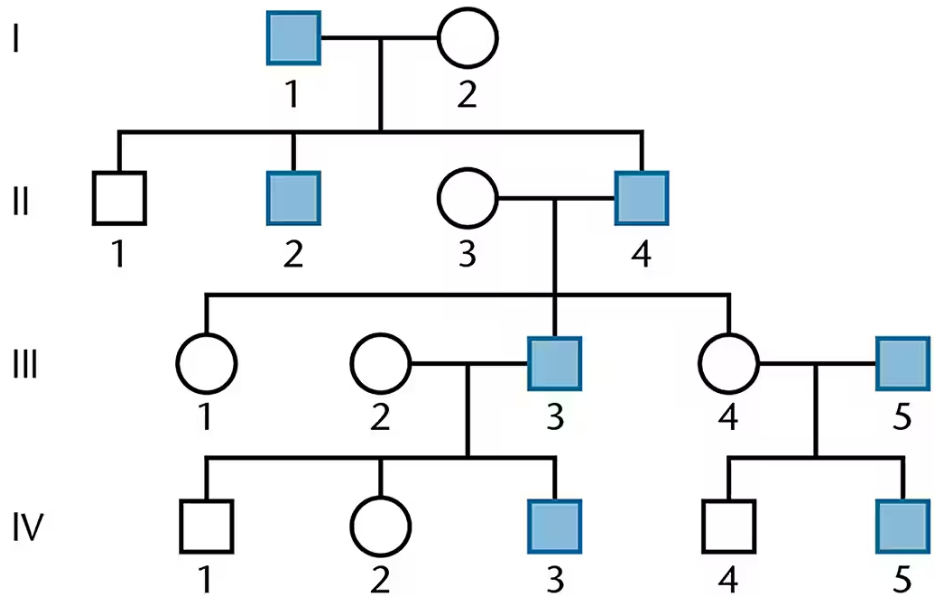
The following pedigree is characteristic of an inherited condition known as male precocious puberty, where affected males show signs of puberty by age 4. Propose a genetic explanation of this phenotype.
Pedigree chart showing affected males with early puberty across four generations, indicated by shaded squares.

Verified step by step guidance
1
Analyze the pedigree to determine the inheritance pattern. Look for clues such as whether the condition is passed from father to son, whether females are affected, and whether the condition skips generations. This will help identify if the trait is autosomal or sex-linked, and dominant or recessive.
Consider the phenotype described in the problem: male precocious puberty. Since the condition specifically affects males, this suggests the possibility of a sex-linked inheritance pattern, likely X-linked or Y-linked.
Evaluate whether the condition could be Y-linked. If the condition is Y-linked, it would only affect males and would be passed directly from father to son without skipping generations. Check the pedigree for this pattern.
If the condition does not fit a Y-linked pattern, consider the possibility of an autosomal dominant inheritance with sex-limited expression. In this case, the gene could be present in both males and females, but the phenotype is only expressed in males due to hormonal or developmental factors.
Propose a genetic explanation based on the evidence. For example, if the condition is Y-linked, it could be caused by a mutation in a gene on the Y chromosome that regulates male puberty. If it is autosomal dominant with sex-limited expression, it could involve a mutation in a gene that interacts with male-specific hormones or pathways.

Verified video answer for a similar problem:

This video solution was recommended by our tutors as helpful for the problem above.
Video duration:
2m
Was this helpful?

Key Concepts

Here are the essential concepts you must grasp in order to answer the question correctly.

Pedigree Analysis

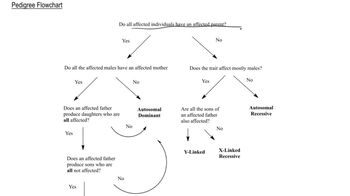
Pedigree analysis is a diagrammatic method used to trace the inheritance patterns of traits through generations in a family. It helps identify whether a trait is autosomal dominant, autosomal recessive, or X-linked by examining the affected individuals and their relatives. Understanding how traits are passed down is crucial for proposing genetic explanations for conditions like male precocious puberty.
Recommended video:
Guided course
01:59
Pedigree Flowchart

Genetic Inheritance Patterns

Genetic inheritance patterns describe how traits and conditions are transmitted from parents to offspring. In the case of male precocious puberty, it is important to consider whether the condition is linked to a specific gene mutation, and whether it follows a dominant or recessive inheritance pattern. This understanding aids in predicting the likelihood of occurrence in future generations.
Recommended video:
Guided course
27:36
Diploid Genetics

Hormonal Regulation and Genetic Mutations

Hormonal regulation involves the control of bodily functions through hormones, which can be influenced by genetic mutations. In male precocious puberty, mutations in genes that regulate hormone production or signaling pathways can lead to early onset of puberty. Identifying these mutations is essential for understanding the genetic basis of the phenotype and its implications for affected individuals.
Recommended video:
Related Practice
Textbook Question

A geneticist from an alien planet that prohibits genetic research brought with him to Earth two pure-breeding lines of frogs. One line croaks by uttering 'rib-it rib-it' and has purple eyes. The other line croaks more softly by muttering 'knee-deep knee-deep' and has green eyes. With a newfound freedom of inquiry, the geneticist mated the two types of frogs, producing F₁ frogs that were all utterers and had blue eyes. A large F₂ generation then yielded the following ratios:

27/64 blue-eyed, 'rib-it' utterer

12/64 green-eyed, 'rib-it' utterer

9/64 blue-eyed, 'knee-deep' mutterer

9/64 purple-eyed, 'rib-it' utterer

4/64 green-eyed, 'knee-deep' mutterer

3/64 purple-eyed, 'knee-deep' mutterer

After years of experiments, the geneticist isolated pure-breeding strains of all six F₂ phenotypes. Indicate the F₁ and F₂ phenotypic ratios of the following cross using these pure-breeding strains: blue-eyed, 'knee-deep' mutterer x purpled-eyed, 'rib-it' utterer.

426
views
Textbook Question

A geneticist from an alien planet that prohibits genetic research brought with him to Earth two pure-breeding lines of frogs. One line croaks by uttering 'rib-it rib-it' and has purple eyes. The other line croaks more softly by muttering 'knee-deep knee-deep' and has green eyes. With a newfound freedom of inquiry, the geneticist mated the two types of frogs, producing F₁ frogs that were all utterers and had blue eyes. A large F₂ generation then yielded the following ratios:

27/64 blue-eyed, 'rib-it' utterer

12/64 green-eyed, 'rib-it' utterer

9/64 blue-eyed, 'knee-deep' mutterer

9/64 purple-eyed, 'rib-it' utterer

4/64 green-eyed, 'knee-deep' mutterer

3/64 purple-eyed, 'knee-deep' mutterer

One set of crosses with his true-breeding lines initially caused the geneticist some confusion. When he crossed true-breeding purple-eyed, 'knee-deep' mutterers with true-breeding green-eyed, 'knee-deep' mutterers, he often got different results. In some matings, all offspring were blue-eyed, 'knee-deep' mutterers, but in other matings all offspring were purple-eyed, 'knee-deep' mutterers. In still a third mating, 1/2 blue-eyed, 'knee-deep' mutterers and 1/2 purple-eyed, 'knee-deep' mutterers were observed. Explain why the results differed.

516
views
Textbook Question

A geneticist from an alien planet that prohibits genetic research brought with him to Earth two pure-breeding lines of frogs. One line croaks by uttering 'rib-it rib-it' and has purple eyes. The other line croaks more softly by muttering 'knee-deep knee-deep' and has green eyes. With a newfound freedom of inquiry, the geneticist mated the two types of frogs, producing F₁ frogs that were all utterers and had blue eyes. A large F₂ generation then yielded the following ratios:

27/64 blue-eyed, 'rib-it' utterer

12/64 green-eyed, 'rib-it' utterer

9/64 blue-eyed, 'knee-deep' mutterer

9/64 purple-eyed, 'rib-it' utterer

4/64 green-eyed, 'knee-deep' mutterer

3/64 purple-eyed, 'knee-deep' mutterer

In another experiment, the geneticist crossed two purple-eyed, 'rib-it' utterers together with the results shown here:

9/16 purple-eyed, 'rib-it' utterer

3/16 purple-eyed, 'knee-deep' mutterer

3/16 green-eyed, 'rib-it' utterer

1/16 green-eyed, 'knee-deep' mutterer

What were the genotypes of the two parents?

472
views
Textbook Question

Students taking a genetics exam were expected to answer the following question by converting data to a 'meaningful ratio' and then solving the problem. The instructor assumed that the final ratio would reflect two gene pairs, and most correct answers did. Here is the exam question:

'Flowers may be white, orange, or brown. When plants with white flowers are crossed with plants with brown flowers, all the F₁ flowers are white. For F₂ flowers, the following data were obtained:

48 white

12 orange

4 brown

Convert the F₂ data to a meaningful ratio that allows you to explain the inheritance of color. Determine the number of genes involved and the genotypes that yield each phenotype.'

Solve the problem for two gene pairs. What is the final F₂ ratio?

497
views
Textbook Question

Students taking a genetics exam were expected to answer the following question by converting data to a 'meaningful ratio' and then solving the problem. The instructor assumed that the final ratio would reflect two gene pairs, and most correct answers did. Here is the exam question: 'Flowers may be white, orange, or brown. When plants with white flowers are crossed with plants with brown flowers, all the F₁ flowers are white. For F₂ flowers, the following data were obtained:

48 white

12 orange

4 brown

Convert the F₂ data to a meaningful ratio that allows you to explain the inheritance of color. Determine the number of genes involved and the genotypes that yield each phenotype.'

A number of students failed to reduce the ratio for two gene pairs as described above and solved the problem using three gene pairs. When examined carefully, their solution was deemed a valid response by the instructor. Solve the problem using three gene pairs

953
views
Textbook Question

Students taking a genetics exam were expected to answer the following question by converting data to a 'meaningful ratio' and then solving the problem. The instructor assumed that the final ratio would reflect two gene pairs, and most correct answers did. Here is the exam question: 'Flowers may be white, orange, or brown. When plants with white flowers are crossed with plants with brown flowers, all the F₁ flowers are white. For F₂ flowers, the following data were obtained:

48 white

12 orange

4 brown

Convert the F₂ data to a meaningful ratio that allows you to explain the inheritance of color. Determine the number of genes involved and the genotypes that yield each phenotype.'

We now have a dilemma. The data are consistent with two alternative mechanisms of inheritance. Propose an experiment that executes crosses involving the original parents that would distinguish between the two solutions proposed by the students. Explain how this experiment would resolve the dilemma.

478
views