Pearson+ LogoPearson+ Logo
Ch. 4 - Extensions of Mendelian Genetics
Klug - Concepts of Genetics  12th Edition
Klug12th EditionConcepts of Genetics ISBN: 9780135564776Not the one you use?Change textbook
Chapter 4, Problem 39f

A geneticist from an alien planet that prohibits genetic research brought with him to Earth two pure-breeding lines of frogs. One line croaks by uttering 'rib-it rib-it' and has purple eyes. The other line croaks more softly by muttering 'knee-deep knee-deep' and has green eyes. With a newfound freedom of inquiry, the geneticist mated the two types of frogs, producing F₁ frogs that were all utterers and had blue eyes. A large F₂ generation then yielded the following ratios:
27/64 blue-eyed, 'rib-it' utterer
12/64 green-eyed, 'rib-it' utterer
9/64 blue-eyed, 'knee-deep' mutterer
9/64 purple-eyed, 'rib-it' utterer
4/64 green-eyed, 'knee-deep' mutterer
3/64 purple-eyed, 'knee-deep' mutterer
One set of crosses with his true-breeding lines initially caused the geneticist some confusion. When he crossed true-breeding purple-eyed, 'knee-deep' mutterers with true-breeding green-eyed, 'knee-deep' mutterers, he often got different results. In some matings, all offspring were blue-eyed, 'knee-deep' mutterers, but in other matings all offspring were purple-eyed, 'knee-deep' mutterers. In still a third mating, 1/2 blue-eyed, 'knee-deep' mutterers and 1/2 purple-eyed, 'knee-deep' mutterers were observed. Explain why the results differed.

Verified step by step guidance
1
Step 1: Begin by analyzing the inheritance patterns of the traits involved. The traits include eye color (purple, green, blue) and vocalization type ('rib-it' utterer vs. 'knee-deep' mutterer). The F₁ generation suggests that both traits are controlled by separate genes, and the F₁ phenotype indicates dominance relationships for each gene.
Step 2: Examine the F₂ generation ratios. The ratios (27/64, 12/64, etc.) suggest a dihybrid cross involving two genes, each with two alleles. Use the phenotypic ratios to infer the genotypes and dominance relationships. For example, blue eyes may result from a combination of alleles from both genes, while purple and green eyes may be determined by specific alleles of one gene.
Step 3: Investigate the results of the crosses between true-breeding purple-eyed, 'knee-deep' mutterers and true-breeding green-eyed, 'knee-deep' mutterers. The differing outcomes suggest that one of the genes involved in eye color is subject to epistasis, where one gene's expression masks or modifies the effect of another gene.
Step 4: Consider the genetic mechanisms behind the differing results. In some matings, all offspring are blue-eyed, 'knee-deep' mutterers, indicating that the blue-eye phenotype is dominant and results from a specific combination of alleles. In other matings, all offspring are purple-eyed, 'knee-deep' mutterers, suggesting that the purple-eye phenotype is dominant under certain genetic conditions. The third mating, with a 1:1 ratio, indicates heterozygosity for one of the genes controlling eye color.
Step 5: Conclude that the differing results are due to variations in the parental genotypes for the eye color gene(s). The geneticist's true-breeding lines may carry different combinations of alleles that interact in unique ways, leading to epistasis or dominance effects that produce the observed phenotypic variations in the offspring.

Verified video answer for a similar problem:

This video solution was recommended by our tutors as helpful for the problem above.
Video duration:
2m
Was this helpful?

Key Concepts

Here are the essential concepts you must grasp in order to answer the question correctly.

Mendelian Genetics

Mendelian genetics is the study of how traits are inherited through generations based on the principles established by Gregor Mendel. It involves understanding dominant and recessive alleles, where dominant traits mask the expression of recessive ones. In this scenario, the traits of eye color and croaking sound are likely governed by Mendelian inheritance, leading to the observed phenotypic ratios in the F₂ generation.
Recommended video:
Guided course
03:45
Descriptive Genetics

Genotype and Phenotype

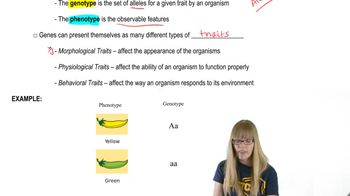
The genotype refers to the genetic makeup of an organism, while the phenotype is the observable expression of that genotype, influenced by environmental factors. In the case of the frogs, the different combinations of alleles (genotypes) result in various phenotypes, such as eye color and croaking sounds. Understanding the relationship between genotype and phenotype is crucial for interpreting the results of the geneticist's crosses.
Recommended video:
Guided course
07:52
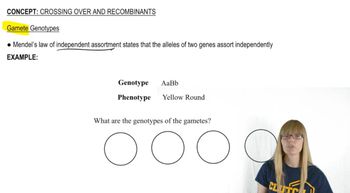
Gamete Genotypes

Incomplete Dominance and Codominance

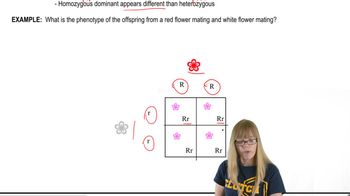
Incomplete dominance and codominance are genetic phenomena where neither allele is completely dominant over the other. In incomplete dominance, the heterozygous phenotype is a blend of the two homozygous phenotypes, while in codominance, both alleles are fully expressed. The varying results from the geneticist's crosses suggest that the traits for eye color and croaking may not follow simple dominance patterns, leading to different offspring phenotypes in different matings.
Recommended video:
Guided course
04:37
Variations on Dominance
Related Practice
Textbook Question

A geneticist from an alien planet that prohibits genetic research brought with him to Earth two pure-breeding lines of frogs. One line croaks by uttering 'rib-it rib-it' and has purple eyes. The other line croaks more softly by muttering 'knee-deep knee-deep' and has green eyes. With a newfound freedom of inquiry, the geneticist mated the two types of frogs, producing F₁ frogs that were all utterers and had blue eyes. A large F₂ generation then yielded the following ratios:

27/64 blue-eyed, 'rib-it' utterer

12/64 green-eyed, 'rib-it' utterer

9/64 blue-eyed, 'knee-deep' mutterer

9/64 purple-eyed, 'rib-it' utterer

4/64 green-eyed, 'knee-deep' mutterer

3/64 purple-eyed, 'knee-deep' mutterer

Assign gene symbols for all phenotypes and indicate the genotypes of the P₁ and F₁ frogs.

508
views
Textbook Question

A geneticist from an alien planet that prohibits genetic research brought with him to Earth two pure-breeding lines of frogs. One line croaks by uttering 'rib-it rib-it' and has purple eyes. The other line croaks more softly by muttering 'knee-deep knee-deep' and has green eyes. With a newfound freedom of inquiry, the geneticist mated the two types of frogs, producing F₁ frogs that were all utterers and had blue eyes. A large F₂ generation then yielded the following ratios:

27/64 blue-eyed, 'rib-it' utterer

12/64 green-eyed, 'rib-it' utterer

9/64 blue-eyed, 'knee-deep' mutterer

9/64 purple-eyed, 'rib-it' utterer

4/64 green-eyed, 'knee-deep' mutterer

3/64 purple-eyed, 'knee-deep' mutterer

Indicate the genotypes of the six F₂ phenotypes.

460
views
Textbook Question

A geneticist from an alien planet that prohibits genetic research brought with him to Earth two pure-breeding lines of frogs. One line croaks by uttering 'rib-it rib-it' and has purple eyes. The other line croaks more softly by muttering 'knee-deep knee-deep' and has green eyes. With a newfound freedom of inquiry, the geneticist mated the two types of frogs, producing F₁ frogs that were all utterers and had blue eyes. A large F₂ generation then yielded the following ratios:

27/64 blue-eyed, 'rib-it' utterer

12/64 green-eyed, 'rib-it' utterer

9/64 blue-eyed, 'knee-deep' mutterer

9/64 purple-eyed, 'rib-it' utterer

4/64 green-eyed, 'knee-deep' mutterer

3/64 purple-eyed, 'knee-deep' mutterer

After years of experiments, the geneticist isolated pure-breeding strains of all six F₂ phenotypes. Indicate the F₁ and F₂ phenotypic ratios of the following cross using these pure-breeding strains: blue-eyed, 'knee-deep' mutterer x purpled-eyed, 'rib-it' utterer.

426
views
Textbook Question

A geneticist from an alien planet that prohibits genetic research brought with him to Earth two pure-breeding lines of frogs. One line croaks by uttering 'rib-it rib-it' and has purple eyes. The other line croaks more softly by muttering 'knee-deep knee-deep' and has green eyes. With a newfound freedom of inquiry, the geneticist mated the two types of frogs, producing F₁ frogs that were all utterers and had blue eyes. A large F₂ generation then yielded the following ratios:

27/64 blue-eyed, 'rib-it' utterer

12/64 green-eyed, 'rib-it' utterer

9/64 blue-eyed, 'knee-deep' mutterer

9/64 purple-eyed, 'rib-it' utterer

4/64 green-eyed, 'knee-deep' mutterer

3/64 purple-eyed, 'knee-deep' mutterer

In another experiment, the geneticist crossed two purple-eyed, 'rib-it' utterers together with the results shown here:

9/16 purple-eyed, 'rib-it' utterer

3/16 purple-eyed, 'knee-deep' mutterer

3/16 green-eyed, 'rib-it' utterer

1/16 green-eyed, 'knee-deep' mutterer

What were the genotypes of the two parents?

472
views
Textbook Question

The following pedigree is characteristic of an inherited condition known as male precocious puberty, where affected males show signs of puberty by age 4. Propose a genetic explanation of this phenotype.

619
views
Textbook Question

Students taking a genetics exam were expected to answer the following question by converting data to a 'meaningful ratio' and then solving the problem. The instructor assumed that the final ratio would reflect two gene pairs, and most correct answers did. Here is the exam question:

'Flowers may be white, orange, or brown. When plants with white flowers are crossed with plants with brown flowers, all the F₁ flowers are white. For F₂ flowers, the following data were obtained:

48 white

12 orange

4 brown

Convert the F₂ data to a meaningful ratio that allows you to explain the inheritance of color. Determine the number of genes involved and the genotypes that yield each phenotype.'

Solve the problem for two gene pairs. What is the final F₂ ratio?

497
views