Pearson+ LogoPearson+ Logo
Ch. 8 - Chromosome Mutations: Variation in Number and Arrangement
Klug - Concepts of Genetics  12th Edition
Klug12th EditionConcepts of Genetics ISBN: 9780135564776Not the one you use?Change textbook
Chapter 8, Problem 24b

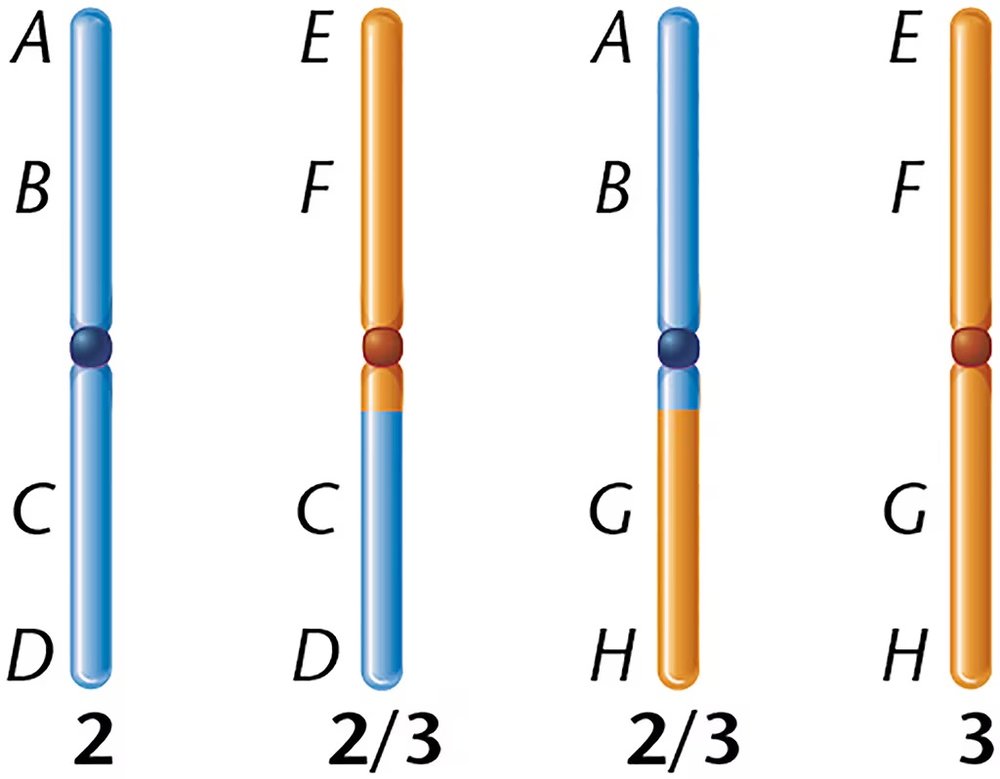
A woman who sought genetic counseling is found to be heterozygous for a chromosomal rearrangement between the second and third chromosomes. Her chromosomes, compared to those in a normal karyotype, are diagrammed to the right.
Diagram showing normal and rearranged chromosomes labeled with segments A-H, illustrating pairing during meiosis with heterozygous rearrangement.
Using a drawing, demonstrate how these chromosomes would pair during meiosis. Be sure to label the different segments of the chromosomes.

Verified step by step guidance
1
Step 1: Identify the normal chromosomes and the rearranged chromosomes. The normal chromosome 2 has segments labeled A, B, C, D, and the normal chromosome 3 has segments E, F, G, H. The rearranged chromosomes show a translocation between chromosomes 2 and 3, where segments C and D from chromosome 2 are swapped with segments G and H from chromosome 3.
Step 2: Understand that during meiosis, homologous chromosomes pair by aligning their similar segments. Because of the translocation, the chromosomes cannot pair linearly as usual. Instead, they form a cross-shaped structure (a quadrivalent) to allow homologous regions to align properly.
Step 3: Draw the pairing structure by placing the normal chromosome 2 and the rearranged chromosome 2/3 opposite each other, and the normal chromosome 3 and the rearranged chromosome 2/3 opposite each other, forming a cross. Label each segment (A, B, C, D, E, F, G, H) on the respective chromosomes to show which segments align with each other.
Step 4: In the cross structure, ensure that segments A and B on the normal chromosome 2 align with A and B on the rearranged chromosome, segments C and D on the normal chromosome 2 align with C and D on the rearranged chromosome 2/3, and similarly for segments E, F, G, H on chromosome 3 and the rearranged chromosome 2/3.
Step 5: This cross-shaped pairing allows for proper synapsis during meiosis despite the rearrangement, and it is important to label the centromeres and segments clearly to visualize how the chromosomes align and segregate.

Verified video answer for a similar problem:

This video solution was recommended by our tutors as helpful for the problem above.
Video duration:
1m
Was this helpful?

Key Concepts

Here are the essential concepts you must grasp in order to answer the question correctly.

Chromosomal Rearrangements

Chromosomal rearrangements involve structural changes in chromosomes, such as translocations, inversions, deletions, or duplications. In this case, a rearrangement between chromosomes 2 and 3 results in a hybrid chromosome containing segments from both. Understanding these rearrangements is crucial for predicting how chromosomes pair and segregate during meiosis.
Recommended video:
Guided course
04:38
Rearrangement Overview

Meiotic Pairing of Homologous Chromosomes

During meiosis, homologous chromosomes pair to ensure proper segregation. When a heterozygous rearrangement is present, chromosomes form complex pairing structures (e.g., loops or cross-shaped configurations) to align homologous segments. This pairing is essential to maintain genetic balance and avoid gametes with duplications or deletions.
Recommended video:
Guided course
07:10
Chromosome Structure

Karyotype and Chromosome Segment Labeling

Karyotyping visually represents chromosomes and their segments, labeled here as A-H, to identify structural differences. Labeling helps track which chromosome parts correspond between normal and rearranged chromosomes, facilitating the understanding of pairing behavior and genetic consequences during meiosis.
Recommended video:
Guided course
10:35
Human Sex Chromosomes
Related Practice
Textbook Question

A couple planning their family are aware that through the past three generations on the husband's side a substantial number of stillbirths have occurred and several malformed babies were born who died early in childhood. The wife has studied genetics and urges her husband to visit a genetic counseling clinic, where a complete karyotype-banding analysis is performed. Although the tests show that he has a normal complement of 46 chromosomes, banding analysis reveals that one member of the chromosome 1 pair (in group A) contains an inversion covering 70 percent of its length. The homolog of chromosome 1 and all other chromosomes show the normal banding sequence.

Would you advise the woman that she will have to bring each pregnancy to term to determine whether the fetus is normal? If not, what else can you suggest?

449
views
Textbook Question

In a cross in Drosophila, a female heterozygous for the autosomally linked genes a, b, c, d, and e (abcde/ +++++) was testcrossed with a male homozygous for all recessive alleles. Even though the distance between each of the loci was at least 3 map units, only four phenotypes were recovered, yielding the following data:

Why are many expected crossover phenotypes missing? Can any of these loci be mapped from the data given here? If so, determine map distances.

876
views
Textbook Question

A woman who sought genetic counseling is found to be heterozygous for a chromosomal rearrangement between the second and third chromosomes. Her chromosomes, compared to those in a normal karyotype, are diagrammed to the right.

What kind of chromosomal aberration is shown?

632
views
Textbook Question

A woman who sought genetic counseling is found to be heterozygous for a chromosomal rearrangement between the second and third chromosomes. Her chromosomes, compared to those in a normal karyotype, are diagrammed to the right.

This woman is phenotypically normal. Does this surprise you? Why or why not? Under what circumstances might you expect a phenotypic effect of such a rearrangement?

627
views
Textbook Question

The woman in Problem 24 has had two miscarriages. She has come to you, an established genetic counselor, with these questions:

Is there a genetic explanation of her frequent miscarriages?

Should she abandon her attempts to have a child of her own?

If not, what is the chance that she could have a normal child? Provide an informed response to her concerns.

614
views
Textbook Question

In a recent cytogenetic study on 1021 cases of Down syndrome, 46 were the result of translocations, the most frequent of which was symbolized as t(14;21). What does this symbol represent, and how many chromosomes would you expect to be present in t(14;21) Down syndrome individuals?

667
views