Pearson+ LogoPearson+ Logo
Ch. 9 - Extranuclear Inheritance
Klug - Concepts of Genetics  12th Edition
Klug12th EditionConcepts of Genetics ISBN: 9780135564776Not the one you use?Change textbook
Chapter 9, Problem 22

Because offspring inherit the mitochondrial genome only from the mother, evolutionarily the mitochondrial genome in males encounters a dead end. The mitochondrial genome in males has no significant impact on the genetic information of future generations. Scientists have proposed that this can result in an accumulation of mutations that have a negative impact on genetic fitness of males but not females. Experiments with Drosophila support this possibility. What experimental data or evidence would you want to evaluate or consider to determine if an accumulation of mtDNA mutations negatively impacts the fitness of males of any species?

Verified step by step guidance
1
Understand the context: Mitochondrial DNA (mtDNA) is maternally inherited, meaning males do not pass their mtDNA to offspring. This creates an evolutionary 'dead end' for male mtDNA, potentially allowing mutations to accumulate that negatively affect males but not females.
Identify the key question: The problem asks for experimental data or evidence to evaluate whether mtDNA mutations negatively impact male fitness in any species.
Step 1: Compare mtDNA mutation rates between males and females. Collect data on the frequency and types of mtDNA mutations in both sexes to determine if males exhibit a higher accumulation of mutations.
Step 2: Assess male fitness traits. Measure traits such as reproductive success, lifespan, or physical performance in males with varying levels of mtDNA mutations to identify any negative correlations.
Step 3: Perform cross-generational studies. Use controlled breeding experiments to track the inheritance and effects of mtDNA mutations across generations, focusing on male offspring to observe any fitness impacts.
Step 4: Conduct species comparisons. Study multiple species to determine if the pattern of male-specific mtDNA mutation accumulation and its impact on fitness is consistent across different organisms.
Step 5: Investigate compensatory mechanisms. Examine whether females have evolved mechanisms to mitigate the effects of mtDNA mutations, such as selective replication of less-mutated mitochondria, and whether these mechanisms are absent or less effective in males.

Verified video answer for a similar problem:

This video solution was recommended by our tutors as helpful for the problem above.
Video duration:
1m
Was this helpful?

Key Concepts

Here are the essential concepts you must grasp in order to answer the question correctly.

Mitochondrial Inheritance

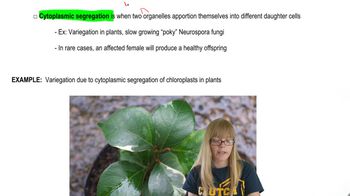
Mitochondrial inheritance refers to the transmission of mitochondrial DNA (mtDNA) exclusively from the mother to her offspring. This unique inheritance pattern means that males do not pass on their mtDNA, leading to a situation where any mutations in their mitochondrial genome do not affect future generations. Understanding this concept is crucial for analyzing how mtDNA mutations can accumulate in males without being purged through natural selection.
Recommended video:
Guided course
05:13
Organelle Inheritance

Mutation Accumulation

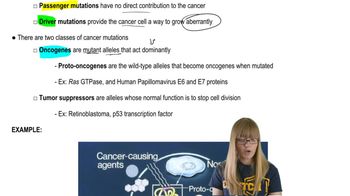
Mutation accumulation is the process by which genetic mutations build up in a population over time, particularly in lineages where those mutations are not subject to strong selective pressures. In the context of mtDNA in males, the lack of transmission to offspring may allow deleterious mutations to persist, potentially leading to reduced fitness. Evaluating the effects of these mutations on male fitness is essential for understanding their evolutionary implications.
Recommended video:
Guided course
04:46
Cancer Mutations

Fitness Assessment in Drosophila

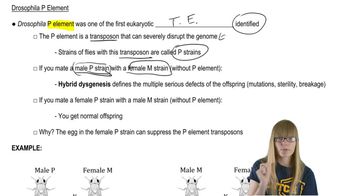
Fitness assessment in Drosophila involves measuring various traits that contribute to reproductive success, such as survival rates, mating success, and offspring viability. Experiments with Drosophila can provide insights into how mtDNA mutations affect male fitness, as these organisms are widely used in genetic studies due to their short life cycles and well-characterized genetics. Analyzing data from such experiments can help determine the impact of mtDNA mutations on male fitness across different species.
Recommended video:
Guided course
03:08
Drosophila P Element