Pearson+ LogoPearson+ Logo
Ch. 9 - Extranuclear Inheritance
Klug - Concepts of Genetics  12th Edition
Klug12th EditionConcepts of Genetics ISBN: 9780135564776Not the one you use?Change textbook
Chapter 9, Problem 1a

How was it established that particular phenotypes are inherited as a result of genetic information present in the chloroplast rather than in the nucleus?

Verified step by step guidance
1
Understand the concept of extranuclear inheritance: Extranuclear inheritance refers to the transmission of genetic information through organelles like mitochondria and chloroplasts, rather than through nuclear DNA. This is often referred to as cytoplasmic inheritance.
Review experimental evidence: Scientists have used reciprocal crosses to determine whether a trait is inherited through the nucleus or the cytoplasm. In reciprocal crosses, the phenotypes of the offspring are compared when the trait is inherited from the mother versus the father.
Analyze maternal inheritance patterns: If a trait is consistently inherited from the mother regardless of the father's phenotype, it suggests that the genetic information responsible for the trait is located in the cytoplasm (e.g., in the chloroplasts or mitochondria), as these organelles are typically inherited maternally.
Consider experiments involving organelle DNA: Researchers have isolated and sequenced DNA from chloroplasts to identify genes responsible for specific traits. By comparing these genes to nuclear DNA, they confirmed that certain phenotypes are linked to chloroplast DNA.
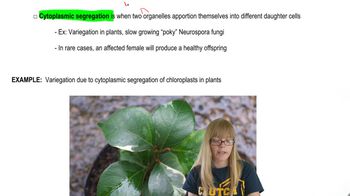
Examine mutant studies: Mutant strains with defects in chloroplast function have been used to demonstrate that specific phenotypes (e.g., variegated leaf patterns) are associated with chloroplast DNA mutations, further supporting the role of chloroplasts in extranuclear inheritance.

Verified video answer for a similar problem:

This video solution was recommended by our tutors as helpful for the problem above.
Video duration:
1m
Was this helpful?

Key Concepts

Here are the essential concepts you must grasp in order to answer the question correctly.

Extranuclear Inheritance

Extranuclear inheritance refers to the transmission of genetic material that occurs outside the nucleus, primarily through organelles like mitochondria and chloroplasts. This type of inheritance is distinct from Mendelian inheritance, which involves nuclear DNA. In plants, traits such as leaf color can be influenced by the genetic information in chloroplasts, which is inherited maternally, meaning offspring receive their chloroplast DNA exclusively from the mother.
Recommended video:
Guided course
05:13
Organelle Inheritance

Maternal Effect

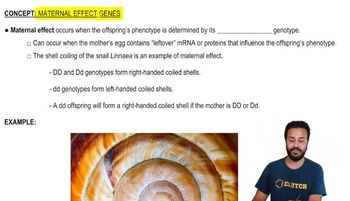
The maternal effect is a phenomenon where the genotype of the mother directly influences the phenotype of her offspring, regardless of the offspring's own genotype. This occurs because the mother provides cytoplasmic factors, such as RNA and proteins, during oogenesis. In the context of chloroplast inheritance, the maternal genotype can determine traits in the offspring, as the chloroplasts are inherited from the mother, affecting characteristics like pigmentation or growth patterns.
Recommended video:
Guided course
03:38
Maternal Effect

Experimental Evidence for Chloroplast Inheritance

Establishing that certain phenotypes are inherited through chloroplasts rather than nuclear DNA often involves experimental crosses and phenotypic analysis. Researchers may perform reciprocal crosses, where they switch the maternal and paternal contributions, to observe differences in offspring traits. If the phenotype is consistent with the maternal genotype regardless of the paternal contribution, it supports the conclusion that the trait is linked to chloroplast inheritance.
Recommended video:
Guided course
05:13
Organelle Inheritance
Related Practice
Textbook Question

In the discussion, we focused on extranuclear inheritance and how traits can be determined by genetic information contained in mitochondria and chloroplasts, and we discussed how expression of maternal genotypes can affect the phenotype of an organism. At the same time, we found many opportunities to consider the methods and reasoning by which much of this information was acquired. From the explanations given in the chapter, what answers would you propose to the following fundamental questions?

How did the discovery of three categories of petite mutations in yeast lead researchers to postulate extranuclear inheritance of colony size?

572
views
Textbook Question

In the discussion, we focused on extranuclear inheritance and how traits can be determined by genetic information contained in mitochondria and chloroplasts, and we discussed how expression of maternal genotypes can affect the phenotype of an organism. At the same time, we found many opportunities to consider the methods and reasoning by which much of this information was acquired. From the explanations given in the chapter, what answers would you propose to the following fundamental questions?

What observations support the endosymbiotic theory?

461
views
Textbook Question

In the discussion, we focused on extranuclear inheritance and how traits can be determined by genetic information contained in mitochondria and chloroplasts, and we discussed how expression of maternal genotypes can affect the phenotype of an organism. At the same time, we found many opportunities to consider the methods and reasoning by which much of this information was acquired. From the explanations given in the chapter, what answers would you propose to the following fundamental questions?

What key observations in crosses between dextrally and sinistrally coiled snails support the explanation that this phenotype is the result of maternal-effect inheritance?

440
views