Pearson+ LogoPearson+ Logo
Ch. 9 - Extranuclear Inheritance
Klug - Concepts of Genetics  12th Edition
Klug12th EditionConcepts of Genetics ISBN: 9780135564776Not the one you use?Change textbook
Chapter 9, Problem 2

Write a short essay that distinguishes between organelle heredity and maternal effect.

Verified step by step guidance
1
Define organelle heredity: Explain that organelle heredity refers to the inheritance of genetic material found in organelles such as mitochondria and chloroplasts, which are passed down to offspring independently of nuclear DNA. Highlight that this type of inheritance is typically uniparental (often maternal) because organelles are usually inherited from the egg cell.
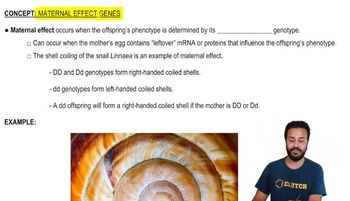
Define maternal effect: Describe the maternal effect as a phenomenon where the phenotype of an organism is determined by the genotype of its mother, rather than its own genotype. This occurs because the mother provides mRNA, proteins, or other factors in the egg cytoplasm that influence early development.
Contrast the genetic basis: Emphasize that organelle heredity involves the transmission of actual genetic material (DNA) located in organelles, while the maternal effect does not involve the inheritance of DNA but rather the influence of maternal gene products on the offspring's phenotype.
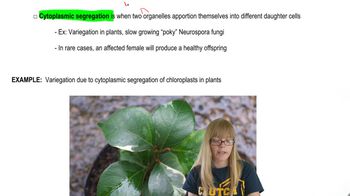
Discuss examples: Provide examples for each concept. For organelle heredity, mention mitochondrial diseases in humans or variegated leaf patterns in plants due to chloroplast inheritance. For maternal effect, mention the shell coiling direction in snails, which is determined by the mother's genotype.
Summarize the distinction: Conclude by summarizing that organelle heredity is about the inheritance of organelle DNA, while the maternal effect is about the influence of maternal gene products on the offspring's phenotype, with no direct inheritance of DNA involved.

Verified video answer for a similar problem:

This video solution was recommended by our tutors as helpful for the problem above.
Video duration:
1m
Was this helpful?

Key Concepts

Here are the essential concepts you must grasp in order to answer the question correctly.

Organelle Heredity

Organelle heredity refers to the transmission of genetic information through organelles, primarily mitochondria and chloroplasts, which contain their own DNA. This type of inheritance is maternal, as these organelles are typically passed from the mother to offspring through the cytoplasm of the egg cell. Consequently, traits associated with organelle DNA can exhibit unique patterns of inheritance that differ from Mendelian genetics.
Recommended video:
Guided course
05:13
Organelle Inheritance

Maternal Effect

Maternal effect is a phenomenon where the phenotype of the offspring is determined not only by its own genotype but also by the genotype of the mother. This occurs because the mother provides specific substances, such as proteins and RNAs, to the egg that influence early development. As a result, even if the offspring has a different genotype, its initial traits can be significantly influenced by the maternal genotype.
Recommended video:
Guided course
03:38
Maternal Effect

Differences in Inheritance Patterns

The key difference between organelle heredity and maternal effect lies in the source of genetic information. Organelle heredity involves the direct inheritance of organelle DNA, while maternal effect involves the influence of maternal contributions to the egg that affect the offspring's phenotype. Understanding these distinctions is crucial for studying inheritance patterns and the roles of maternal contributions in development.
Recommended video:
Guided course
05:13
Organelle Inheritance
Related Practice
Textbook Question

In the discussion, we focused on extranuclear inheritance and how traits can be determined by genetic information contained in mitochondria and chloroplasts, and we discussed how expression of maternal genotypes can affect the phenotype of an organism. At the same time, we found many opportunities to consider the methods and reasoning by which much of this information was acquired. From the explanations given in the chapter, what answers would you propose to the following fundamental questions?

What observations support the endosymbiotic theory?

461
views
Textbook Question

In the discussion, we focused on extranuclear inheritance and how traits can be determined by genetic information contained in mitochondria and chloroplasts, and we discussed how expression of maternal genotypes can affect the phenotype of an organism. At the same time, we found many opportunities to consider the methods and reasoning by which much of this information was acquired. From the explanations given in the chapter, what answers would you propose to the following fundamental questions?

What key observations in crosses between dextrally and sinistrally coiled snails support the explanation that this phenotype is the result of maternal-effect inheritance?

440
views
Textbook Question

In the discussion, we focused on extranuclear inheritance and how traits can be determined by genetic information contained in mitochondria and chloroplasts, and we discussed how expression of maternal genotypes can affect the phenotype of an organism. At the same time, we found many opportunities to consider the methods and reasoning by which much of this information was acquired. From the explanations given in the chapter, what answers would you propose to the following fundamental questions?

What findings demonstrate a maternal effect as the basis of a mode of inheritance?

545
views
Textbook Question

Streptomycin resistance in Chlamydomonas may result from a mutation in either a chloroplast gene or a nuclear gene. What phenotypic results would occur in a cross between a member of an mt⁺ strain resistant in both genes and a member of a strain sensitive to the antibiotic? What results would occur in the reciprocal cross?

1784
views
Textbook Question

A plant may have green, white, or green-and-white (variegated) leaves on its branches, owing to a mutation in the chloroplast that prevents color from developing. Predict the results of the following crosses:


  Ovule Source        Pollen Source

(a) Green branch    x  White branch

(b) White branch     x  Green branch

(c) Variegated branch x  Green branch

(d) Green branch    x  Variegated branch

601
views
Textbook Question

In diploid yeast strains, sporulation and subsequent meiosis can produce haploid ascospores, which may fuse to reestablish diploid cells. When ascospores from a segregational petite strain fuse with those of a normal wild-type strain, the diploid zygotes are all normal. Following meiosis, ascospores are petite and normal. Is the segregational petite phenotype inherited as a dominant or a recessive trait?

422
views