What reactive chemical groups are found at the 5' and 3' carbons of nucleotides? What is the name of the bond formed when nucleotides are joined in a single strand? Is this bond covalent or noncovalent?
Ch. 1 - The Molecular Basis of Heredity, Variation, and Evolution

Sanders3rd EditionGenetic Analysis: An Integrated ApproachISBN: 9780135564172Not the one you use?Change textbook
All textbooks
Sanders 3rd Edition
Ch. 1 - The Molecular Basis of Heredity, Variation, and Evolution
Problem 19
Sanders 3rd Edition
Ch. 1 - The Molecular Basis of Heredity, Variation, and Evolution
Problem 19Chapter 1, Problem 19
A portion of a polypeptide contains the amino acids Trp-Lys-Met-Ala-Val. Write the possible mRNA and template-strand DNA sequences. (Hint: Use A/G and T/C to indicate that either adenine/guanine or thymine/cytosine could occur in a particular position, and use N to indicate that any DNA nucleotide could appear.)
Verified step by step guidance1
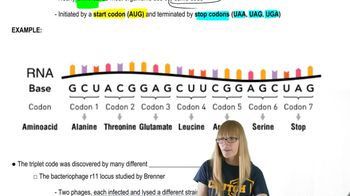
span>Identify the codons for each amino acid in the polypeptide sequence: Trp (Tryptophan), Lys (Lysine), Met (Methionine), Ala (Alanine), and Val (Valine).
span>Trp is encoded by the codon UGG. Lys is encoded by AAA or AAG. Met is encoded by AUG. Ala is encoded by GCU, GCC, GCA, or GCG. Val is encoded by GUU, GUC, GUA, or GUG.
span>Write the possible mRNA sequences using the identified codons: UGG for Trp, AAA/AAG for Lys, AUG for Met, GCU/GCC/GCA/GCG for Ala, and GUU/GUC/GUA/GUG for Val.
span>Determine the template-strand DNA sequences by replacing each mRNA nucleotide with its complementary DNA nucleotide: A with T, U with A, G with C, and C with G.
span>Use A/G and T/C to indicate positions where either adenine/guanine or thymine/cytosine could occur, and use N to indicate any nucleotide could appear, based on the degeneracy of the genetic code.

Verified video answer for a similar problem:
This video solution was recommended by our tutors as helpful for the problem above.
Video duration:
36sWas this helpful?
Key Concepts
Here are the essential concepts you must grasp in order to answer the question correctly.
Genetic Code
The genetic code is a set of rules that defines how the sequence of nucleotides in DNA and RNA corresponds to the sequence of amino acids in proteins. Each amino acid is encoded by a specific triplet of nucleotides called a codon. Understanding the genetic code is essential for translating polypeptide sequences back into their corresponding mRNA and DNA sequences.
Recommended video:
Guided course
The Genetic Code
Transcription
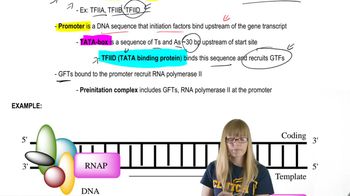
Transcription is the process by which the information in a DNA sequence is copied into a complementary RNA sequence. During this process, RNA polymerase synthesizes mRNA from the DNA template strand, replacing thymine (T) with uracil (U). This concept is crucial for determining the mRNA sequence from the given polypeptide.
Recommended video:
Guided course
Eukaryotic Transcription
Complementary Base Pairing
Complementary base pairing refers to the specific pairing of nitrogenous bases in nucleic acids: adenine (A) pairs with thymine (T) in DNA and uracil (U) in RNA, while guanine (G) pairs with cytosine (C). This principle is fundamental for deducing the template DNA strand from the mRNA sequence, as it ensures accurate pairing during transcription and replication.
Recommended video:
Guided course
Base Distortions
Related Practice
Textbook Question
761
views
Textbook Question
Identify two differences in chemical composition that distinguish DNA from RNA.
603
views
Textbook Question
What is the central dogma of biology? Identify and describe the molecular processes that accomplish the flow of genetic information described in the central dogma.
1229
views
Textbook Question
The following segment of DNA is the template strand transcribed into mRNA:
5'-...GACATGGAA...-3'
What is the sequence of mRNA created from this sequence?
1366
views
Textbook Question
The following segment of DNA is the template strand transcribed into mRNA:
5'-...GACATGGAA...-3'
What is the amino acid sequence produced by translation?
951
views
Textbook Question
Using the following amino acid sequences obtained from different species of apes, construct a phylogenetic tree of the apes.
525
views