Pearson+ LogoPearson+ Logo
Ch. 11 - Gene Mutation, DNA Repair, and Homologous Recombination
Sanders - Genetic Analysis: An Integrated Approach 3rd Edition
Sanders3rd EditionGenetic Analysis: An Integrated ApproachISBN: 9780135564172Not the one you use?Change textbook
Chapter 11, Problem 25

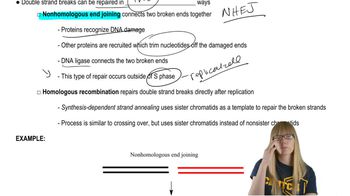
Briefly compare the production of DNA double-strand breaks in bacteria versus the double-strand breaks that precede homologous recombination.

Verified step by step guidance
1
Understand that DNA double-strand breaks (DSBs) are critical events in both bacterial DNA repair and eukaryotic homologous recombination.
In bacteria, DSBs can occur due to external factors like radiation or chemical agents, or as a result of cellular processes such as replication fork collapse.
In eukaryotes, DSBs are intentionally introduced during meiosis to initiate homologous recombination, a process essential for genetic diversity.
Recognize that the enzymes involved in creating DSBs differ: in bacteria, DSBs are often repaired by the RecBCD pathway, while in eukaryotes, the Spo11 enzyme is responsible for creating DSBs during meiosis.
Compare the purpose: bacterial DSBs are primarily for repair and survival, whereas eukaryotic DSBs during meiosis are for genetic recombination and diversity.

Verified video answer for a similar problem:

This video solution was recommended by our tutors as helpful for the problem above.
Video duration:
4m
Was this helpful?

Key Concepts

Here are the essential concepts you must grasp in order to answer the question correctly.

DNA Double-Strand Breaks (DSBs)

DNA double-strand breaks are critical lesions that occur when both strands of the DNA helix are severed. These breaks can arise from various sources, including environmental factors, replication errors, or during cellular processes like meiosis. In bacteria, DSBs can be induced by stress or damage, while in eukaryotes, they often occur as a precursor to homologous recombination, a process essential for accurate DNA repair and genetic diversity.
Recommended video:
Guided course
03:03
Double Strand Breaks

Homologous Recombination

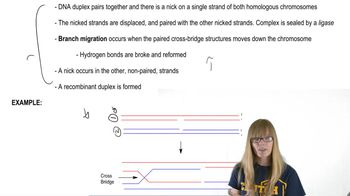
Homologous recombination is a genetic process where two similar or identical DNA molecules exchange genetic information. This mechanism is crucial for repairing DSBs in eukaryotic cells, ensuring that genetic material is accurately restored. It involves the alignment of homologous sequences and the formation of a joint molecule, which facilitates the exchange of DNA segments, thereby promoting genetic diversity and stability.
Recommended video:
Guided course
03:51
Recombination after Single Strand Breaks

Bacterial DNA Repair Mechanisms

Bacteria possess unique DNA repair mechanisms that differ from those in eukaryotes. They often utilize non-homologous end joining (NHEJ) or single-strand annealing to repair DSBs, as they lack the complex machinery for homologous recombination found in eukaryotic cells. This adaptability allows bacteria to respond quickly to DNA damage, although it may result in less precise repair compared to the homologous recombination pathway.
Recommended video:
Guided course
05:44
Repair Pathways
Related Practice
Textbook Question

Many human genes are known to have homologs in the mouse genome. One approach to investigating human hereditary disease is to produce mutations of the mouse homologs of human genes by methods that can precisely target specific nucleotides for mutation.

Despite the homologies that exist between human and mouse genes, some attempts to study human hereditary disease processes by inducing mutations in mouse genes indicate there is little to be learned about human disease in this way. In general terms, describe how and why the study of mouse gene mutations might fail to produce useful information about human disease processes.

590
views
Textbook Question
The fluctuation test performed by Luria and Delbrück is consistent with the random mutation hypothesis. Briefly describe their experiment and identify how the results match the prediction of the random mutation hypothesis. What would have to be different about the experimental results for them to agree with the prediction of the adaptive mutation hypothesis?
967
views
Textbook Question
In this chapter, three features of genes or of DNA sequence that contribute to the occurrence of mutational hotspots were described. Identify those three features and briefly describe why they are associated with mutational hotspots.
671
views
Textbook Question
During mismatch repair, why is it necessary to distinguish between the template strand and the newly made daughter strand? Describe how this is accomplished.
698
views
Textbook Question

Following the spill of a mixture of chemicals into a small pond, bacteria from the pond are tested and show an unusually high rate of mutation. A number of mutant cultures are grown from mutant colonies and treated with known mutagens to study the rate of reversion. Most of the mutant cultures show a significantly higher reversion rate when exposed to base analogs such as proflavin and 2-aminopurine. What does this suggest about the nature of the chemicals in the spill?

437
views
Textbook Question

In an Ames test using hisSalmonella bacteria a researcher determines that adding a test compound plus the S9 extract produces a large number of his⁺ revertants but mixing the his⁻ strain plus the test compound without adding S9 does not produce an elevated number of his⁺ revertants.

What is the reason for the different experimental results described?

737
views