Pearson+ LogoPearson+ Logo
Ch. 11 - Gene Mutation, DNA Repair, and Homologous Recombination
Sanders - Genetic Analysis: An Integrated Approach 3rd Edition
Sanders3rd EditionGenetic Analysis: An Integrated ApproachISBN: 9780135564172Not the one you use?Change textbook
Chapter 11, Problem 33c

In an experiment employing the methods of the Ames test, two strains of Salmonella are used. Strain A contains a base-substitution mutation, and Strain B contains a frameshift mutation. Four plates are prepared to test the mutagenicity of the compound ethyl methanesulfonate (EMS). Plate 1 is a control plate with Strain A and S9 extract but no EMS. Plate 2 is also a control plate and contains Strain B and S9 extract but no EMS. Plate 3 contains Strain A along with S9 extract and EMS, and Plate 4 contains Strain B, S9 extract, and EMS.
Why is the S9 extract added to each of the plates?

Verified step by step guidance
1
The S9 extract is a mixture of enzymes derived from the liver of a rodent, typically a rat. It is used in the Ames test to mimic the metabolic processes that occur in a living organism.
Many compounds are not directly mutagenic but become mutagenic after being metabolized by enzymes in the liver. The S9 extract contains these metabolic enzymes, such as cytochrome P450, which can activate or detoxify potential mutagens.
By adding the S9 extract to the plates, the experiment simulates the metabolic activation of the compound (in this case, EMS) as it would occur in a living organism. This ensures that the test accounts for both direct and metabolically activated mutagens.
The inclusion of S9 extract in both control and experimental plates ensures that any observed effects are due to the compound being tested (EMS) and not the metabolic enzymes themselves.
In summary, the S9 extract is essential for assessing the mutagenicity of compounds that require metabolic activation, providing a more accurate representation of how the compound might behave in a biological system.

Verified video answer for a similar problem:

This video solution was recommended by our tutors as helpful for the problem above.
Video duration:
3m
Was this helpful?

Key Concepts

Here are the essential concepts you must grasp in order to answer the question correctly.

Ames Test

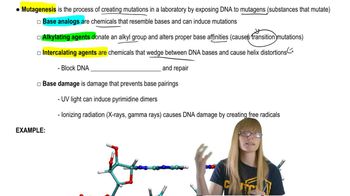
The Ames test is a widely used method for assessing the mutagenic potential of chemical compounds. It employs specific strains of bacteria, typically Salmonella, that are sensitive to mutations. By observing the growth of these bacteria in the presence of a potential mutagen, researchers can infer whether the compound causes genetic changes, which may indicate carcinogenic properties.
Recommended video:
Guided course
04:29
Induced Mutations

S9 Extract

S9 extract is a metabolic activation system derived from the liver of rodents, often used in mutagenicity testing. It contains enzymes that mimic the metabolic processes that occur in living organisms, allowing researchers to evaluate how a compound is metabolized and whether it becomes mutagenic after such transformation. The addition of S9 extract helps to simulate in vivo conditions, providing a more accurate assessment of a compound's mutagenic potential.
Recommended video:
Guided course
04:17
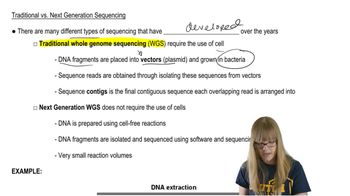
Traditional vs. Next-Gen

Types of Mutations

Mutations can be classified into various types, including base-substitution mutations and frameshift mutations. A base-substitution mutation involves the replacement of one nucleotide with another, potentially altering a single amino acid in a protein. In contrast, a frameshift mutation results from the insertion or deletion of nucleotides, shifting the reading frame of the genetic code and often leading to significant changes in protein structure and function. Understanding these mutations is crucial for interpreting the results of the Ames test.
Recommended video:
Guided course
10:48
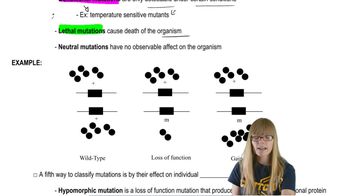
Mutations and Phenotypes
Related Practice
Textbook Question

Alkaptonuria is a human autosomal recessive disorder caused by mutation of the HAO gene that encodes the enzyme homogentisic acid oxidase. A map of the HAO gene region reveals four BamHI restriction sites (B1 to B4) in the wild-type allele and three BamHI restriction sites in the mutant allele. BamHI utilizes the restriction sequence 5′-GGATCC-3′. The BamHI restriction sequence identified as B3 is altered to 5′-GGAACC-3′ in the mutant allele. The mutation results in a Ser-to-Thr missense mutation. Restriction maps of the two alleles are shown below, and the binding sites of two molecular probes (probe A and probe B) are identified.

DNA samples taken from a mother (M), father (F), and two children (C1 and C2) are analyzed by Southern blotting of BamHI-digested DNA. The gel electrophoresis results are illustrated.

Explain how the DNA sequence change results in a Ser-to-Thr missense mutation.

534
views
Textbook Question

In an experiment employing the methods of the Ames test, two strains of Salmonella are used. Strain A contains a base-substitution mutation, and Strain B contains a frameshift mutation. Four plates are prepared to test the mutagenicity of the compound ethyl methanesulfonate (EMS). Plate 1 is a control plate with Strain A and S9 extract but no EMS. Plate 2 is also a control plate and contains Strain B and S9 extract but no EMS. Plate 3 contains Strain A along with S9 extract and EMS, and Plate 4 contains Strain B, S9 extract, and EMS.

Characterize the expected distribution of colony growth on the four plates. Defend your growth prediction for each plate.

633
views
Textbook Question

In an experiment employing the methods of the Ames test, two strains of Salmonella are used. Strain A contains a base-substitution mutation, and Strain B contains a frameshift mutation. Four plates are prepared to test the mutagenicity of the compound ethyl methanesulfonate (EMS). Plate 1 is a control plate with Strain A and S9 extract but no EMS. Plate 2 is also a control plate and contains Strain B and S9 extract but no EMS. Plate 3 contains Strain A along with S9 extract and EMS, and Plate 4 contains Strain B, S9 extract, and EMS.

What event is being detected by growth of a colony on any of the four plates?

566
views
Textbook Question

In an experiment employing the methods of the Ames test, two strains of Salmonella are used. Strain A contains a base-substitution mutation, and Strain B contains a frameshift mutation. Four plates are prepared to test the mutagenicity of the compound ethyl methanesulfonate (EMS). Plate 1 is a control plate with Strain A and S9 extract but no EMS. Plate 2 is also a control plate and contains Strain B and S9 extract but no EMS. Plate 3 contains Strain A along with S9 extract and EMS, and Plate 4 contains Strain B, S9 extract, and EMS.

Suppose the compound being tested was proflavin instead of EMS. Would this change the Ames test results? Explain why or why not.

803
views
Textbook Question

Using your knowledge of DNA repair pathways, choose the pathway that would be used to repair the following types of DNA damage. Explain your reasoning.

A change in DNA sequence caused by a mistake made by DNA polymerase during replication

564
views
Textbook Question

Using your knowledge of DNA repair pathways, choose the pathway that would be used to repair the following types of DNA damage. Explain your reasoning.

Heavily damaged bacterial DNA

861
views