Pearson+ LogoPearson+ Logo
Ch. 11 - Gene Mutation, DNA Repair, and Homologous Recombination
Sanders - Genetic Analysis: An Integrated Approach 3rd Edition
Sanders3rd EditionGenetic Analysis: An Integrated ApproachISBN: 9780135564172Not the one you use?Change textbook
Chapter 11, Problem 34b

Using your knowledge of DNA repair pathways, choose the pathway that would be used to repair the following types of DNA damage. Explain your reasoning.
Heavily damaged bacterial DNA

Verified step by step guidance
1
Understand the context: Heavily damaged bacterial DNA often involves widespread damage that cannot be repaired by standard, high-fidelity repair mechanisms. This type of damage may include double-strand breaks, bulky adducts, or extensive base modifications.
Identify the appropriate repair pathway: For heavily damaged bacterial DNA, the SOS response is typically activated. This is a global response to DNA damage in bacteria that induces the expression of multiple DNA repair genes, including those involved in translesion synthesis (TLS).
Explain the reasoning: The SOS response allows the cell to bypass lesions that block replication by using specialized DNA polymerases (e.g., Pol IV and Pol V) that can synthesize DNA across damaged templates. While this process is error-prone, it ensures that replication can continue, which is critical for cell survival under extreme damage conditions.
Discuss the trade-offs: The error-prone nature of the SOS response can lead to mutations, but this trade-off is necessary for the survival of the bacterial cell when the DNA damage is too extensive for high-fidelity repair mechanisms like base excision repair (BER) or nucleotide excision repair (NER).
Conclude with the pathway choice: The SOS response is the most suitable pathway for repairing heavily damaged bacterial DNA because it provides a mechanism to tolerate and bypass extensive DNA damage, ensuring the continuation of replication and cell survival.

Verified video answer for a similar problem:

This video solution was recommended by our tutors as helpful for the problem above.
Video duration:
4m
Was this helpful?

Key Concepts

Here are the essential concepts you must grasp in order to answer the question correctly.

DNA Repair Pathways

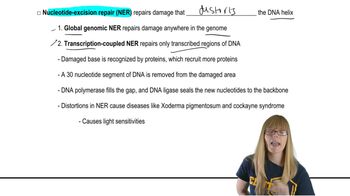
DNA repair pathways are cellular mechanisms that identify and correct damage to the DNA molecule. These pathways are crucial for maintaining genomic stability and preventing mutations that could lead to diseases such as cancer. Different types of damage, such as single-strand breaks, double-strand breaks, and base modifications, are repaired by specific pathways, including nucleotide excision repair, base excision repair, and homologous recombination.
Recommended video:
Guided course
05:44
Repair Pathways

SOS Response in Bacteria

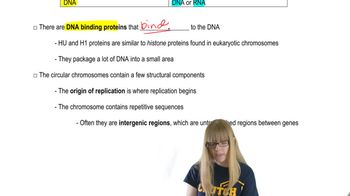
The SOS response is a global response to DNA damage in bacteria, particularly in Escherichia coli. When DNA is heavily damaged, the SOS response is activated, leading to the expression of several genes involved in DNA repair and mutagenesis. This pathway allows bacteria to tolerate and repair extensive DNA damage, often through error-prone repair mechanisms that can introduce mutations but also enable survival under stress.
Recommended video:
Guided course
02:39
Bacteria and Viral Chromosome Structure

Homologous Recombination

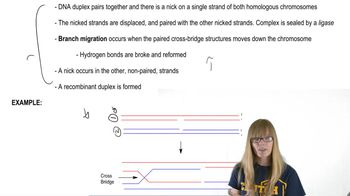
Homologous recombination is a precise DNA repair mechanism that uses a homologous sequence as a template to repair double-strand breaks. This pathway is essential for maintaining genetic integrity, especially in organisms with complex genomes. In bacteria, homologous recombination can also facilitate the exchange of genetic material, contributing to genetic diversity and adaptation.
Recommended video:
Guided course
03:51
Recombination after Single Strand Breaks
Related Practice
Textbook Question

In an experiment employing the methods of the Ames test, two strains of Salmonella are used. Strain A contains a base-substitution mutation, and Strain B contains a frameshift mutation. Four plates are prepared to test the mutagenicity of the compound ethyl methanesulfonate (EMS). Plate 1 is a control plate with Strain A and S9 extract but no EMS. Plate 2 is also a control plate and contains Strain B and S9 extract but no EMS. Plate 3 contains Strain A along with S9 extract and EMS, and Plate 4 contains Strain B, S9 extract, and EMS.

Why is the S9 extract added to each of the plates?

538
views
Textbook Question

In an experiment employing the methods of the Ames test, two strains of Salmonella are used. Strain A contains a base-substitution mutation, and Strain B contains a frameshift mutation. Four plates are prepared to test the mutagenicity of the compound ethyl methanesulfonate (EMS). Plate 1 is a control plate with Strain A and S9 extract but no EMS. Plate 2 is also a control plate and contains Strain B and S9 extract but no EMS. Plate 3 contains Strain A along with S9 extract and EMS, and Plate 4 contains Strain B, S9 extract, and EMS.

Suppose the compound being tested was proflavin instead of EMS. Would this change the Ames test results? Explain why or why not.

803
views
Textbook Question

Using your knowledge of DNA repair pathways, choose the pathway that would be used to repair the following types of DNA damage. Explain your reasoning.

A change in DNA sequence caused by a mistake made by DNA polymerase during replication

564
views
Textbook Question

Using your knowledge of DNA repair pathways, choose the pathway that would be used to repair the following types of DNA damage. Explain your reasoning.

A thymine dimer induced as a result of UV exposure

707
views
Textbook Question

Using your knowledge of DNA repair pathways, choose the pathway that would be used to repair the following types of DNA damage. Explain your reasoning.

A double-strand break that occurs just after replication in an actively dividing cell

539
views
Textbook Question

Using your knowledge of DNA repair pathways, choose the pathway that would be used to repair the following types of DNA damage. Explain your reasoning.

A double-stranded break that occurs during G1 and prevents completion of DNA replication

464
views