Pearson+ LogoPearson+ Logo
Ch. 11 - Gene Mutation, DNA Repair, and Homologous Recombination
Sanders - Genetic Analysis: An Integrated Approach 3rd Edition
Sanders3rd EditionGenetic Analysis: An Integrated ApproachISBN: 9780135564172Not the one you use?Change textbook
Chapter 11, Problem 21

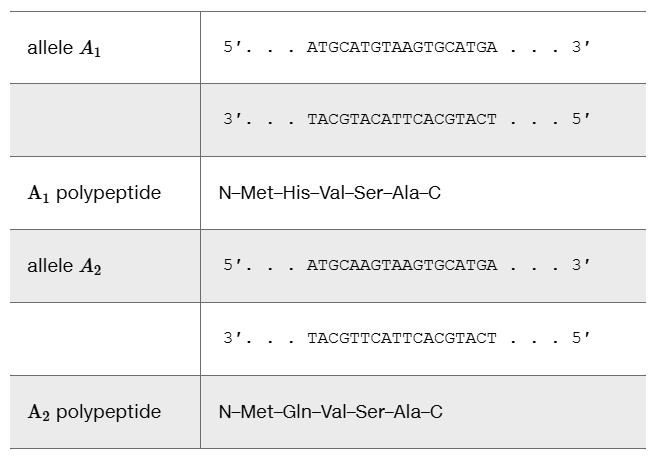
The two DNA and polypeptide sequences shown are for alleles at a hypothetical locus that produce different polypeptides, both five amino acids long. In each case, the lower DNA strand is the template strand:
DNA sequences and polypeptides for two alleles, showing differences in amino acid composition.
Based on DNA and polypeptide sequences alone, is there any way to determine which allele is dominant and which is recessive? Why or why not?

Verified step by step guidance
1
Step 1: Understand the concept of dominance and recessiveness in genetics. Dominance refers to an allele that expresses its trait even in the presence of another allele, while recessiveness refers to an allele whose trait is masked by a dominant allele. Dominance is determined by phenotypic expression, not by DNA or polypeptide sequences alone.
Step 2: Analyze the DNA sequences provided for allele A₁ and allele A₂. Note the difference in the sequences: allele A₁ has 'ATGCATGTAAGTGCATGA' while allele A₂ has 'ATGCAAGTAAGTGCATGA'. The difference lies in the third codon, where A₁ has 'ATG' (coding for His) and A₂ has 'AAG' (coding for Gln).
Step 3: Examine the polypeptide sequences. Allele A₁ produces a polypeptide sequence N–Met–His–Val–Ser–Ala–C, while allele A₂ produces N–Met–Gln–Val–Ser–Ala–C. The difference in the polypeptides is due to the single nucleotide change in the DNA sequence, resulting in a substitution of His with Gln.
Step 4: Consider the relationship between DNA sequence, polypeptide sequence, and dominance. Dominance is determined by the observable phenotype, which may involve the functional impact of the polypeptides produced by the alleles. Without information about the phenotypic effects of these polypeptides, it is impossible to determine dominance or recessiveness based solely on the DNA and polypeptide sequences.
Step 5: Conclude that additional information about the phenotypic expression of these alleles is required to determine dominance or recessiveness. For example, if one allele produces a functional protein while the other does not, or if one allele's protein has a greater impact on the phenotype, this could indicate dominance. However, such information is not provided in the problem.

Verified video answer for a similar problem:

This video solution was recommended by our tutors as helpful for the problem above.
Video duration:
1m
Was this helpful?

Key Concepts

Here are the essential concepts you must grasp in order to answer the question correctly.

Alleles and Dominance

Alleles are different versions of a gene that can produce variations in traits. Dominance refers to the relationship between alleles, where a dominant allele can mask the expression of a recessive allele in a heterozygous individual. To determine dominance, one typically needs to observe the phenotypic effects of the alleles in a biological context, rather than just their sequences.
Recommended video:
Guided course
04:37
Variations on Dominance

DNA and Polypeptide Translation

DNA sequences are transcribed into messenger RNA (mRNA), which is then translated into polypeptides (proteins). The specific sequence of nucleotides in DNA determines the sequence of amino acids in a polypeptide. While the polypeptide sequences can indicate functional differences, they do not inherently reveal dominance without additional context about their effects on phenotype.
Recommended video:
Guided course
04:01
Translation Elongation

Phenotypic Expression

Phenotypic expression refers to the observable traits or characteristics of an organism, which result from the interaction of its genotype with the environment. To determine which allele is dominant, one must assess how each allele affects the phenotype when expressed, as the mere presence of different polypeptide sequences does not provide sufficient information about their dominance without experimental evidence.
Recommended video:
Guided course
02:09
Penetrance and Expressivity
Related Practice
Textbook Question

Using the adenine–thymine base pair in this DNA sequence

...GCTC...

...CGAG...

Give the sequence after a transversion mutation.

628
views
Textbook Question

The partial amino acid sequence of a wild-type protein is

… Arg-Met-Tyr-Thr-Leu-Cys-Ser …

The same portion of the protein from a mutant has the sequence

… Arg-Met-Leu-Tyr-Ala-Leu-Phe …

Identify the type of mutation.

714
views
Textbook Question

The partial amino acid sequence of a wild-type protein is

… Arg-Met-Tyr-Thr-Leu-Cys-Ser …

The same portion of the protein from a mutant has the sequence

… Arg-Met-Leu-Tyr-Ala-Leu-Phe …

Give the sequence of the wild-type DNA template strand. Use A/G if the nucleotide could be either purine, T/C if it could be either pyrimidine, N if any nucleotide could occur at a site, or the alternative nucleotides if a purine and a pyrimidine are possible.

602
views
Textbook Question

Many human genes are known to have homologs in the mouse genome. One approach to investigating human hereditary disease is to produce mutations of the mouse homologs of human genes by methods that can precisely target specific nucleotides for mutation.

Numerous studies of mutations of the mouse homologs of human genes have yielded valuable information about how gene mutations influence the human disease process. In general terms, describe how and why creating mutations of the mouse homologs can give information about human hereditary disease processes.

734
views
Textbook Question

Many human genes are known to have homologs in the mouse genome. One approach to investigating human hereditary disease is to produce mutations of the mouse homologs of human genes by methods that can precisely target specific nucleotides for mutation.

Despite the homologies that exist between human and mouse genes, some attempts to study human hereditary disease processes by inducing mutations in mouse genes indicate there is little to be learned about human disease in this way. In general terms, describe how and why the study of mouse gene mutations might fail to produce useful information about human disease processes.

590
views
Textbook Question
The fluctuation test performed by Luria and Delbrück is consistent with the random mutation hypothesis. Briefly describe their experiment and identify how the results match the prediction of the random mutation hypothesis. What would have to be different about the experimental results for them to agree with the prediction of the adaptive mutation hypothesis?
967
views