Textbook Question
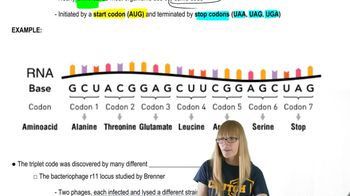
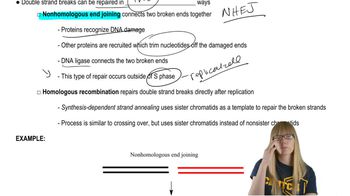
The partial amino acid sequence of a wild-type protein is
… Arg-Met-Tyr-Thr-Leu-Cys-Ser …
The same portion of the protein from a mutant has the sequence
… Arg-Met-Leu-Tyr-Ala-Leu-Phe …
Identify the type of mutation.
715
views

 Sanders 3rd EditionCh. 11 - Gene Mutation, DNA Repair, and Homologous RecombinationProblem 20b
 Verified step by step guidance
 11:43
11:43
 03:03
03:03 03:38
03:38The partial amino acid sequence of a wild-type protein is
… Arg-Met-Tyr-Thr-Leu-Cys-Ser …
The same portion of the protein from a mutant has the sequence
… Arg-Met-Leu-Tyr-Ala-Leu-Phe …
Identify the type of mutation.
Using the adenine–thymine base pair in this DNA sequence
...GCTC...
...CGAG...
Give the sequence after a transition mutation.
The two DNA and polypeptide sequences shown are for alleles at a hypothetical locus that produce different polypeptides, both five amino acids long. In each case, the lower DNA strand is the template strand:
Based on DNA and polypeptide sequences alone, is there any way to determine which allele is dominant and which is recessive? Why or why not?
Many human genes are known to have homologs in the mouse genome. One approach to investigating human hereditary disease is to produce mutations of the mouse homologs of human genes by methods that can precisely target specific nucleotides for mutation.
Numerous studies of mutations of the mouse homologs of human genes have yielded valuable information about how gene mutations influence the human disease process. In general terms, describe how and why creating mutations of the mouse homologs can give information about human hereditary disease processes.
Many human genes are known to have homologs in the mouse genome. One approach to investigating human hereditary disease is to produce mutations of the mouse homologs of human genes by methods that can precisely target specific nucleotides for mutation.
Despite the homologies that exist between human and mouse genes, some attempts to study human hereditary disease processes by inducing mutations in mouse genes indicate there is little to be learned about human disease in this way. In general terms, describe how and why the study of mouse gene mutations might fail to produce useful information about human disease processes.
Using the adenine–thymine base pair in this DNA sequence
...GCTC...
...CGAG...
Give the sequence after a transversion mutation.