Pearson+ LogoPearson+ Logo
Ch. 16 - Genomics: Genetics from a Whole-Genome Perspective
Sanders - Genetic Analysis: An Integrated Approach 3rd Edition
Sanders3rd EditionGenetic Analysis: An Integrated ApproachISBN: 9780135564172Not the one you use?Change textbook
Chapter 16, Problem 6a

You are designing algorithms for the bioinformatic prediction of gene sequences. How might algorithms differ for predicting genes in bacterial versus eukaryotic genomic sequence?

Verified step by step guidance
1
Understand the structural differences between bacterial and eukaryotic genomes: Bacterial genomes are typically smaller, circular, and lack introns, while eukaryotic genomes are larger, linear, and contain introns and exons.
Consider the presence of operons in bacterial genomes: Bacterial genes are often organized into operons, where multiple genes are transcribed together under a single promoter. Algorithms for bacterial gene prediction should account for this feature.
Account for splicing in eukaryotic genomes: Eukaryotic genes contain introns that are spliced out during mRNA processing. Algorithms for eukaryotic gene prediction must identify exon-intron boundaries using splice site signals (e.g., donor and acceptor sites).
Incorporate promoter and regulatory element differences: Bacterial promoters are simpler and have conserved sequences like the -10 and -35 regions, while eukaryotic promoters are more complex and may include TATA boxes and enhancers. Algorithms should be tailored to detect these specific features.
Use codon bias and GC content: Both bacterial and eukaryotic genomes exhibit codon usage bias and characteristic GC content, which can be used to refine gene predictions. However, the patterns differ between the two, so the algorithm must adapt to the organism type.

Verified video answer for a similar problem:

This video solution was recommended by our tutors as helpful for the problem above.
Video duration:
2m
Was this helpful?

Key Concepts

Here are the essential concepts you must grasp in order to answer the question correctly.

Gene Structure Differences

Bacterial genes are typically organized in operons, allowing multiple genes to be transcribed together, while eukaryotic genes are often split by introns and exons, requiring splicing. This structural difference affects how algorithms identify and predict gene sequences, as eukaryotic algorithms must account for splicing and regulatory elements that are less prevalent in bacterial genomes.
Recommended video:
Guided course
03:49
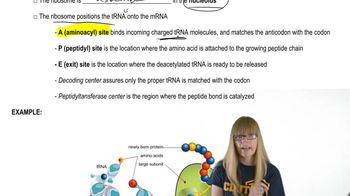
Ribosome Structure

Regulatory Elements

Eukaryotic genomes contain complex regulatory elements, such as enhancers and silencers, which influence gene expression. In contrast, bacterial gene regulation is often simpler, relying primarily on promoter regions. Algorithms for eukaryotic gene prediction must incorporate these regulatory sequences to accurately predict gene locations and expression patterns.
Recommended video:
Guided course
05:30
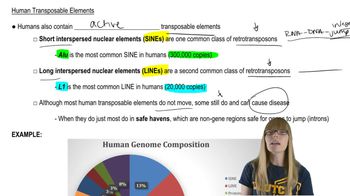
Human Transposable Elements

Sequence Complexity and Size

Eukaryotic genomes are generally larger and more complex than bacterial genomes, containing more repetitive sequences and non-coding DNA. This complexity poses challenges for algorithms, which must efficiently handle larger datasets and distinguish between functional and non-functional sequences, a task that is less demanding in the more streamlined bacterial genomes.
Recommended video:
Guided course
04:12
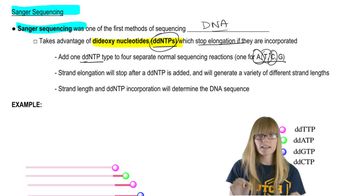
Sanger Sequencing