Pearson+ LogoPearson+ Logo
Ch. 16 - Genomics: Genetics from a Whole-Genome Perspective
Sanders - Genetic Analysis: An Integrated Approach 3rd Edition
Sanders3rd EditionGenetic Analysis: An Integrated ApproachISBN: 9780135564172Not the one you use?Change textbook
Chapter 16, Problem 7

You have sequenced a 100-kb region of the Bacillus anthracis genome (the bacterium that causes anthrax) and a 100-kb region from the Gorilla gorilla genome. What differences and similarities might you expect to see in the annotation of the sequences, for example, in the number of genes, gene structure, regulatory sequences, and repetitive DNA?

Verified step by step guidance
1
Step 1: Understand the biological context by recognizing that Bacillus anthracis is a prokaryotic bacterium, while Gorilla gorilla is a eukaryotic mammal. This fundamental difference affects genome organization and annotation features.
Step 2: Compare gene number and density. Prokaryotic genomes like B. anthracis typically have a higher gene density with fewer non-coding regions, so expect more genes per 100 kb compared to the gorilla genome, which has larger intergenic regions and introns.
Step 3: Examine gene structure differences. In B. anthracis, genes are usually continuous coding sequences without introns, whereas gorilla genes contain introns and exons, requiring annotation of splice sites and exon-intron boundaries.
Step 4: Analyze regulatory sequences. Prokaryotic regulatory elements are often simpler, such as promoters and operators located close to genes, while eukaryotic regulatory sequences include complex promoters, enhancers, silencers, and insulators that can be located far from the gene.
Step 5: Investigate repetitive DNA content. The gorilla genome is expected to have a higher proportion of repetitive elements like transposons, satellite DNA, and segmental duplications, whereas B. anthracis has fewer and simpler repetitive sequences.

Verified video answer for a similar problem:

This video solution was recommended by our tutors as helpful for the problem above.
Video duration:
2m
Was this helpful?

Key Concepts

Here are the essential concepts you must grasp in order to answer the question correctly.

Comparative Genomics

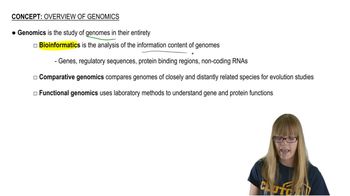
Comparative genomics involves analyzing and comparing the genomes of different species to identify similarities and differences. It helps reveal evolutionary relationships, conserved genes, and species-specific adaptations. In this case, comparing Bacillus anthracis (a bacterium) and Gorilla gorilla (a primate) highlights vast differences in genome complexity and organization.
Recommended video:
Guided course
02:48
Genomics Overview

Gene Structure and Organization

Gene structure refers to the arrangement of coding regions (exons), non-coding regions (introns), promoters, and other regulatory elements within a gene. Prokaryotic genes like those in Bacillus anthracis are typically simpler, often lacking introns, while eukaryotic genes in Gorilla gorilla have complex structures with multiple exons and introns, affecting gene expression and regulation.
Recommended video:
Guided course
06:25
DNA Structure

Repetitive DNA and Regulatory Sequences

Repetitive DNA includes sequences repeated many times in the genome, such as transposons and satellite DNA, which are more abundant in eukaryotes like gorillas. Regulatory sequences control gene expression and differ between prokaryotes and eukaryotes; bacterial regulatory elements are often simpler, while eukaryotic genomes contain diverse enhancers, silencers, and complex promoter regions.
Recommended video:
Guided course
08:41
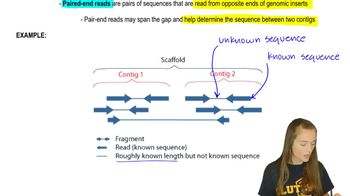
Sequencing Difficulties