How do comparisons between genomes of related species help refine gene annotation?

Sanders 3rd Edition
Ch. 16 - Genomics: Genetics from a Whole-Genome Perspective
Problem 8You have just obtained 100 kb of genomic sequence from an as-yet-unsequenced mammalian genome. What are three methods you might use to identify potential genes in the 100 kb? What are the advantages and limitations of each method?
Verified step by step guidance
Verified video answer for a similar problem:
Key Concepts
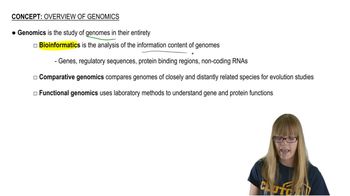
Gene Prediction Algorithms
Comparative Genomics
Transcriptome Analysis
You are designing algorithms for the bioinformatic prediction of gene sequences. How might algorithms differ for predicting genes in bacterial versus eukaryotic genomic sequence?
You have sequenced a 100-kb region of the Bacillus anthracis genome (the bacterium that causes anthrax) and a 100-kb region from the Gorilla gorilla genome. What differences and similarities might you expect to see in the annotation of the sequences, for example, in the number of genes, gene structure, regulatory sequences, and repetitive DNA?
The human genome contains a large number of pseudogenes. How would you distinguish whether a particular sequence encodes a gene or a pseudogene? How do pseudogenes arise?
Based on the tree of life in the following figure (Figure 16.12), would you expect human proteins to be more similar to fungal proteins or to plant proteins? Would you expect plant proteins to be more similar to fungal proteins or to human proteins?
When comparing genes from two sequenced genomes, how does one determine whether two genes are orthologous? What pitfalls arise when one or both of the genomes are not sequenced?