Pearson+ LogoPearson+ Logo
Ch. 17 - Organelle Inheritance and the Evolution of Organelle Genomes
Sanders - Genetic Analysis: An Integrated Approach 3rd Edition
Sanders3rd EditionGenetic Analysis: An Integrated ApproachISBN: 9780135564172Not the one you use?Change textbook
Chapter 17, Problem 25

Elysia chlorotica is a sea slug that acquires chloroplasts by consuming an algal food source, Vaucheria litorea. The ingested chloroplasts are sequestered in the sea slug's digestive epithelium, where they actively photosynthesize for months after ingestion. In the algae, the algal nuclear genome encodes more than 90% but not all of the proteins required for chloroplast metabolism. Thus it is suspected that the sea slug actively maintains ingested chloroplasts, supplying them with photosynthetic proteins encoded in the sea slug genome. How would you determine whether the sea slug has acquired photosynthetic genes by horizontal gene transfer from its algal food source? Discuss the steps required for heritable endosymbiosis to eventuate, and their plausibility.

Verified step by step guidance
1
Step 1: Begin by isolating and sequencing the genome of Elysia chlorotica. This will allow you to identify all the genes present in the sea slug's genome. Use high-throughput sequencing technologies to ensure comprehensive coverage of the genome.
Step 2: Compare the sea slug's genome to the genome of its algal food source, Vaucheria litorea. Specifically, look for genes related to photosynthesis in the sea slug's genome that are homologous to those found in the algae. Use bioinformatics tools to identify homologous sequences and assess their similarity.
Step 3: Determine whether the identified photosynthetic genes in the sea slug's genome are functional. This can be done by analyzing their expression using techniques such as reverse transcription PCR (RT-PCR) or RNA sequencing to confirm that these genes are transcribed into mRNA.
Step 4: Investigate whether the proteins encoded by these genes are synthesized and functional in the sea slug. Use proteomics approaches, such as mass spectrometry, to detect the presence of photosynthetic proteins in the sea slug's tissues. Additionally, confirm their localization to the chloroplasts using immunofluorescence microscopy or other localization techniques.
Step 5: Discuss the plausibility of heritable endosymbiosis. For heritable endosymbiosis to occur, the photosynthetic genes must be stably integrated into the sea slug's germline genome and passed on to offspring. Evaluate whether there is evidence of vertical transmission of these genes and whether the chloroplasts themselves are inherited by the next generation. Consider the evolutionary and ecological implications of such a relationship.

Verified video answer for a similar problem:

This video solution was recommended by our tutors as helpful for the problem above.
Video duration:
3m
Was this helpful?

Key Concepts

Here are the essential concepts you must grasp in order to answer the question correctly.

Horizontal Gene Transfer (HGT)

Horizontal Gene Transfer is the process by which an organism incorporates genetic material from another organism without being its offspring. This can occur through various mechanisms, such as transformation, transduction, or conjugation. In the context of Elysia chlorotica, HGT would involve the transfer of photosynthetic genes from the algal genome to the sea slug's genome, enabling it to produce proteins necessary for maintaining the chloroplasts.
Recommended video:
Guided course
09:09
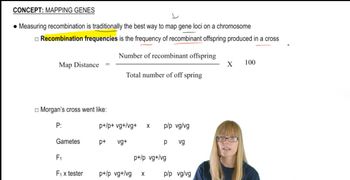
Mapping Genes

Endosymbiosis

Endosymbiosis is a symbiotic relationship where one organism lives inside the cells of another. This concept is crucial for understanding how Elysia chlorotica retains functional chloroplasts from algae. For endosymbiosis to be heritable, the endosymbiont's genetic material must be integrated into the host's genome, allowing for the transfer of traits across generations, which raises questions about the mechanisms and evolutionary advantages of such integration.
Recommended video:
Guided course
04:11
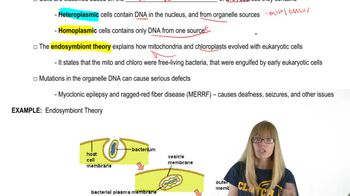
Organelle DNA Characteristics

Gene Expression and Protein Synthesis

Gene expression is the process by which information from a gene is used to synthesize functional gene products, typically proteins. In Elysia chlorotica, the ability to maintain and utilize chloroplasts depends on the expression of photosynthetic genes. Understanding how the sea slug regulates the expression of these genes, potentially acquired through HGT, is essential for determining the mechanisms that allow it to sustain photosynthesis and the implications for its evolutionary biology.
Recommended video:
Related Practice
Textbook Question

Cytoplasmic male sterility (CMS) in plants has been exploited to produce hybrid seeds. Specific CMS alleles in the mitochondrial genome can be suppressed by specific dominant alleles in the nuclear genome, called Restorer of fertility alleles, RF. Consider the following cross:

♀CMS 1Rf 1/Rf1 rf2/rf2 × ♂CMS2rf 1/rf1 Rf2/Rf2

What genotypes and phenotypes do you expect in the F₁? If some of the F₁ plants are male fertile, what genotypes and phenotypes do you expect in the F₂?

456
views
Textbook Question

Wolves and coyotes can interbreed in captivity, and now, because of changes in their habitat distribution, they may have the opportunity to interbreed in the wild. To examine this possibility, mitochondrial DNA from wolf and coyote populations throughout North America—including habitats where the two species both reside—was analyzed, and a phylogenetic tree was constructed from the resulting data. A sequence from a jackal was used as an outgroup, and a sequence from a domestic dog was included, demonstrating wolves as the origin of domestic dogs. What do you conclude about the possibility that interspecific hybridization occurred between wolves and coyotes on the basis of this phylogenetic tree?

444
views
Textbook Question

Considering the phylogenetic assignment of Plasmodium falciparum, the malarial parasite, to the phylum Apicomplexa, what might you speculate as to whether the parasite is susceptible to aminoglycoside antibiotics?

422
views
Textbook Question

Most large protein complexes in mitochondria and chloroplasts are composed both of proteins encoded in the organelle genome and proteins encoded in the nuclear genome. What complexities does this introduce for gene regulation (i.e., for ensuring that the appropriate relative numbers of the proteins in a complex are produced)?

431
views
Textbook Question

Mothers will pass on a mitochondrial defect to their offspring. In a type of gene therapy, one approach to circumvent this problem is to have two different maternal contributions, with the nucleus of the female with the defective mitochondria being placed in an enucleated egg derived from a female with normal mitochondria. After fertilization, the resulting offspring would have three parental sources of DNA—with nuclear DNA derived from a mother and a father, and mitochondrial DNA derived from another 'mother.' Recently, children with this genetic makeup have been born, but the elimination of defective mitochondria is not complete, with the amount of defective mitochondria derived from the defective mother ranging from 0 to 9%. Discuss potential complications resulting from such a mixture of genomes.

390
views