Pearson+ LogoPearson+ Logo
Ch. 2 - Transmission Genetics
Sanders - Genetic Analysis: An Integrated Approach 3rd Edition
Sanders3rd EditionGenetic Analysis: An Integrated ApproachISBN: 9780135564172Not the one you use?Change textbook
Chapter 2, Problem 35

For a single dice roll, there is a 1/6 chance that any particular number will appear. For a pair of dice, each specific combination of numbers has a probability of 1/36 occurring. Most total values of two dice can occur more than one way. As a test of random probability theory, a student decides to roll a pair of six-sided dice 300 times and tabulate the results. She tabulates the number of times each different total value of the two dice occurs. Her results are the following:

Total Value of Two Dice      Number of Times Rolled
               2                                          7
               3                                         11
               4                                         23
               5                                         36
               6                                         42
               7                                         53
               8                                         40
               9                                         38
              10                                        30
              11                                        12
              12                                         8
           TOTAL                                   300

The student tells you that her results fail to prove that random chance is the explanation for the outcome of this experiment. Is she correct or incorrect? Support your answer.

Verified step by step guidance
1
Calculate the expected probability for each total value of two dice. For example, the probability of rolling a total of 7 is the highest because there are more combinations (6) that result in 7.
Determine the expected frequency for each total value by multiplying the probability of each total by the total number of rolls (300).
Compare the expected frequencies with the observed frequencies from the student's results.
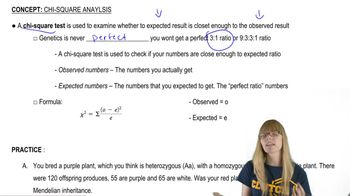
Use a statistical test, such as the chi-square test, to determine if the differences between observed and expected frequencies are statistically significant.
Interpret the results of the statistical test to decide if the observed frequencies could be due to random chance or if there is a significant deviation.

Verified video answer for a similar problem:

This video solution was recommended by our tutors as helpful for the problem above.
Video duration:
4m
Was this helpful?

Key Concepts

Here are the essential concepts you must grasp in order to answer the question correctly.

Probability Theory

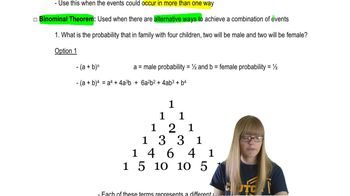
Probability theory is the branch of mathematics that deals with the likelihood of events occurring. In the context of rolling dice, it quantifies the chances of obtaining specific outcomes. For example, when rolling two six-sided dice, the total number of possible outcomes is 36, and each combination has a defined probability. Understanding these probabilities is essential for analyzing the student's results.
Recommended video:

Randomness and Variability

Randomness refers to the unpredictability of outcomes in an experiment, while variability indicates the differences in results that can occur due to chance. In rolling dice, even with a fair setup, the results can vary significantly over a limited number of trials. This concept is crucial for interpreting the student's findings, as random chance can lead to unexpected distributions of outcomes, which may not align with theoretical probabilities.
Recommended video:
Guided course
07:55
Non-Random Mating

Statistical Significance

Statistical significance is a measure that helps determine whether the results of an experiment are likely due to chance or if they reflect a true effect. In the context of the student's dice rolls, analyzing the frequency of each total value against expected probabilities can reveal whether the observed results deviate significantly from what would be expected by random chance. This analysis is key to supporting or refuting the student's claim about randomness.
Recommended video:
Guided course
02:48
Chi Square Analysis
Related Practice
Textbook Question

An organism having the genotype AaBbCcDdEe is self-fertilized. Assuming the five genes assort independently, determine the following proportions:


Gametes that are expected to be ABcde.

739
views
Textbook Question

An organism having the genotype AaBbCcDdEe is self-fertilized. Assuming the five genes assort independently, determine the following proportions:


Progeny that are expected to have the genotype AabbCcDdE–

496
views
Textbook Question

A man and a woman are each heterozygous carriers of an autosomal recessive mutation of a disorder that is fatal in infancy. They both want to have multiple children, but they are concerned about the risk of the disorder appearing in one or more of their children. In separate calculations, determine the probabilities of the couple having five children with 0, 1, 2, 3, 4, and all 5 children being affected by the disorder.

601
views
Textbook Question

You have four guinea pigs for a genetic study. One male and one female are from a strain that is pure-breeding for short brown fur. A second male and female are from a strain that is pure-breeding for long white fur. You are asked to perform two different experiments to test the proposal that short fur is dominant to long fur and that brown is dominant to white. You may use any of the four original pure-breeding guinea pigs or any of their offspring in experimental matings. Design two different experiments (crossing different animals and using different combinations of phenotypes) to test the dominance relationships of alleles for fur length and color, and make predictions for each cross based on the proposed relationships. Anticipate that the litter size will be 12 for each mating and that female guinea pigs can produce three litters in their lifetime.

431
views
Textbook Question

Galactosemia is an autosomal recessive disorder caused by the inability to metabolize galactose, a component of the lactose found in mammalian milk. Galactosemia can be partially managed by eliminating dietary intake of lactose and galactose. Amanda is healthy, as are her parents, but her brother Alonzo has galactosemia. Brice has a similar family history. He and his parents are healthy, but his sister Brianna has galactosemia. Amanda and Brice are planning a family and seek genetic counseling. Based on the information provided, complete the following activities and answer the questions.

Draw a pedigree that includes Amanda, Brice, and their siblings and parents. Identify the genotype of each person, using G and g to represent the dominant and recessive alleles, respectively.

1097
views
Textbook Question

Galactosemia is an autosomal recessive disorder caused by the inability to metabolize galactose, a component of the lactose found in mammalian milk. Galactosemia can be partially managed by eliminating dietary intake of lactose and galactose. Amanda is healthy, as are her parents, but her brother Alonzo has galactosemia. Brice has a similar family history. He and his parents are healthy, but his sister Brianna has galactosemia. Amanda and Brice are planning a family and seek genetic counseling. Based on the information provided, complete the following activities and answer the questions.


What is the probability that Amanda is a carrier of the allele for galactosemia? What is the probability that Brice is a carrier? Explain your reasoning for each answer.

433
views