Pearson+ LogoPearson+ Logo
Ch. 2 - Transmission Genetics
Sanders - Genetic Analysis: An Integrated Approach 3rd Edition
Sanders3rd EditionGenetic Analysis: An Integrated ApproachISBN: 9780135564172Not the one you use?Change textbook
Chapter 2, Problem 23d

List all the different gametes that are possible from the following genotypes.


AabbCCdd

Verified step by step guidance
1
Identify the genotype: AabbCCdd. Each gene pair represents a locus, and the alleles at each locus can segregate independently during gamete formation (Mendel's Law of Independent Assortment).
Determine which loci are heterozygous (contain two different alleles) and which are homozygous (contain identical alleles). In this case: A is heterozygous (Aa), b is homozygous recessive (bb), C is homozygous dominant (CC), and d is homozygous recessive (dd).
Recognize that homozygous loci (bb, CC, dd) will only contribute one type of allele to the gametes (b, C, and d, respectively), while heterozygous loci (Aa) will contribute two possible alleles (A or a).
Calculate the total number of unique gametes by using the formula \( 2^n \), where \( n \) is the number of heterozygous loci. In this case, there is 1 heterozygous locus (Aa), so \( 2^1 = 2 \) unique gametes are possible.
List all possible combinations of alleles for the gametes by combining one allele from each locus: A from Aa, b from bb, C from CC, and d from dd for one gamete, and a from Aa, b from bb, C from CC, and d from dd for the other gamete. The two gametes are: AbCd and abCd.

Verified video answer for a similar problem:

This video solution was recommended by our tutors as helpful for the problem above.
Video duration:
2m
Was this helpful?

Key Concepts

Here are the essential concepts you must grasp in order to answer the question correctly.

Gametes

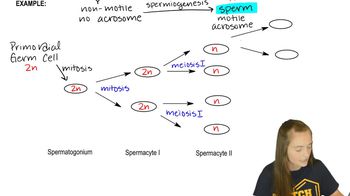
Gametes are reproductive cells that carry half the genetic information of an organism. In sexually reproducing organisms, gametes are produced through meiosis, resulting in cells that contain one allele for each gene. Understanding how gametes are formed is crucial for predicting genetic combinations in offspring.
Recommended video:
Guided course
21:21
Gamete Development

Genotype

A genotype refers to the specific genetic makeup of an organism, represented by the alleles it possesses for particular genes. In the example AabbCCdd, the genotype indicates the alleles for four different genes. Analyzing the genotype helps in determining the possible combinations of alleles that can be passed on to gametes.
Recommended video:
Guided course
07:52
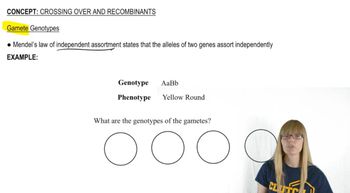
Gamete Genotypes

Independent Assortment

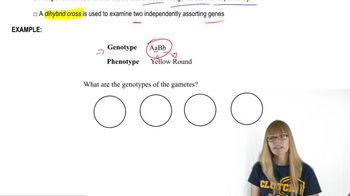
Independent assortment is a principle of genetics stating that alleles for different genes segregate independently of one another during gamete formation. This means that the distribution of one pair of alleles does not affect the distribution of another pair, allowing for a variety of combinations in the resulting gametes from a given genotype.
Recommended video:
Guided course
04:58
Gamete Genetics and Independent Assortment