Pearson+ LogoPearson+ Logo
Ch. 20 - Population Genetics and Evolution at the Population, Species, and Molecular Levels
Sanders - Genetic Analysis: An Integrated Approach 3rd Edition
Sanders3rd EditionGenetic Analysis: An Integrated ApproachISBN: 9780135564172Not the one you use?Change textbook
Chapter 20, Problem 1c

Compare and contrast the terms in each of the following pairs:
Natural selection and Genetic drift

Verified step by step guidance
1
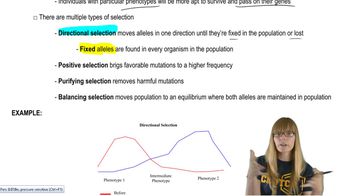
Define natural selection: Natural selection is the process by which individuals with advantageous traits are more likely to survive and reproduce, passing those traits to the next generation. It is a non-random mechanism driven by environmental pressures.
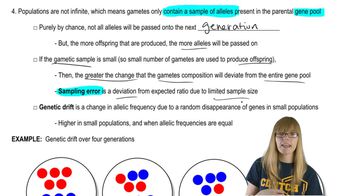
Define genetic drift: Genetic drift refers to random changes in allele frequencies within a population, often due to chance events like bottlenecks or founder effects. It is a stochastic process and does not depend on the fitness of the alleles.
Compare the mechanisms: Natural selection is a directional process that favors traits increasing an organism's fitness, while genetic drift is random and can lead to the loss or fixation of alleles regardless of their impact on fitness.
Contrast the scale of impact: Natural selection tends to have a stronger effect in large populations where advantageous traits can spread effectively, whereas genetic drift has a more pronounced effect in small populations where random events can significantly alter allele frequencies.
Discuss the outcomes: Natural selection leads to adaptation and increased fitness over time, while genetic drift can result in reduced genetic variation and may even lead to the fixation of deleterious alleles in a population.

Verified video answer for a similar problem:

This video solution was recommended by our tutors as helpful for the problem above.
Video duration:
2m
Was this helpful?

Key Concepts

Here are the essential concepts you must grasp in order to answer the question correctly.

Natural Selection

Natural selection is a fundamental mechanism of evolution, proposed by Charles Darwin. It occurs when individuals with advantageous traits are more likely to survive and reproduce, passing those traits to the next generation. This process leads to adaptations in populations over time, as beneficial traits become more common while detrimental traits diminish.
Recommended video:
Guided course
05:54
Natural Selection

Genetic Drift

Genetic drift is a random process that can lead to changes in allele frequencies within a population, particularly in small populations. Unlike natural selection, which is driven by environmental pressures, genetic drift occurs due to chance events, such as random mating or catastrophic events, resulting in the loss of genetic variation and potentially leading to the fixation of alleles.
Recommended video:
Guided course
10:15
Genetic Drift

Comparison of Mechanisms

While both natural selection and genetic drift are mechanisms of evolution, they operate differently. Natural selection is a non-random process that favors traits that enhance survival and reproduction, whereas genetic drift is a random process that can lead to significant changes in a population's genetic makeup without regard to fitness. Understanding these differences is crucial for studying evolutionary dynamics.
Recommended video: