The following is a partial pedigree of the British royal family. The family contains several inbred individuals and a number of inbreeding pathways. Carefully evaluate the pedigree, and identify the pathways and common ancestors that produce inbred individuals A (Alice in generation IV), B (George VI in generation VI), and C (Charles in generation VIII).
Ch. 20 - Population Genetics and Evolution at the Population, Species, and Molecular Levels

Sanders3rd EditionGenetic Analysis: An Integrated ApproachISBN: 9780135564172Not the one you use?Change textbook
All textbooks
Sanders 3rd Edition
Ch. 20 - Population Genetics and Evolution at the Population, Species, and Molecular Levels
Problem 36c
Sanders 3rd Edition
Ch. 20 - Population Genetics and Evolution at the Population, Species, and Molecular Levels
Problem 36cChapter 20, Problem 36c
Draw a separate hypothetical pedigree identifying the inbred individuals and the inbreeding pathways for each of the following inbreeding coefficients:
F=4(1/2)⁸
Verified step by step guidance1
Step 1: Understand the concept of inbreeding coefficient (F). The inbreeding coefficient quantifies the probability that an individual has inherited two alleles that are identical by descent from a common ancestor. In this case, F = 4(1/2)⁸ represents the degree of inbreeding in the pedigree.
Step 2: Break down the formula F = 4(1/2)⁸. The term (1/2)⁸ indicates the probability of allele transmission through eight generations, and the factor of 4 accounts for the number of pathways through which alleles can be inherited from a common ancestor.
Step 3: Identify the inbreeding pathways. In a pedigree, inbreeding occurs when two individuals who are related mate, leading to offspring with alleles that are identical by descent. Trace the pathways through which alleles are transmitted from the common ancestor to the inbred individual over eight generations.
Step 4: Draw the pedigree. Start with the common ancestor at the top and trace the lineage through eight generations. Ensure that the mating pairs in the pedigree reflect the relationships necessary to produce inbred individuals. Highlight the inbred individuals and label the pathways contributing to the inbreeding coefficient.
Step 5: Verify the pedigree structure. Confirm that the number of generations and pathways matches the formula F = 4(1/2)⁸. Ensure that the inbred individuals are correctly identified and that the pedigree accurately represents the hypothetical scenario described.

Verified video answer for a similar problem:
This video solution was recommended by our tutors as helpful for the problem above.
Video duration:
1mWas this helpful?
Key Concepts
Here are the essential concepts you must grasp in order to answer the question correctly.
Inbreeding Coefficient (F)
The inbreeding coefficient (F) quantifies the probability that two alleles at a locus are identical by descent. It ranges from 0 (no inbreeding) to 1 (complete inbreeding). In this context, F=4(1/2)⁸ indicates a specific level of inbreeding, which can be calculated to understand the genetic relationships among individuals in a pedigree.
Recommended video:
Guided course
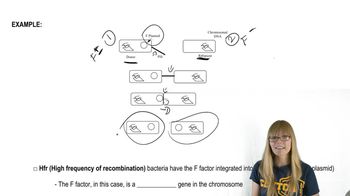
F Factor and Hfr
Pedigree Analysis
Pedigree analysis is a method used to trace the inheritance of traits through generations in a family tree format. It helps identify relationships between individuals, including inbred individuals, by illustrating how traits are passed down. Understanding how to construct and interpret pedigrees is essential for visualizing inbreeding pathways and calculating inbreeding coefficients.
Recommended video:
Guided course
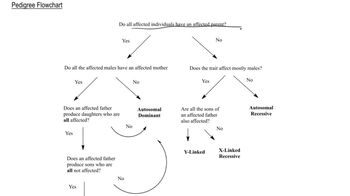
Pedigree Flowchart
Inbreeding Pathways
Inbreeding pathways refer to the specific routes through which genetic material is shared among individuals in a pedigree. These pathways can reveal how closely related individuals are and how inbreeding occurs within a population. Identifying these pathways is crucial for understanding the implications of inbreeding on genetic diversity and potential health issues in offspring.
Recommended video:
Guided course
Repair Pathways
Related Practice
Textbook Question
631
views
Textbook Question
Draw a separate hypothetical pedigree identifying the inbred individuals and the inbreeding pathways for each of the following inbreeding coefficients:
F=4(1/2)⁶
425
views
Textbook Question
Draw a separate hypothetical pedigree identifying the inbred individuals and the inbreeding pathways for each of the following inbreeding coefficients:
F=2(1/2)⁵
694
views
Textbook Question
Draw a separate hypothetical pedigree identifying the inbred individuals and the inbreeding pathways for each of the following inbreeding coefficients:
F=2(1/2)⁷
404
views
Textbook Question
The human melanocortin 1 receptor gene (MC1R) plays a major role in producing eumelanin, a black-brown pigment that helps determine hair color and skin color. Jonathan Rees and several colleagues (J. L. Rees et al., Am. J. Human Genet. 66(2000): 1351–1361) studied multiple MC1R alleles in African and European populations. Although this research found several MC1R alleles in African populations, MC1R alleles that decrease the production of eumelanin were rare. In contrast, several alleles decreasing eumelanin production were found in European populations. How can these results be explained by natural selection?
665
views
Textbook Question
Achromatopsia is a rare autosomal recessive form of complete color blindness that affects about 1 in 20,000 people in most populations. People with this disorder see only in black and white and have extreme sensitivity to light and poor visual acuity. On Pingelap Island, one of a cluster of coral atoll islands in the Federated States of Micronesia, approximately 10% of the 3000 indigenous Pingelapese inhabitants have achromatopsia.Achromatopsia was first recorded on Pingelap in the mid-1800s, about four generations after a typhoon devastated Pingelap and reduced the island population to about 20 people. All Pingelapese with achromatopsia trace their ancestry to one male who was one of the 20 typhoon survivors. Provide a genetic explanation for the origin of achromatopsia on Pingelap, and explain the most likely evolutionary model for the high frequency there of achromatopsia.
441
views