Pearson+ LogoPearson+ Logo
Ch. 20 - Population Genetics and Evolution at the Population, Species, and Molecular Levels
Sanders - Genetic Analysis: An Integrated Approach 3rd Edition
Sanders3rd EditionGenetic Analysis: An Integrated ApproachISBN: 9780135564172Not the one you use?Change textbook
Chapter 20, Problem 36a

Draw a separate hypothetical pedigree identifying the inbred individuals and the inbreeding pathways for each of the following inbreeding coefficients:
F=4(1/2)⁶

Verified step by step guidance
1
Step 1: Understand the concept of inbreeding coefficient (F). The inbreeding coefficient quantifies the probability that two alleles at a locus are identical by descent. It is calculated based on the pathways of inheritance in a pedigree.
Step 2: Recognize the formula for calculating F. In this case, F = 4(1/2)⁶. This formula indicates that there are four pathways contributing to the inbreeding coefficient, and each pathway involves six generations of inheritance.
Step 3: Draw a hypothetical pedigree. Start with a common ancestor at the top of the pedigree. Trace the pathways of inheritance through six generations, ensuring that the same ancestor contributes genetic material to both parents of the inbred individual.
Step 4: Identify the inbred individual in the pedigree. This individual will have parents who are related through the common ancestor. Mark this individual clearly and label the pathways that lead to their inbreeding.
Step 5: Highlight the inbreeding pathways. For each of the four pathways, trace the flow of genetic material from the common ancestor to the inbred individual, passing through six generations. Ensure that the pathways are distinct and correctly represent the formula F = 4(1/2)⁶.

Verified video answer for a similar problem:

This video solution was recommended by our tutors as helpful for the problem above.
Video duration:
1m
Was this helpful?

Key Concepts

Here are the essential concepts you must grasp in order to answer the question correctly.

Inbreeding Coefficient (F)

The inbreeding coefficient (F) quantifies the probability that two alleles at a locus are identical by descent. It ranges from 0 (no inbreeding) to 1 (complete inbreeding). In this context, F=4(1/2)⁶ indicates a specific level of inbreeding, which can be calculated based on the number of generations and the relatedness of the individuals involved.
Recommended video:
Guided course
08:52
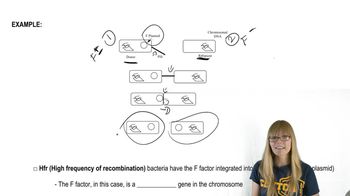
F Factor and Hfr

Pedigree Analysis

Pedigree analysis is a method used to trace the inheritance of traits through generations in a family tree format. It helps identify relationships between individuals, including inbred individuals, by illustrating how traits are passed down. Understanding how to construct and interpret pedigrees is essential for visualizing inbreeding pathways and calculating inbreeding coefficients.
Recommended video:
Guided course
01:59
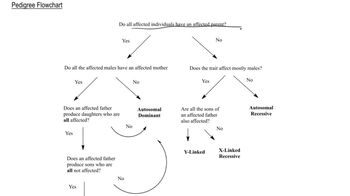
Pedigree Flowchart

Inbreeding Pathways

Inbreeding pathways refer to the specific routes through which genetic material is passed between related individuals, leading to inbreeding. These pathways can be traced in a pedigree to identify how closely related individuals contribute to the genetic makeup of offspring. Recognizing these pathways is crucial for understanding the implications of inbreeding on genetic diversity and potential health issues in a population.
Recommended video:
Guided course
05:44
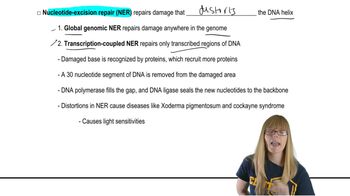
Repair Pathways