Pearson+ LogoPearson+ Logo
Ch. 20 - Population Genetics and Evolution at the Population, Species, and Molecular Levels
Sanders - Genetic Analysis: An Integrated Approach 3rd Edition
Sanders3rd EditionGenetic Analysis: An Integrated ApproachISBN: 9780135564172Not the one you use?Change textbook
Chapter 20, Problem 36b

Draw a separate hypothetical pedigree identifying the inbred individuals and the inbreeding pathways for each of the following inbreeding coefficients:
F=2(1/2)⁵

Verified step by step guidance
1
Step 1: Understand the concept of inbreeding coefficient (F). The inbreeding coefficient quantifies the probability that an individual has inherited two alleles that are identical by descent from a common ancestor. In this case, F = 2(1/2)⁵ represents the calculation for a specific inbreeding scenario.
Step 2: Break down the formula F = 2(1/2)⁵. The term (1/2)⁵ represents the probability of alleles being passed down through five generations, and the factor of 2 accounts for the two pathways through which alleles can be inherited from a common ancestor.
Step 3: Draw a hypothetical pedigree. Start by identifying the common ancestor at the top of the pedigree. Then, trace two separate pathways through five generations to the inbred individual. Ensure that the individual at the bottom of the pedigree is connected to the common ancestor through both pathways.
Step 4: Label the inbred individual and the pathways. Clearly mark the individual with the inbreeding coefficient F and highlight the two pathways leading to this individual. Use arrows or lines to show the generational connections.
Step 5: Verify the pedigree structure. Ensure that the pedigree accurately reflects the calculation of F = 2(1/2)⁵, with two distinct pathways and five generations leading to the inbred individual. Double-check that the common ancestor is correctly positioned and connected.

Verified video answer for a similar problem:

This video solution was recommended by our tutors as helpful for the problem above.
Video duration:
1m
Was this helpful?

Key Concepts

Here are the essential concepts you must grasp in order to answer the question correctly.

Inbreeding Coefficient (F)

The inbreeding coefficient (F) quantifies the probability that two alleles at a locus are identical by descent. It ranges from 0 (no inbreeding) to 1 (complete inbreeding). In this context, F=2(1/2)⁵ indicates a specific level of inbreeding, which can be calculated based on the number of generations and the relatedness of the individuals involved.
Recommended video:
Guided course
08:52
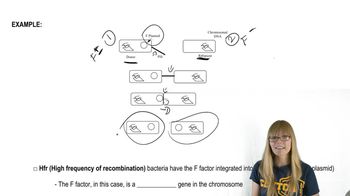
F Factor and Hfr

Pedigree Analysis

Pedigree analysis is a method used to trace the inheritance of traits through generations in a family tree format. It helps identify relationships between individuals, including inbred individuals, by illustrating how traits are passed down. Understanding how to construct and interpret pedigrees is essential for visualizing inbreeding pathways and calculating inbreeding coefficients.
Recommended video:
Guided course
01:59
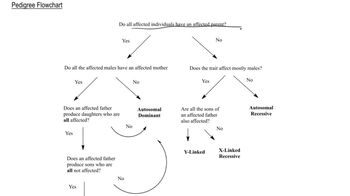
Pedigree Flowchart

Inbreeding Pathways

Inbreeding pathways refer to the specific routes through which genetic material is passed between related individuals, leading to inbreeding. These pathways can be traced in a pedigree to identify how closely related individuals contribute to the genetic makeup of offspring. Recognizing these pathways is crucial for understanding the implications of inbreeding on genetic diversity and potential health issues in a population.
Recommended video:
Guided course
05:44
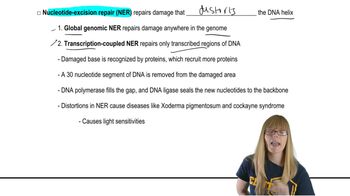
Repair Pathways
Related Practice
Textbook Question

Evaluate the following pedigree, and answer the questions below. Calculate F for any inbred members of this family.

428
views
Textbook Question

The following is a partial pedigree of the British royal family. The family contains several inbred individuals and a number of inbreeding pathways. Carefully evaluate the pedigree, and identify the pathways and common ancestors that produce inbred individuals A (Alice in generation IV), B (George VI in generation VI), and C (Charles in generation VIII).

631
views
Textbook Question

Draw a separate hypothetical pedigree identifying the inbred individuals and the inbreeding pathways for each of the following inbreeding coefficients:

F=4(1/2)⁶

425
views
Textbook Question

Draw a separate hypothetical pedigree identifying the inbred individuals and the inbreeding pathways for each of the following inbreeding coefficients:

F=4(1/2)⁸

427
views
Textbook Question

Draw a separate hypothetical pedigree identifying the inbred individuals and the inbreeding pathways for each of the following inbreeding coefficients:

F=2(1/2)⁷

404
views
Textbook Question
The human melanocortin 1 receptor gene (MC1R) plays a major role in producing eumelanin, a black-brown pigment that helps determine hair color and skin color. Jonathan Rees and several colleagues (J. L. Rees et al., Am. J. Human Genet. 66(2000): 1351–1361) studied multiple MC1R alleles in African and European populations. Although this research found several MC1R alleles in African populations, MC1R alleles that decrease the production of eumelanin were rare. In contrast, several alleles decreasing eumelanin production were found in European populations. How can these results be explained by natural selection?
665
views