Pearson+ LogoPearson+ Logo
Ch. 20 - Population Genetics and Evolution at the Population, Species, and Molecular Levels
Sanders - Genetic Analysis: An Integrated Approach 3rd Edition
Sanders3rd EditionGenetic Analysis: An Integrated ApproachISBN: 9780135564172Not the one you use?Change textbook
Chapter 20, Problem 6

Genetic drift, an evolutionary process affecting all populations, can have a significant effect in small populations, even though its effect is negligible in large populations. Explain why this is the case.

Verified step by step guidance
1
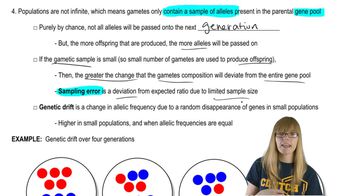
Understand that genetic drift refers to random changes in allele frequencies within a population due to chance events, rather than natural selection.
Recognize that in small populations, random sampling effects are more pronounced because each individual's genetic contribution represents a larger fraction of the gene pool.
Explain that because of this, alleles can become fixed (reach 100% frequency) or lost (0% frequency) more quickly in small populations purely by chance.
Contrast this with large populations, where the large number of individuals buffers against random fluctuations, making genetic drift's effect negligible.
Summarize that the impact of genetic drift is inversely related to population size because random events have a stronger influence when fewer individuals contribute genetically.

Verified video answer for a similar problem:

This video solution was recommended by our tutors as helpful for the problem above.
Video duration:
2m
Was this helpful?

Key Concepts

Here are the essential concepts you must grasp in order to answer the question correctly.

Genetic Drift

Genetic drift is a random change in allele frequencies within a population due to chance events. It occurs independently of natural selection and can lead to the loss or fixation of alleles over time, especially in small populations.
Recommended video:
Guided course
10:15
Genetic Drift

Population Size and Genetic Variation

Population size influences the impact of genetic drift; in small populations, random fluctuations can drastically change allele frequencies, reducing genetic variation. In large populations, these random changes are diluted, making drift effects negligible.
Recommended video:
Guided course
09:28
Genomic Variation

Founder Effect and Bottleneck Effect

The founder effect and bottleneck effect are examples of genetic drift where small groups establish new populations or survive drastic reductions, respectively. Both lead to reduced genetic diversity and increased influence of random allele frequency changes.
Recommended video:
Guided course
03:38
Maternal Effect